AICPA - Big Savings Alert – Don’t Miss This Deal - Ends In 1d 00h 00m 00s Coupon code: 26Y30OFF
  1. Home
  2. AICPA
  3. CPA-Business Exam
  4. Free CPA-Business Questions

Free AICPA CPA Business Environment and Concepts (CPA-Business) Practice Questions

These AICPA CPA-Business sample questions are a small glimpse of our full set of AICPA CPA-Business actual questions. They give you a preview of what the real CPA-Business exam might look like and the contents of Pass4Future's premium AICPA CPA-Business product. You must not underestimate the value of AICPA CPA-Business practice exam questions, as they allow you to understand the actual CPA Business Environment and Concepts exam in greater depth. Using them will save your time and money otherwise wasted in CPA Business Environment and Concepts exam reattempts. Study guides and tutorials provide you with theoretical details about the CPA-Business exam; these CPA-Business practice exam questions prepare you to pass the exam. Get Pass4Future's premium access to continue your CPA-Business exam practice with the complete set of AICPA CPA-Business realistic questions. Our AICPA CPA-Business practice questions come in various formats; make sure to check out the details and free demo of each format.

AICPA CPA-Business Sample Exam Questions

Page:    1 / 14   
Total 530 questions

Question 1

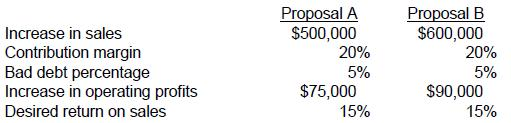
The sales manager at Ryan Company feels confident that if the credit policy at Ryan's was changed, sales would increase and, consequently, the company would utilize excess capacity. The two credit proposals being considered are as follows:

Currently, payment terms are net 30. The proposal payment terms for Proposal A and Proposal B are net 45 and net 90, respectively. An analysis to compare these two proposals for the change in credit policy would include all of the following factors, except the:


Answer : B

Choice 'b' is correct. Because the bad debt percentage is the same under either of the two proposals, there is no differential cost associated with bad debt. Because it is not a differential cost, it is not considered in comparing the two alternatives.

Choice 'a' is incorrect. Because Proposal A and B have different net collection dates, Proposal B will cause a greater amount of accounts receivable with a corresponding increase in working capital. The cost to fund this will be greater for Proposal B, so this is a legitimate concern.

Choice 'c' is incorrect. Customers may feel they should be given the extended terms. If this is granted, the additional working capital need will be even greater.

Choice 'd' is incorrect. Banks may require that days sales outstanding cannot exceed a certain number of days. If so, it will be harder to meet this covenant with Proposal B.


Question 2

The amount of inventory that a company would tend to hold in safety stock would increase as the:


Answer : A

Choice 'a' is correct. As the cost of carrying inventory decreases, safety stock would tend to increase to reduce the risk of stock outs.

Choice 'b' is incorrect. As sales become more predictable (sales variability decreases), less (not more) safety stock would be needed because the risk of stock outs would have decreased.

Choice 'c' is incorrect. If the cost of stock outs decrease, safety stock would decrease.

Choice 'd' is incorrect. If lead-time decreases, safety stock would decrease.


Question 3

The level of safety stock in inventory management depends on all of the following, except the:


Answer : D

Choice 'd' is correct. Reorder costs do not impact the level of safety stock.

Choices 'a', 'b', and 'c' are incorrect. Safety stock levels are affected by:

1. Uncertain sales forecasts - greater uncertainty means a higher level of safety stock should be carried.

2. Dissatisfaction of customers - if customers are dissatisfied with back orders (which occur when there are stock outs), then more safety stock should be carried to prevent stock outs.

3. Uncertain lead times - greater uncertainty means a higher level of safety stock is needed.


Question 4

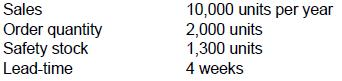
The following information regarding inventory policy was assembled by the JRJ Corporation. The company uses a 50-week year in all calculations.

The reorder point is:


Answer : B

Choice 'b' is correct. A 50-week year would mean that 200 units are sold per week (10,000 units per year over 50 weeks). Therefore, 800 units are sold during the lead-time (4 weeks 200 units per week). Required safety stock is 1,300 units, which means that no less than 1,300 units must be on hand at any time. The reorder point is then 2,100 units (1,300 safety stock plus the 800 units used during lead time).

Choices 'a', 'c', and 'd' are incorrect, per the above Explanation:.


Question 5

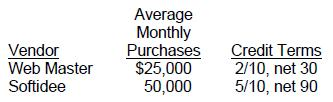
CyberAge outlet, a relatively new store, is a cafe that offers customers the opportunity to browse the Internet or play computer games at their tables while they drink coffee. The customer pays a fee based on the amount of time spent signed on to the computer. The store also sells books, tee shirts, and computer accessories. CyberAge has been paying all of its bills on the last day of the payment period, thus forfeiting all supplier discounts. Shown below are data on CyberAge's two major vendors, including average monthly purchases and credit terms.

Should CyberAge use trade credit and continue paying at the end of the credit period?


Answer : D

Choice 'd' is correct. Yes, CyberAge should use trade credit and continue paying at the end of the credit period, if the cost of alternative short-term financing is more.

Choices 'a', 'b', and 'c' are incorrect, per the above Explanation:.


Page:    1 / 14   
Total 530 questions