Pass4Future also provide interactive practice exam software for preparing APICS Certified Supply Chain Professional (CSCP) Exam effectively. You are welcome to explore sample free APICS CSCP Exam questions below and also try APICS CSCP Exam practice test software.
Do you know that you can access more real APICS CSCP exam questions via Premium Access? ()
Which of the following statements best describes a fundamental requirement for developing and maintaining good business relationships in an effective supplier partnership?
Answer : C
A fundamental requirement for developing and maintaining good business relationships in an effective supplier partnership is a means of periodic feedback for issue resolution. This means that both parties should communicate regularly and transparently, share information and insights, and address any problems or concerns in a timely and constructive manner12. Feedback is essential for building trust, alignment, and collaboration between suppliers and customers, as well as for improving performance, quality, and innovation34. The other options are not as comprehensive or relevant as the correct answer. While the supplier must commit to meeting the customer's performance metrics, and the buyer must commit to improving processes, these are not sufficient for developing and maintaining good business relationships. They are more specific aspects of supplier performance management and continuous improvement, which are important but not the only factors for effective supplier partnerships1. Similarly, while both parties should focus on cost reduction to improve competitiveness, this is not the primary or sole objective of a supplier partnership. Cost reduction is one of the potential benefits of a supplier partnership, but it is not the main driver or requirement for forming and sustaining such a relationship2. A supplier partnership should also aim for creating value, enhancing customer satisfaction, and achieving strategic goals34.
A company whose business strategy is to be environmentally responsible would most likely have a supply chain focused on:
Answer : C
A company that aims to be environmentally responsible would focus on making its supply chain more efficient to reduce environmental impact.
Resource Efficiency: Increasing process efficiency means using resources more effectively, which reduces waste and energy consumption.
Sustainable Practices: Implementing sustainable practices such as optimizing production processes, reducing emissions, and minimizing waste contributes to environmental responsibility.
Cost Reduction: Efficient processes also lead to cost savings, which can be reinvested in further sustainability initiatives.
Increasing process efficiency aligns with the goal of environmental responsibility by reducing the overall environmental footprint of the supply chain.
Srivastava, Samir K. 'Green supply-chain management: A state-of-the-art literature review.' International Journal of Management Reviews.
Sarkis, Joseph. 'A Strategic Decision Framework for Green Supply Chain Management.' Journal of Cleaner Production.
One of the difficulties in purchasing services is to:
Answer : D
Purchasing services presents unique challenges compared to purchasing tangible goods. One of the primary difficulties is measuring the quality of services provided. Unlike physical products, services are often intangible and can vary significantly based on the provider's performance, making it challenging to establish objective quality metrics. This subjectivity in service delivery requires robust monitoring and feedback mechanisms to ensure that the services meet the required standards consistently.
Ellram, L. M., Tate, W. L., & Billington, C. (2007). Services supply management: The next frontier for improved organizational performance. California Management Review, 49(4), 44-66.
van der Valk, W., & Rozemeijer, F. (2009). Buying business services: towards a structured service purchasing process. Journal of Services Marketing, 23(1), 3-10.
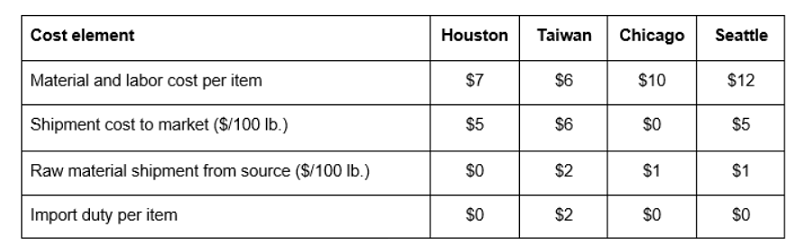
A company is determining where it should manufacture a product weighing 1 lb. for the Chicago market with a demand of 100,000 items per year. Costs for each of four possible locations are summarized in the table below. If the company wants to minimize the total cost to supply the items to the Chicago market, where should the items be produced?

Answer : C
To find the total cost of supplying the items to the Chicago market from each location, we need to multiply the demand (100,000 items) by the sum of the material and labor cost per item, the shipment cost to market per item, and the import duty per item. The shipment cost to market per item can be obtained by dividing the shipment cost to market per 100 lb. by 100, since each item weighs 1 lb. The raw material shipment from source cost is irrelevant for this question, since it does not affect the total cost to supply the items to the Chicago market. Using this formula, we can calculate the total cost for each location as follows:
Houston: 100,000 x ($7 + $5/100 + $0) = $712,000
Taiwan: 100,000 x ($6 + $6/100 + $2) = $814,000
Chicago: 100,000 x ($10 + $0/100 + $0) = $1,000,000
Seattle: 100,000 x ($12 + $5/100 + $0) = $1,205,000
The location with the lowest total cost is Chicago, with $1,000,000. Therefore, the items should be produced in Chicago to minimize the total cost to supply the items to the Chicago market.
Which of the following forecasting techniques is often used in causal forecasting?
Answer : C
Causal forecasting is a method used to predict future events by examining the cause-and-effect relationships among variables. It goes beyond simple trend analysis and considers various factors that could influence the forecasted quantity.
Regression analysis is a statistical process for estimating the relationships among variables. In the context of causal forecasting, regression is used to identify and measure the impact of one or more independent variables on a dependent variable. This technique is particularly useful when you want to forecast a variable based on the relationship it has with other variables.
For example, a company might use regression analysis to forecast sales based on advertising spend, assuming that there is a causal relationship between advertising and sales. The regression model would allow the company to quantify the expected increase in sales for each unit of increased advertising spend.