Pass4Future also provide interactive practice exam software for preparing ARDMS Sonography Principles and Instrumentation (SPI) Exam effectively. You are welcome to explore sample free ARDMS SPI Exam questions below and also try ARDMS SPI Exam practice test software.
Do you know that you can access more real ARDMS SPI exam questions via Premium Access? ()
Which type of resolution does damping improve?
Answer : D
Comprehensive and Detailed Explanation From Exact Extract:
Damping reduces the number of cycles per pulse, shortening pulse duration and spatial pulse length, which directly improves axial resolution.
Principles and Instrumentation:
'Axial resolution improves with shorter spatial pulse length, achieved by damping, which limits ringing of the transducer.'
Lateral resolution (A) depends on beam width.
Contrast resolution (B) relates to dynamic range.
Temporal resolution (C) is tied to frame rate.
Therefore, the correct answer is D: Axial.
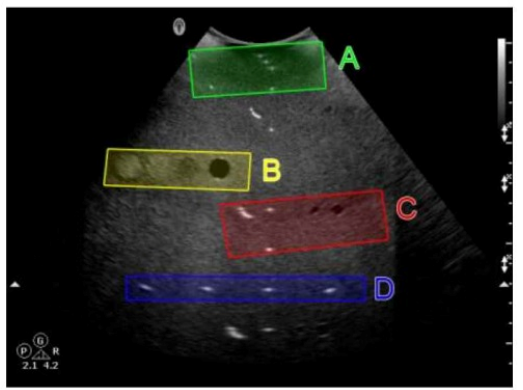
Which target group is used to evaluate transverse distance measurement accuracy in this tissue-mimicking phantom image?

Answer : C
Comprehensive and Detailed Explanation From Exact Extract:
In a tissue-mimicking phantom, the group of targets aligned side-by-side (horizontally) is used to evaluate transverse (lateral) distance measurement accuracy. In the image, target group C (in red) represents the lateral spacing targets.
Principles and Instrumentation state:
'Transverse distance accuracy is evaluated using laterally spaced targets in the phantom to verify correct lateral measurement calibration.'
Group A (top) is typically for near field assessment.
Group B may be for axial resolution or cyst evaluation.
Group D (deep) may assess depth calibration or sensitivity.
Therefore, the correct answer is C: C.
---
What reduces speckle and increases visualization of specular reflectors and attenuated structures?
Answer : D
Spatial compounding involves acquiring multiple frames from different angles and averaging them. This technique reduces speckle noise, which is a granular interference pattern, and enhances the visualization of specular reflectors (smooth surfaces that reflect sound in a single direction) and attenuated structures (structures that reduce the intensity of the sound beam). By averaging frames from different angles, spatial compounding improves image quality and contrast resolution.
ARDMS Sonography Principles and Instrumentation guidelines
Hedrick, W. R., Hykes, D. L., & Starchman, D. E. (2005). Ultrasound Physics and Instrumentation.
During 3-D volume acquisition, the quality of the images is most dependent upon which factor?
Answer : A
During 3-D volume acquisition in ultrasound, the quality of the images is most dependent on the number of slices acquired. This is because the more slices (or planes) that are captured, the more detailed and accurate the reconstruction of the 3-D volume will be. This allows for better spatial resolution and more precise visualization of anatomical structures. Other factors, such as power output, rendering methods, and speed of post-processing, also affect image quality but are secondary to the number of slices in terms of fundamental image acquisition quality. Reference: ARDMS Sonography Principles and Instrumentation (SPI) Review, 3-D Ultrasound Imaging section.
Which type of display process rescans only the region of interest and improves resolution?
Answer : B
Write magnification, or pre-processing zoom, involves rescanning the region of interest (ROI) with more scan lines, thus acquiring new data for that specific area. This process increases the spatial resolution of the image in the magnified area because it gathers more detailed data by adjusting the scan parameters, resulting in improved image quality. This is different from read magnification (post-processing zoom), which simply enlarges the existing image data without increasing resolution.
ARDMS Sonography Principles & Instrumentation Guidelines
Hedrick WR, Hykes DL, Starchman DE. Ultrasound Physics and Instrumentation. 4th ed. Philadelphia, PA: Elsevier Saunders; 2005.