Pass4Future also provide interactive practice exam software for preparing CIPS Global Commercial Strategy (L6M2) Exam effectively. You are welcome to explore sample free CIPS L6M2 Exam questions below and also try CIPS L6M2 Exam practice test software.
Do you know that you can access more real CIPS L6M2 exam questions via Premium Access? ()
SIMULATION
XYZ is a manufacturing company based in the UK. It has a large complex supply chain and imports raw materials from Argentina and South Africa. It sells completed products internationally via their website. Evaluate the role of licencing and taxation on XYZ's operations.
Answer : A
Evaluation of the Role of Licensing and Taxation on XYZ's Operations
Introduction
Licensing and taxation play a critical role in international trade, supply chain management, and overall financial performance. For XYZ, a UK-based manufacturing company that imports raw materials from Argentina and South Africa and sells internationally via an e-commerce platform, compliance with licensing and taxation regulations is essential to ensure smooth operations, cost efficiency, and legal compliance.
This evaluation will assess the impact of licensing and taxation on XYZ's global supply chain, import/export activities, and financial performance.
1. The Role of Licensing in XYZ's Operations
1.1 Import and Export Licensing Regulations
As XYZ imports raw materials from Argentina and South Africa, it must comply with the UK's import licensing requirements and trade agreements with these countries.
Impact on XYZ:
Import licenses may be required for certain restricted raw materials (e.g., metals, chemicals, agricultural products).
Export control laws may apply, depending on the destination of final products.
Delays or fines may occur if licenses are not properly managed.
Example: If XYZ imports metal components subject to UK trade restrictions, it must secure import licenses before shipment clearance.
1.2 Industry-Specific Licensing Requirements
Some industries require special licenses to manufacture and sell products globally.
Impact on XYZ:
If XYZ manufactures electronics or chemical-based products, it may need compliance certifications (e.g., CE marking in the EU, FDA approval in the US).
Failure to meet licensing requirements can block international sales.
Example: A UK manufacturer selling medical devices must obtain MHRA (Medicines and Healthcare products Regulatory Agency) approval before distributing products.
1.3 E-Commerce & Digital Sales Licensing
As XYZ sells its products internationally via its website, it must comply with:
Consumer Protection Laws (e.g., GDPR for EU customers).
E-commerce business registration and online sales regulations.
Example: XYZ may need a VAT number in the EU if it sells products to European customers via its website.
2. The Role of Taxation in XYZ's Operations
2.1 Import Duties and Tariffs
XYZ's supply chain involves importing raw materials from Argentina and South Africa, which may attract import duties and tariffs.
Impact on XYZ:
Higher import duties increase raw material costs and impact profitability.
Tariff-free trade agreements (e.g., UK-South Africa trade deal) may reduce costs.
Post-Brexit UK-EU trade regulations may affect supply chain tax structures.
Example: If the UK imposes high tariffs on South African goods, XYZ may need to find alternative suppliers or negotiate better deals.
2.2 Corporate Tax & International Tax Compliance
XYZ must comply with UK corporate tax laws and international taxation regulations.
Impact on XYZ:
Paying corporate tax in the UK based on global sales revenue.
Managing international tax obligations when selling in multiple countries.
Risk of double taxation if the same income is taxed in multiple jurisdictions.
Example: If XYZ sells products in Germany and the US, it may need to register for tax in those countries and comply with local VAT/GST requirements.
2.3 Value Added Tax (VAT) & Sales Tax
Since XYZ sells internationally via its website, it must adhere to global VAT and sales tax rules.
Impact on XYZ:
In the EU, VAT registration is required for online sales above a certain threshold.
In the US, sales tax regulations vary by state.
Compliance with UK VAT laws (e.g., 20% standard rate) on domestic sales.
Example: A UK company selling online to EU customers must comply with the EU One-Stop-Shop (OSS) VAT scheme.
2.4 Transfer Pricing & Tax Efficiency
If XYZ has international subsidiaries or supply chain partners, it must manage transfer pricing regulations.
Impact on XYZ:
Ensuring fair pricing between UK operations and overseas suppliers to avoid tax penalties.
Optimizing tax-efficient supply chain structures to minimize tax burdens.
Example: Multinational companies like Apple and Amazon use tax-efficient structures to reduce liabilities.
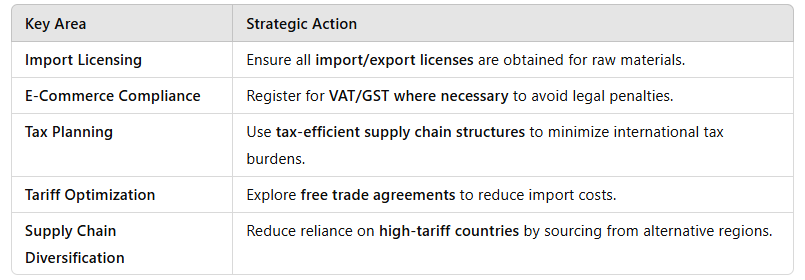
3. Strategic Actions for XYZ to Manage Licensing and Taxation Effectively
XYZ can take several steps to optimize tax compliance and licensing efficiency:

Conclusion
Licensing and taxation have a major impact on XYZ's international manufacturing and e-commerce operations. To maintain profitability and regulatory compliance, XYZ must:
Ensure import/export licensing aligns with UK and international trade laws.
Manage import duties, VAT, and corporate tax obligations effectively.
Optimize its supply chain and tax planning to reduce costs.
By proactively managing these areas, XYZ can enhance its global competitiveness while minimizing risks.
SIMULATION
Discuss how the following can impact upon supply chain operations and business strategy:
1) Discrimination, equality and diversity
2) Redundancy and dismissal
3) Working time and payment
Answer : A
Impact of Employment Policies on Supply Chain Operations and Business Strategy
Introduction
Employment policies such as discrimination, equality and diversity, redundancy and dismissal, and working time and payment have a significant impact on supply chain operations and business strategy. These factors influence employee productivity, legal compliance, reputation, and operational efficiency.
For businesses operating in global supply chains, ensuring compliance with employment laws and ethical workforce practices is crucial to maintaining sustainability, cost efficiency, and risk management.
1. Impact of Discrimination, Equality, and Diversity on Supply Chain Operations and Business Strategy
Discrimination laws and diversity and inclusion (D&I) policies ensure fair treatment in the workplace.
Impact on Supply Chain Operations
Companies must prevent workplace discrimination across hiring, promotions, and supplier engagement.
Non-compliance with equality laws can lead to legal penalties, reputational damage, and operational disruptions.
Supply chain leaders must promote diverse supplier partnerships and inclusive hiring practices.
Example: Many multinational corporations, such as Unilever and IBM, have supplier diversity programs that prioritize working with minority-owned and women-owned businesses.
Impact on Business Strategy
Encourages innovation and diverse perspectives in problem-solving.
Enhances brand reputation and customer loyalty through ethical business practices.
Helps businesses attract top global talent by fostering an inclusive workplace.
Strategic Action: Businesses should implement anti-discrimination training and diversity recruitment strategies to create a fair and inclusive work environment.
2. Impact of Redundancy and Dismissal on Supply Chain Operations and Business Strategy
Redundancy and dismissal policies regulate how companies terminate employment due to economic downturns, automation, or restructuring.
Impact on Supply Chain Operations
Workforce reductions can disrupt production schedules and supplier relationships.
Companies must ensure fair redundancy policies to prevent legal claims or industrial action.
Automation may lead to worker displacement, requiring retraining programs.
Example: Ford's decision to restructure operations in the UK resulted in job losses, requiring compliance with UK redundancy laws and union negotiations.
Impact on Business Strategy
Must balance cost-cutting measures with employee morale and brand reputation.
Need to comply with national and international labor laws to avoid legal action.
Investing in employee retraining and redeployment can reduce negative effects of redundancy.
Strategic Action: Businesses should establish clear redundancy frameworks, provide severance packages, and offer outplacement support for affected employees.
3. Impact of Working Time and Payment on Supply Chain Operations and Business Strategy
Working time regulations and fair wage policies impact labor costs, productivity, and compliance.
Impact on Supply Chain Operations
Ensuring compliance with working time laws (e.g., UK Working Time Regulations 1998) prevents overworking employees.
Failure to meet minimum wage and overtime regulations can lead to legal disputes.
Supply chains must ensure fair pay for workers in offshore factories to meet ethical sourcing standards.
Example: The UK National Minimum Wage Act ensures fair wages, while the Modern Slavery Act (2015) prevents exploitation in global supply chains.
Impact on Business Strategy
Fair wages enhance employee motivation and reduce turnover.
Complying with wage and hour laws prevents reputational risks and fines.
Ethical pay practices attract conscious consumers and investors.
Strategic Action: Businesses should conduct regular wage audits and ensure global supplier compliance with fair labor laws.
Conclusion
Employment policies related to discrimination, redundancy, and working time/pay significantly impact supply chain operations and business strategy. Companies must ensure:
Diversity and equality policies to foster innovation and enhance reputation.
Ethical redundancy and dismissal processes to maintain legal compliance.
Fair wages and working hours to improve productivity and worker well-being.
By aligning HR policies with supply chain strategy, businesses can enhance efficiency, reduce risks, and build a sustainable competitive advantage.
SIMULATION
Discuss the following strategic decisions, explaining the advantages and constraints of each: Market Penetration, Product Development and Market Development.
Answer : A
Evaluation of Strategic Decisions: Market Penetration, Product Development, and Market Development
Introduction
Strategic decisions in business involve selecting the best approach to grow market share, increase revenue, and sustain competitive advantage. According to Ansoff's Growth Matrix, businesses can pursue four strategic directions:
Market Penetration (expanding sales in existing markets with existing products)
Product Development (introducing new products to existing markets)
Market Development (expanding into new markets with existing products)
Diversification (introducing new products to new markets)
This answer focuses on Market Penetration, Product Development, and Market Development, discussing their advantages and constraints.
1. Market Penetration (Increasing sales of existing products in existing markets)
Explanation
Market penetration involves increasing market share by:
Encouraging existing customers to buy more.
Attracting competitors' customers.
Increasing promotional efforts.
Improving pricing strategies.
Example: Coca-Cola uses aggressive marketing, promotions, and pricing strategies to increase sales in existing markets.
Advantages of Market Penetration
Low Risk -- No need for new product development.
Cost-Effective -- Uses existing infrastructure and supply chain.
Builds Market Leadership -- Strengthens brand loyalty and customer retention.
Quick Revenue Growth -- Increased sales generate higher profits.
Constraints of Market Penetration
Market Saturation -- Limited growth potential if the market is already saturated.
Intense Competition -- Competitors may retaliate with price cuts and promotions.
Diminishing Returns -- Lowering prices to attract customers can reduce profitability.
Strategic Consideration: Businesses should assess customer demand and competitive intensity before implementing a market penetration strategy.
2. Product Development (Introducing new products to existing markets)
Explanation
Product development involves launching new or improved products to meet evolving customer needs. This can include:
Innovation -- Developing new features or technology.
Product Line Extensions -- Introducing variations (e.g., new flavors, models, packaging).
Customization -- Tailoring products to specific customer preferences.
Example: Apple frequently launches new iPhone models to attract existing customers.
Advantages of Product Development
Higher Customer Retention -- Keeps existing customers engaged with new offerings.
Brand Differentiation -- Strengthens competitive advantage through innovation.
Increases Revenue Streams -- Expands product portfolio and market opportunities.
Constraints of Product Development
High R&D Costs -- Requires investment in innovation and testing.
Market Uncertainty -- New products may fail if not aligned with customer needs.
Risk of Cannibalization -- New products may reduce sales of existing products.
Strategic Consideration: Businesses should conduct market research, prototyping, and feasibility analysis before launching new products.
3. Market Development (Expanding into new markets with existing products)
Explanation
Market development involves selling existing products in new geographical areas or customer segments. Strategies include:
Expanding into international markets.
Targeting new demographics (e.g., different age groups or industries).
Entering new distribution channels (e.g., e-commerce, retail stores).
Example: McDonald's expands into new countries, adapting its menu to local preferences.
Advantages of Market Development
Access to New Revenue Streams -- Increases customer base and sales.
Diversifies Market Risk -- Reduces dependency on a single region.
Leverages Existing Products -- No need for costly product innovation.
Constraints of Market Development
Cultural and Regulatory Barriers -- Differences in consumer behavior, legal requirements, and competition.
High Entry Costs -- Requires investment in marketing, distribution, and local partnerships.
Operational Challenges -- Managing supply chains and logistics in new markets.
Strategic Consideration: Businesses should conduct market analysis and risk assessments before expanding internationally.
Conclusion
Each strategic decision has unique benefits and challenges:
Market Penetration is low-risk but limited by market saturation.
Product Development drives innovation but requires high investment.
Market Development expands revenue streams but involves cultural and regulatory challenges.
The best approach depends on a company's competitive position, financial resources, and long-term growth objectives.
SIMULATION
Evaluate diversification as a growth strategy. What are the main drivers and risks?
Answer : A
Evaluation of Diversification as a Growth Strategy
Introduction
Diversification is a growth strategy where a company expands into new markets or develops new products that are different from its existing offerings. It is the riskiest strategy in Ansoff's Growth Matrix, but it can provide significant opportunities for business expansion, revenue diversification, and risk mitigation.
Diversification is driven by factors such as market saturation, competitive pressure, and technological advancements but also carries risks related to high investment costs and operational complexity.
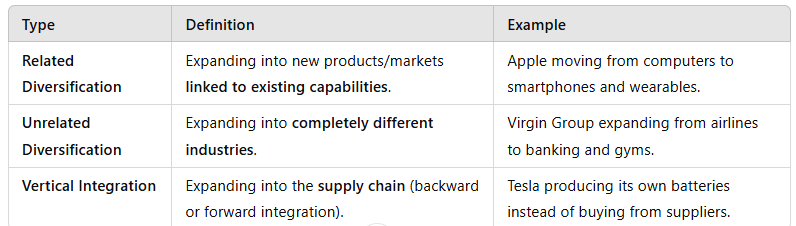
1. Types of Diversification

2. Main Drivers of Diversification
1. Market Saturation and Competitive Pressure
When a business reaches peak growth in its existing market, diversification helps find new revenue streams.
Competition forces businesses to explore new industries for continued growth.
Example: Amazon expanded from an online bookstore to cloud computing (AWS) due to competition and limited retail growth.
2. Risk Reduction and Business Sustainability
Diversifying reduces dependence on a single market or product.
Protects the business against economic downturns and industry-specific risks.
Example: Samsung operates in electronics, shipbuilding, and insurance, reducing reliance on one sector.
3. Leveraging Core Competencies and Brand Strength
Companies use existing expertise, technology, or brand reputation to enter new markets.
Example: Nike expanded from sportswear to fitness apps and wearable technology.
4. Technological Advancements & Market Opportunities
Digital transformation and innovation create opportunities for diversification.
Companies invest in new technologies, AI, and automation to expand their offerings.
Example: Google diversified into AI, smart home devices, and autonomous vehicles (Waymo).
3. Risks of Diversification
1. High Investment Costs & Uncertain Returns
Diversification requires significant R&D, marketing, and infrastructure investment.
ROI is uncertain, and failure can result in financial losses.
Example: Coca-Cola's failed diversification into the wine industry resulted in losses due to brand mismatch.
2. Lack of Expertise & Operational Challenges
Expanding into unfamiliar industries increases operational complexity and risks.
Companies may lack the expertise required for success.
Example: Tesco's expansion into the US market (Fresh & Easy) failed due to a lack of understanding of American consumer behavior.
3. Dilution of Brand Identity
Expanding into unrelated sectors can confuse customers and weaken brand strength.
Example: Harley-Davidson's attempt to enter the perfume market damaged its brand credibility.
4. Regulatory and Legal Barriers
Compliance with different industry regulations can be complex and costly.
Example: Facebook faced regulatory scrutiny when diversifying into financial services with Libra cryptocurrency.
4. Conclusion
Diversification can be a high-reward growth strategy, but it requires careful planning, market research, and strategic alignment.
Main drivers include market saturation, risk reduction, leveraging expertise, and technology opportunities.
Key risks include high costs, operational challenges, brand dilution, and regulatory barriers.
Companies must evaluate diversification carefully and ensure strategic fit, financial feasibility, and market demand before expanding into new industries.
SIMULATION
Analyse the GE McKinsey Matrix as a tool to influence directional policy
Answer : A
Analysis of the GE McKinsey Matrix as a Tool to Influence Directional Policy
Introduction
The GE McKinsey Matrix is a strategic tool used by businesses to prioritize investments, allocate resources, and influence directional policy. It expands on the BCG Matrix by evaluating business units or product portfolios based on two dimensions:
Industry Attractiveness (external factors such as market growth, competition, and profitability).
Business Unit Strength (internal factors such as brand strength, financial performance, and operational efficiency).
The matrix helps organizations decide where to invest, grow, or divest, making it a valuable tool for influencing long-term strategic direction.
1. Explanation of the GE McKinsey Matrix
The GE McKinsey Matrix categorizes business units into nine strategic zones, guiding investment decisions:
| Industry Attractiveness

Example:
Apple's iPhone (High Industry, Strong Business Unit) Invest & Grow
Microsoft's Bing Search Engine (Low Industry, Weak Business Unit) Divest or Harvest
2. How the GE McKinsey Matrix Influences Directional Policy
1. Investment Prioritization
Identifies which business units deserve more investment.
Helps companies allocate resources to high-potential markets.
Example: Amazon invests heavily in AWS (Cloud Computing) due to high industry growth and strong business positioning.
2. Market Entry and Expansion Decisions
Assists in geographical and market expansion decisions.
Helps assess whether to enter emerging industries.
Example: Tesla entered renewable energy (solar panels, batteries) due to high industry potential.
3. Strategic Exit or Divestment Decisions
Identifies low-performing divisions that should be divested.
Prevents financial losses by exiting declining markets.
Example: GE sold its financial services division (GE Capital) to refocus on industrial manufacturing.
4. Balancing Risk and Portfolio Diversification
Encourages a balanced portfolio of high-growth and stable businesses.
Ensures companies avoid over-reliance on a single product or market.
Example: Google (Alphabet) maintains a diverse portfolio of AI, search, and cloud businesses to balance risk.
3. Advantages and Limitations of the GE McKinsey Matrix
Advantages
More detailed than the BCG Matrix -- Considers multiple industry and business factors.
Helps with long-term strategic planning -- Guides investment, expansion, and divestment.
Balances risk and growth -- Prevents over-reliance on a single revenue source.
Limitations
Subjective analysis -- Industry attractiveness and business strength are difficult to quantify.
Complex implementation -- Requires detailed data collection and industry research.
No direct action plan -- Only provides guidance on resource allocation, not execution strategies.
4. Conclusion
The GE McKinsey Matrix is a powerful tool for influencing directional policy by helping companies prioritize investments, expand into attractive markets, and exit underperforming businesses. However, it should be used alongside financial analysis and market research to ensure strategic success.