Cisco - Big Savings Alert – Don’t Miss This Deal - Ends In 1d 00h 00m 00s Coupon code: 26Y30OFF
  1. Home
  2. Cisco
  3. 300-540 Exam
  4. Free 300-540 Questions

Free Practice Questions for Cisco 300-540 Exam

Pass4Future also provide interactive practice exam software for preparing Cisco Designing and Implementing Cisco Service Provider Cloud Network Infrastructure v1.0 (300-540) Exam effectively. You are welcome to explore sample free Cisco 300-540 Exam questions below and also try Cisco 300-540 Exam practice test software.

Page:    1 / 14   
Total 61 questions

Question 1

How does log management assist in meeting the requirements of cloud security regulatory compliance?


Answer : A

Comprehensive and Detailed Explanation From Cisco SP Cloud Network Infrastructure Security Knowledge

Cloud security compliance frameworks (such as ISO 27001, PCI-DSS, GDPR, SOC 2, HIPAA) require:

Evidence of security events

Retention of logs for audit periods

Ability to generate compliance reports

Traceability and accountability

Incident investigation support

Effective log management enables:

Centralized collection of application, network, and system logs

Storage of logs for mandated retention periods

Generation of audit-ready reports

Documentation required for compliance assessments

Demonstration that monitoring and security controls are active and functioning

Therefore, the role of log management in regulatory compliance is primarily about documentation, traceability, auditing, and reporting, which aligns only with Option A.

The other options do not directly serve regulatory compliance requirements:

B relates to resource optimization, not compliance.

C refers to interoperability, which is unrelated to regulatory auditing.

D improves security but does not directly address compliance documentation.


Question 2

What is a benefit of a carrier-neutral data center?


Answer : B

Carrier-neutral facilities allow customers to connect to multiple telecom carriers, providing:

Physical path diversity

Redundancy

Competitive options

High availability for interconnects

Thus, path diversity on multiple carriers is the primary benefit.


Question 3

An engineer recently deployed a Secure Endpoint VPC in AirGap mode. Which command must be run in the Secure Endpoint Private Cloud portal to update the package to the latest version?


Answer : A

Comprehensive and Detailed Explanation

In Cisco Secure Endpoint Private Cloud AirGap mode, Internet access is disabled. Updates must be uploaded manually and then triggered inside the Secure Endpoint console.

The command force update -y initiates the update of the manually uploaded Secure Endpoint package.

Other commands are not used for Secure Endpoint updates:

rpm -qa Lists Linux packages only

jamf-sync all Used for Apple JAMF integrations

genisoimage Used to create ISO files, irrelevant to Secure Endpoint

Therefore, A is correct.


Question 4

Refer to the exhibit.

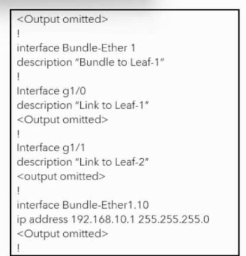
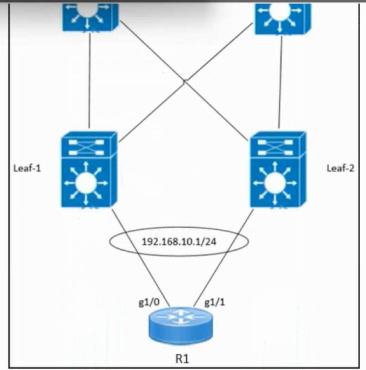
Refer to the exhibit. An engineer must configure EVPN port-active multihoming on router R1. Which command must be run against the g1/0 and g1/1 interfaces on R1 to complete the physical Ethernet bundle for multihoming on a host named Host-1?


Answer : D

From Cisco's EVPN VXLAN multihoming design requirements, port-active multihoming uses a single LAG (EtherChannel / Bundle-Ether) between the host/router and the pair of leaf switches. All physical interfaces participating in that bundle must be configured with:

bundle id <number> mode active

This command:

Associates the physical interfaces (g1/0 and g1/1) with Bundle-Ether1.

Uses LACP active mode, which is required for EVPN port-active multihoming.

Enables the host-facing port-channel required to support EVPN multihomed connectivity.

In the exhibit, R1 already has:

interface Bundle-Ether1

description 'Bundle to Leaf-1'

...

interface Bundle-Ether1.10

ip address 192.168.10.1 255.255.255.0

This confirms that the engineer intends to bundle g1/0 and g1/1 together into Bundle-Ether1, and the missing step is adding the interfaces into that bundle.

The correct configuration is:

interface g1/0

bundle id 1 mode active

interface g1/1

bundle id 1 mode active

Why the other options are incorrect

A . evpn ethernet-segment 1

This command is used on EVPN leaf switches (not R1) to define an ESI for multihoming. R1 is not an EVPN VTEP.

B . switchport mode trunk

R1 is a router, not a switch. L3 interfaces do not use switchport.

C . encapsulation dot1q 1

This applies only to subinterfaces, not physical interfaces, and is unrelated to building a LAG for port-active multihoming.


Question 5

Which command must be run on a Cisco IOS device to configure six parallel iBGP and eBGP routes that can be installed into a routing table?


Answer : A

Comprehensive and Detailed Explanation From Cisco SP Core Optimization Knowledge

Cisco IOS supports BGP Multipath for installing multiple equal-cost BGP routes (both iBGP and eBGP) into the routing table. The correct global BGP command syntax to set the number of allowable parallel BGP paths is:

maximum-paths <number>

For BGP specifically, the form is:

maximum-paths bgp <number>

This enables the router to install up to the specified number of equal-cost BGP routes (iBGP and eBGP) into the RIB and then potentially into the FIB.

Setting:

maximum-paths bgp 6

allows six parallel ECMP paths learned via BGP---this matches the requirement in the question.

Why the other options are incorrect

B . multipath eibgp 6

Not a valid Cisco IOS command.

C . maximum paths bgp routers 6

Invalid syntax.

D . maximum-paths eibgp 6

The correct keyword is bgp, not eibgp.

Cisco does not use ''eibgp'' in this context; IOS supports BGP multipath across iBGP/eBGP automatically when configured under maximum-paths bgp.


Page:    1 / 14   
Total 61 questions