Cisco - Big Savings Alert – Don’t Miss This Deal - Ends In 1d 00h 00m 00s Coupon code: 26Y30OFF
  1. Home
  2. Cisco
  3. 350-101 Exam
  4. Free 350-101 Questions

Free Practice Questions for Cisco 350-101 Exam

Pass4Future also provide interactive practice exam software for preparing Cisco Implementing and Operating Cisco Wireless Core Technologies (350-101) Exam effectively. You are welcome to explore sample free Cisco 350-101 Exam questions below and also try Cisco 350-101 Exam practice test software.

Page:    1 / 14   
Total 103 questions

Question 1

What is a characteristic of gain in wireless antenna design?


Answer : C

In wireless antenna design, gain refers to the measure of an antenna's ability to focus energy in a particular direction compared to a reference antenna, usually an isotropic radiator. Gain does not generate additional power; instead, it redistributes radiated energy to increase signal strength in the intended direction, enhancing the effective range and performance of the wireless link. This directional amplification is crucial in both point-to-point and point-to-multipoint deployments, as higher gain antennas can concentrate RF energy to overcome path loss and improve received signal strength at the target. Option A describes system loss calculation, which relates to link budgets, not antenna gain. Option B is unrelated, as checksum figures are part of digital error detection in wireless frames. Option D pertains to environmental tolerance, not RF signal characteristics. In Cisco Wireless Core Technologies, antenna gain is considered during RF planning, coverage modeling, and site surveys to ensure optimal signal distribution, proper overlap, and minimal interference, particularly for high-density deployments. Using high-gain directional antennas in corridors or long hallways, for instance, improves coverage and throughput while minimizing interference outside the target area. Reference topics: RF Fundamentals --- Antenna gain, directional radiation patterns, link budget, site survey planning.


Question 2

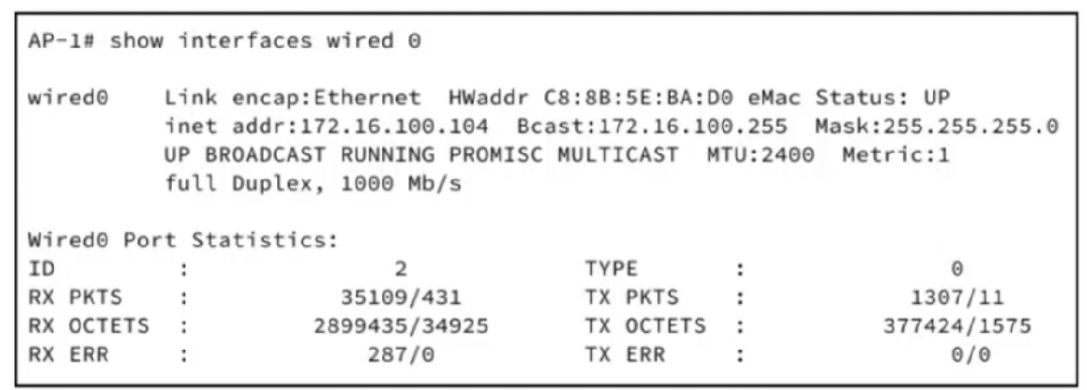
Refer to the exhibit.

Refer to the exhibit. An engineer configured a static IP address on a LWAPP, but it is not reachable for management. The engineer configured the wrong gateway and must now change the default gateway to 172.16.100.1. Which CLI command must the engineer use?


Answer : D

When deploying a Lightweight Access Point (LWAPP) in a Cisco wireless network, proper Layer 3 configuration is essential for management and connectivity to the Wireless LAN Controller (WLC). Each LWAPP requires a valid IP address, subnet mask, and default gateway to communicate beyond its local subnet. In the exhibit, the AP is assigned 172.16.100.104/24, but the previously configured gateway was incorrect, preventing communication with the WLC. Cisco IOS XE requires that the AP's IP interface be configured with the correct default gateway to route traffic properly. The correct syntax is capwap ap ip <AP-IP> <Subnet-Mask> <Default-Gateway>. Option D matches the IP, subnet mask, and gateway for the given network, ensuring the AP can reach the WLC for LWAPP registration. Option A only changes the gateway without setting the IP explicitly, which is insufficient if the IP needs adjustment. Option B incorrectly configures the controller's IP, which does not affect the AP's default gateway. Option C uses an incorrect subnet mask (255.255.255.192), which would place the AP in a different subnet, breaking connectivity. Proper default gateway configuration is critical to avoid registration failures and management issues. Reference topics: Client Connectivity Configuration --- LWAPP AP IP configuration, default gateway, WLC communication, Layer 3 reachability.


Question 3

Which process enables seamless Layer 2 handoff in a wireless network during roaming?


Answer : C

The correct answer is fast BSS transition protocol, which is IEEE 802.11r Fast Transition. Cisco describes 802.11r BSS Fast Transition as the mechanism used to provide seamless roaming for wireless clients by reducing the time required to roam between access points. It achieves this by allowing keying material to be prepared or cached so that the client does not perform a full authentication exchange every time it moves to another AP within the same mobility domain.

This is specifically relevant to Layer 2 roaming because the client remains in the same Layer 2 network while reassociating to a different BSS. Fast Transition reduces roam latency, which is critical for voice, video, collaboration, barcode scanners, and other real-time applications. Cisco also classifies fast secure roaming as the method used to accelerate client roaming when Layer 2 security is configured on the WLAN. Increased beacon intervals do not provide handoff acceleration. Optimized roaming helps with sticky-client behavior but is not the secure handoff protocol. Deferred probe response is an RF/client steering behavior, not an 802.11 Layer 2 roaming key-transition method. Reference topics: 802.11r Fast BSS Transition, Layer 2 roaming, fast secure roaming, WLAN mobility, and Catalyst 9800 roaming design.


Question 4

How does MIMO operate during wireless transmission?


Answer : A

MIMO, or Multiple-Input Multiple-Output, is a core 802.11n and later wireless technology that uses multiple transmit and receive radio chains and antennas to improve wireless performance. Cisco's Wireless RF Reference Guide explains that IEEE 802.11n introduced MIMO, replacing the older single-radio SISO model with multiple radios, each using its own antenna, to increase data rates and improve reception in multipath environments. Cisco also notes that weak or distorted multipath signals can be received by more than one radio and reconstructed, improving decode quality and reliability.

This directly supports option A: MIMO exploits multiple RF paths rather than treating multipath as purely destructive. Depending on implementation, MIMO can use spatial diversity, maximal ratio combining, and spatial streams to increase throughput, improve signal-to-noise ratio, reduce retries, and make more efficient use of airtime. Cisco describes spatial stream notation such as 4x4:4 as four transmitters, four receivers, and four spatial streams. Option B describes frequency hopping, not MIMO. Option C is not a MIMO function. Option D is the opposite of MIMO because MIMO deliberately uses multiple antennas and radio paths. Reference topics: 802.11 Technology Fundamentals --- MIMO, spatial streams, multipath, SISO versus MIMO, and 802.11n/ac/ax PHY enhancements.


Question 5

A network administrator at a marketing company manages a Cisco Catalyst 9800 Series Wireless Controller running Cisco IOS XE 17.x. The WLAN named XYZ-Guest is set up for visitors, and the administrator wants to implement a web authentication (WebAuth) portal using an external server to manage guest access. To ensure seamless and secure guest authentication, the controller must be configured to use an external WebAuth server for the WLAN. The administrator must configure the XYZ-Guest WLAN to use an external WebAuth server with a parameter map named webauth-ext. Which set of Cisco IOS XE commands must be used?


Answer : A

For configuring guest access on a Cisco Catalyst 9800 WLC using an external WebAuth server, the WLAN must be explicitly associated with the external server through a parameter map. The correct command syntax in Cisco IOS XE is wireless wlan <wlan-name> followed by security web-auth external . This configuration links the WLAN to the external WebAuth server defined in the parameter map, allowing guests to be redirected to the portal for authentication. The parameter map (webauth-ext) contains details such as server IP, port, and other authentication parameters required for the external WebAuth interaction. Option B is incorrect because it improperly uses multiple WLAN names in one command, which is not valid syntax. Option C uses parameter external security-map, which is invalid and does not associate the WLAN correctly with the WebAuth server. Option D incorrectly combines the security and parameter-map syntax and is not supported in IOS XE for external WebAuth. Cisco Wireless Core Technologies recommends this approach for centralized guest management, allowing consistent enforcement of guest policies, seamless authentication, and integration with external WebAuth servers across multiple WLANs and APs. Reference topics: Client Connectivity Configuration --- WebAuth, external guest portal, WLAN parameter map configuration, Cisco IOS XE 17.x.


Page:    1 / 14   
Total 103 questions