These Cisco 350-601 sample questions are a small glimpse of our full set of Cisco 350-601 actual questions. They give you a preview of what the real 350-601 exam might look like and the contents of Pass4Future's premium Cisco 350-601 product. You must not underestimate the value of Cisco 350-601 practice exam questions, as they allow you to understand the actual Implementing and Operating Cisco Data Center Core Technologies exam in greater depth. Using them will save your time and money otherwise wasted in Implementing and Operating Cisco Data Center Core Technologies exam reattempts. Study guides and tutorials provide you with theoretical details about the 350-601 exam; these 350-601 practice exam questions prepare you to pass the exam. Get Pass4Future's premium access to continue your 350-601 exam practice with the complete set of Cisco 350-601 realistic questions. Our Cisco 350-601 practice questions come in various formats; make sure to check out the details and free demo of each format.
Do you know that you can access more real Cisco 350-601 exam questions via Premium Access? ()
Refer to the exhibit. An engineer is performing a Cisco Nexus 3000 Series Switch configuration backup with a TFTP server that is reachable in the global routing table. Which action completes the scheduler configuration?
Answer : A
In the context of Cisco Nexus switches, VRF (Virtual Routing and Forwarding) is used to create multiple virtual routing tables within a single switch. By using the default VRF for the scheduler job, the engineer ensures that the TFTP server, which is reachable in the global routing table, can be accessed without the need for additional VRF configuration. This simplifies the backup process and avoids potential issues with VRF-specific routing that could prevent access to the TFTP server.
Refer to the exhibit.

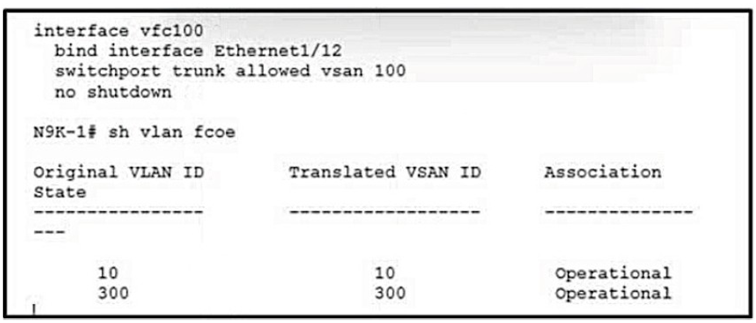
An engineer configures FCoE in a newly installed data center. Which configuration must be applied to activate VSAN 100 on VFC100?
Answer : B
The configuration snippet in the exhibit shows that VSAN 100 is allowed on interface Ethernet1/12 with the command ''switchport trunk allowed vsan 100''. This means option B, ''Allow VSAN 100 on interface eth1/12'', is the correct answer. In Cisco Data Center Core Technologies, it's essential to allow specific VSANs on an interface to enable traffic flow for those VSANs. Reference: Implementing and Operating Cisco Data Center Core Technologies (DCCOR) - Configuring FCoE
An engineer is designing a cloud solution for an organization. The security requirements mandate that the cloud must be hosted in a local data center but leverage the remote data center for remote backups. Additionally, the workloads in the data center must be scaled out to a known cloud provider in the future. Which cloud deployment model must be used to meet these requirements?
Answer : B
The hybrid cloud model is the most suitable for the described scenario. It allows for a combination of local (private) cloud infrastructure with remote (public) cloud services. This model supports hosting the primary workloads in a local data center, utilizing remote data centers for backups, and provides the flexibility to scale out to a public cloud provider when necessary. The hybrid cloud model offers the benefits of both private and public clouds, including security, scalability, and flexibility, which aligns with the organization's requirements.
Refer to the exhibit.


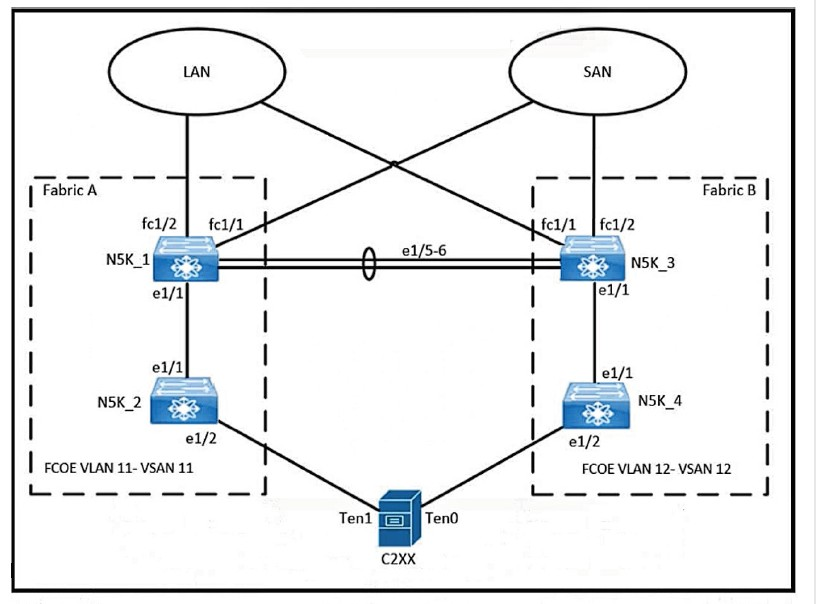
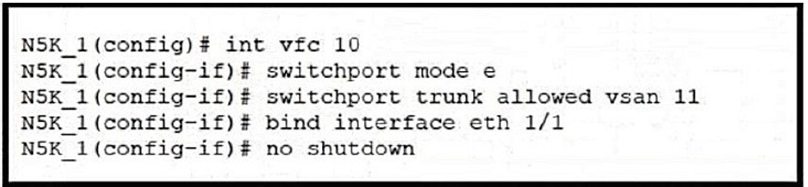
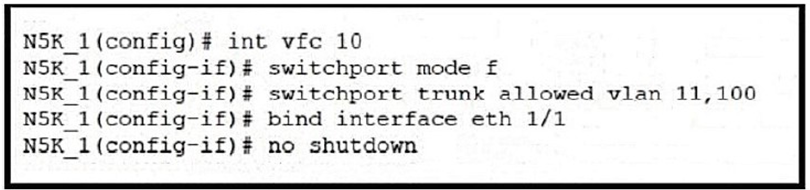
An engineer must configure FCoE with these requirements:
* VLAN 100 must be used to carry the Ethernet traffic.
* Fabric A must use FCoE on VLAN 11 and VSAN11.
* Fabric B must use FCoE on VLAN 12 and VSAN 12.
* vfc 10 on Fabric A must be bound to Ethernet 1/1 on N5K_1.
* vfc 11 on Fabric B must be bound to Ethernet 1/1 on N5K_2.
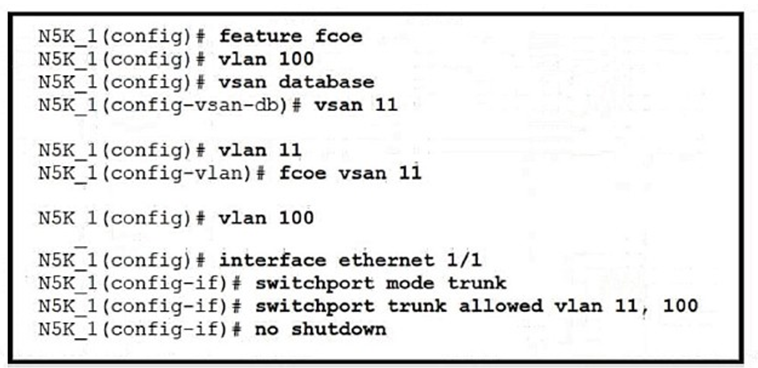
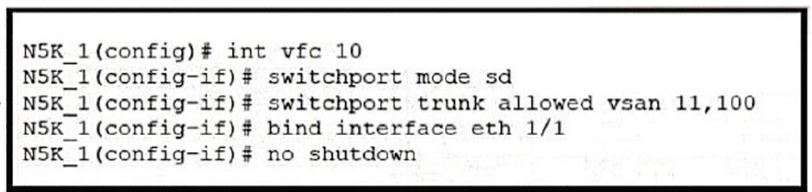
Which interface vfc 10 configuration accomplishes these requirements?
A)

B)

C)

Answer : A
The configuration for interface vfc 10 that meets the requirements is Option A. This option correctly binds vfc 10 to Ethernet 1/1 on N5K_1, which is part of Fabric A, and allows VLAN 11 for FCoE traffic as well as VLAN 100 for Ethernet traffic. The configuration ensures that VLAN 11 is used for FCoE on VSAN11, which is specific to Fabric A, and also includes VLAN 100 as required for Ethernet traffic.
An engineer must configure port aggregation between two Cisco MDS 9000 Series Switches. The solution must meet these requirements:
* Suspend member interface if parameters mismatch.
* Load-balance traffic on multiple ports.
* Support traffic from multiple VSANs.
Which port channel configuration must be used?
Answer : C
The requirements listed are indicative of a need for a port channel configuration that supports Enhanced ISL (EISL) or E Port channels. These channels are used for inter-switch links (ISLs) between Cisco MDS switches and can carry traffic for multiple VSANs. The 'Active' mode is necessary to ensure that the port channel will suspend an individual member link if there is a configuration mismatch, which is a feature of the PortChannel protocol LACP (Link Aggregation Control Protocol).This mode also supports load balancing and can handle traffic from multiple VSANs12.