These CompTIA SY0-801 sample questions are a small glimpse of our full set of CompTIA SY0-801 actual questions. They give you a preview of what the real SY0-801 exam might look like and the contents of Pass4Future's premium CompTIA SY0-801 product. You must not underestimate the value of CompTIA SY0-801 practice exam questions, as they allow you to understand the actual CompTIA Security+ Certification Exam (New Version) exam in greater depth. Using them will save your time and money otherwise wasted in CompTIA Security+ Certification Exam (New Version) exam reattempts. Study guides and tutorials provide you with theoretical details about the SY0-801 exam; these SY0-801 practice exam questions prepare you to pass the exam. Get Pass4Future's premium access to continue your SY0-801 exam practice with the complete set of CompTIA SY0-801 realistic questions. Our CompTIA SY0-801 practice questions come in various formats; make sure to check out the details and free demo of each format.
Do you know that you can access more real CompTIA SY0-801 exam questions via Premium Access? ()
Which of the following is a characteristic of Online Certificate Status Protocol (OCSP)?
Answer : A
The Online Certificate Status Protocol (OCSP) is a public key infrastructure mechanism that enables applications and systems to determine the revocation status of digital certificates without downloading an entire Certificate Revocation List (CRL).
When a client needs to verify a certificate's revocation status, it can submit an OCSP request to an authorized responder. The responder processes the request and returns a digitally signed response containing one of three certificate status values: good, revoked, or unknown.
A good status indicates that the responder has not identified the certificate as revoked, subject to the protocol's defined semantics. A revoked status indicates that the certificate has been revoked or is otherwise treated as revoked under applicable protocol rules. An unknown status indicates that the responder cannot establish the requested certificate's status.
OCSP responders may operate within on-premises or cloud-hosted infrastructure. Certificate status validation is generally automated and does not require manual user intervention. Direct OCSP requests typically require network connectivity, although OCSP stapling allows a server to supply a previously obtained signed response.
The three recognized certificate status values are the defining characteristic specified by RFC 6960.
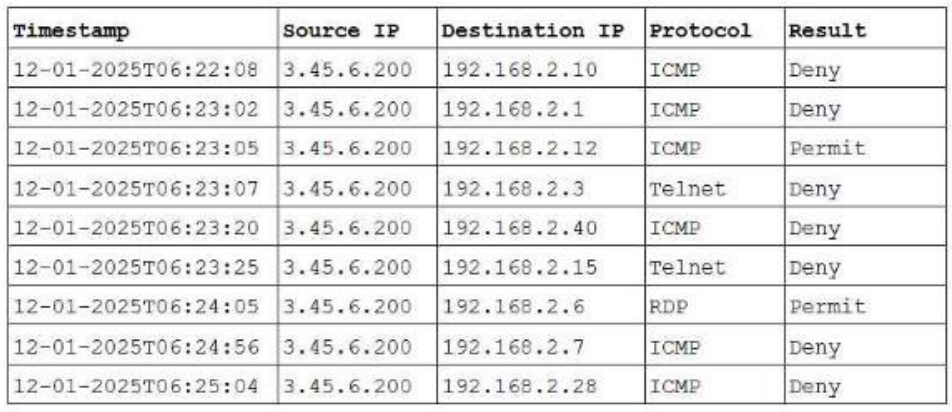
During an investigation of a known malicious IP address, the security operations center (SOC) team analyzes the following packet capture output:

Which of the following should the SOC team do first?
Answer : D
The recorded network activity identifies repeated connection attempts from a known malicious IP address targeting multiple internal systems. Although most attempts were denied, the security infrastructure permitted ICMP traffic to 192.168.2.12 and Remote Desktop Protocol (RDP) traffic to 192.168.2.6. These permitted connections warrant immediate investigation.
The RDP connection is particularly significant because RDP provides remote interactive access to computer systems. An allowed connection does not establish successful authentication or compromise, but it demonstrates that the malicious source could reach the relevant service. Investigators should correlate firewall records with authentication logs, endpoint telemetry, session records, and other available evidence to determine whether unauthorized access occurred.
Blocking all inbound ICMP traffic is unnecessarily broad and does not address the permitted RDP connection. Running credentialed vulnerability scans across all addresses introduces additional activity without immediately establishing whether exploitation occurred. Updating threat intelligence feeds does not resolve the existing suspicious connections.
Investigating the affected hosts enables the SOC to establish the incident's scope, determine whether compromise occurred, preserve relevant evidence, and select proportionate containment measures based on confirmed findings.
An administrator develops a document that includes a series of steps about configuration, management, and maintenance processes for the network. Which of the following describes this document?
Answer : B
Procedures are documented, sequential instructions that explain how organizational activities must be performed. They translate higher-level security policies and technical standards into practical operational steps that authorized personnel can follow consistently.
A network administration procedure may describe the required sequence for configuring network devices, applying firmware updates, reviewing firewall rules, backing up configurations, validating connectivity, and performing scheduled maintenance.
Well-developed procedures identify responsible personnel, prerequisites, required approvals, implementation steps, validation activities, and escalation requirements. They may also incorporate rollback instructions to restore normal operations if maintenance introduces unexpected problems.
Policies define management expectations, organizational security objectives, and mandatory rules. They establish what must be achieved but generally do not specify every operational step.
Standards establish mandatory technical or operational requirements, such as approved encryption algorithms, minimum authentication requirements, or network configuration baselines. Guidelines provide recommended practices and typically allow greater flexibility based on operational circumstances.
The defining characteristic of the administrator's document is its series of actionable steps. Procedures therefore provide the most accurate classification because they establish how configuration, management, and maintenance activities are executed.
SIMULATION
Scenario: Threat intelligence analysis and compromised server remediation
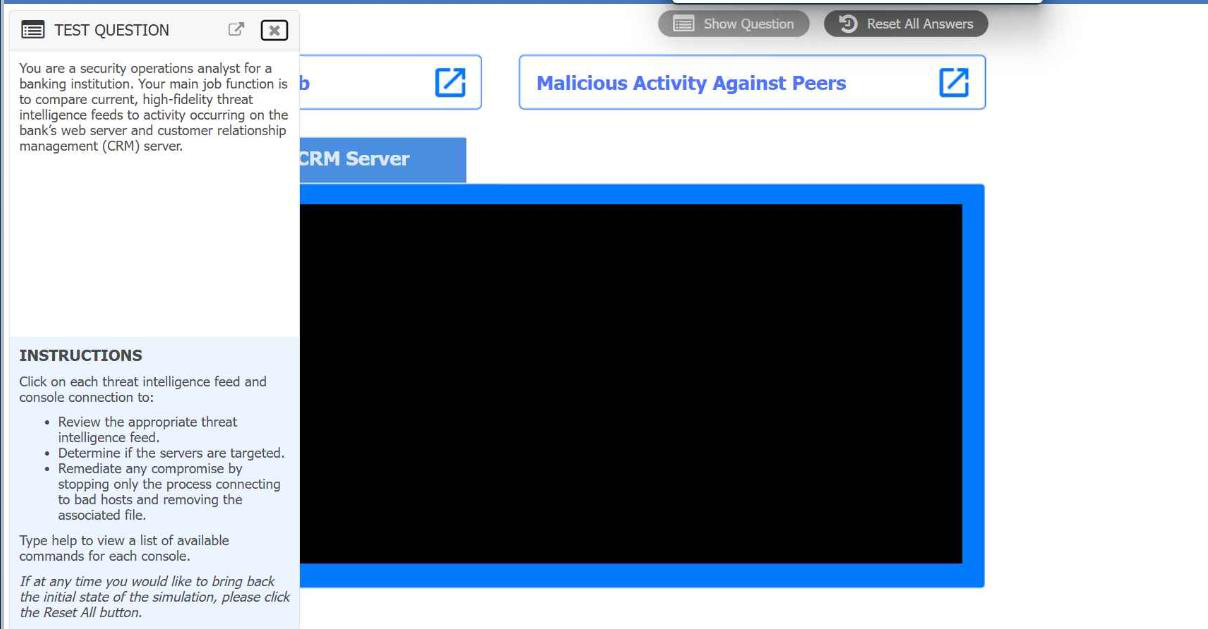
You are a security operations analyst for a banking institution. Your main job function is to compare current, high-fidelity threat intelligence feeds to activity occurring on the bank's web server and customer relationship management (CRM) server.
The security operations center (SOC) has received multiple threat intelligence reports containing indicators of potentially malicious network activity.
You must review the available threat intelligence feeds, investigate the network connections and running processes on both servers, and remediate any confirmed compromise without interrupting legitimate banking services.
INSTRUCTIONS:
Click on each threat intelligence feed and console connection to:
* Review the appropriate threat intelligence feed.
* Determine if the servers are targeted.
* Remediate any compromise by stopping only the process connecting to bad hosts and removing the associated file.
Type help to view a list of available commands for each console.
If at any time you would like to return to the initial state of the simulation, click the Reset All button.
Exhibit 1 --- Original simulation interface


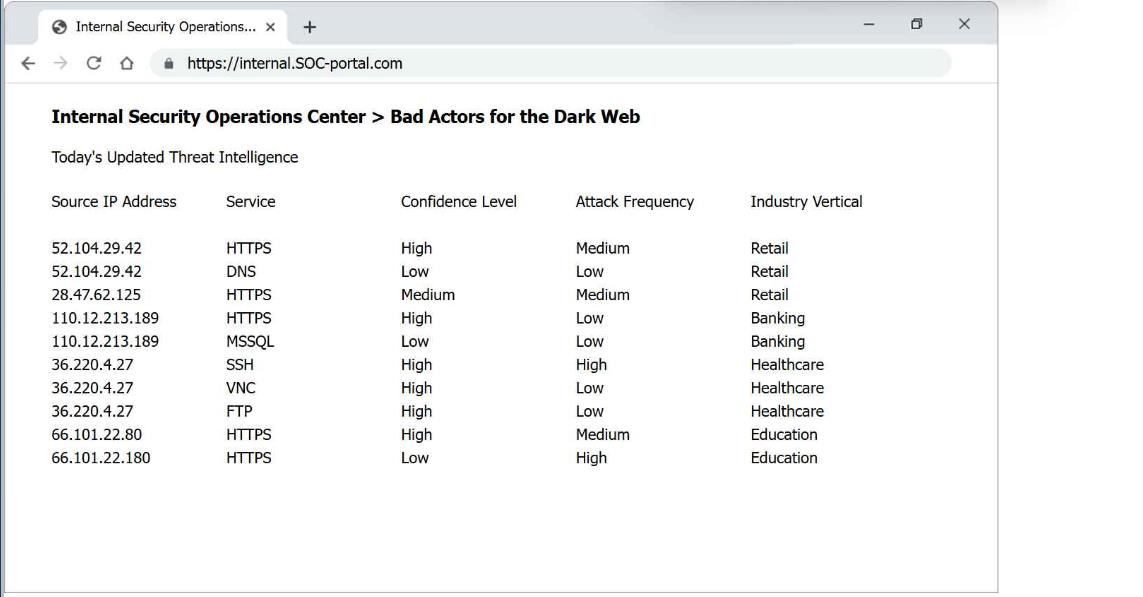
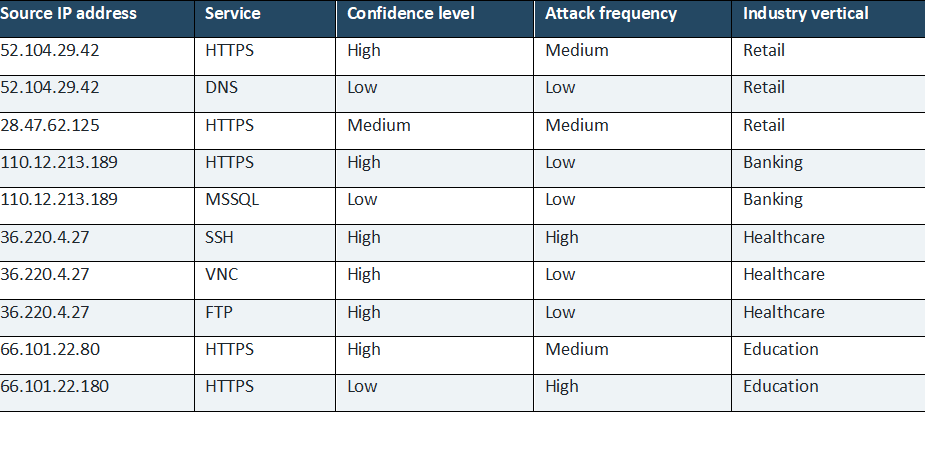
Exhibit 2 --- Bad Actors for the Dark Web
Internal Security Operations Center --- Today's Updated Threat Intelligence


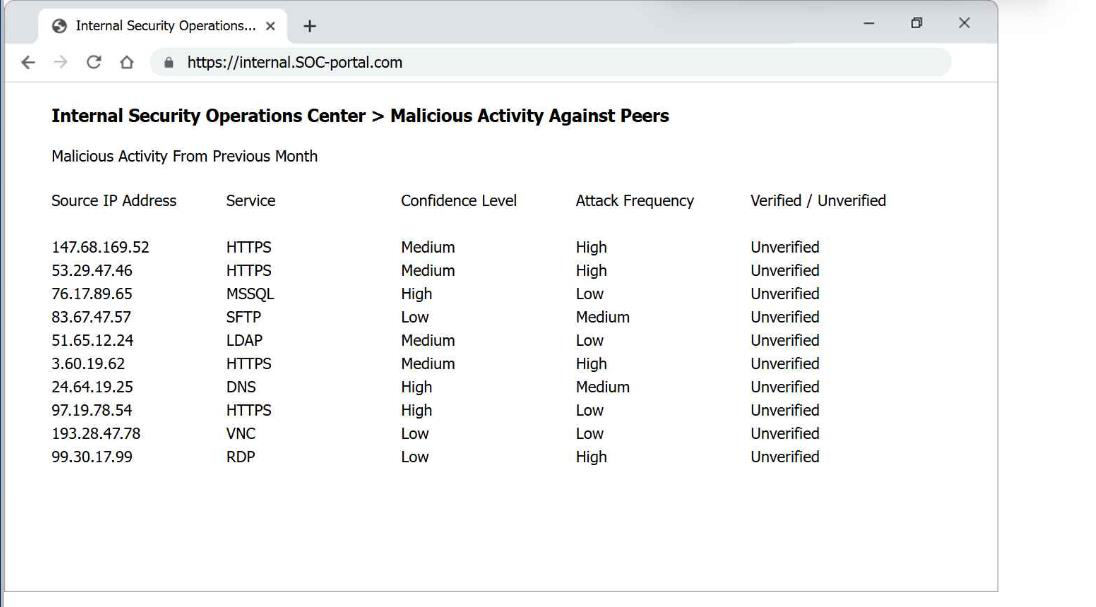
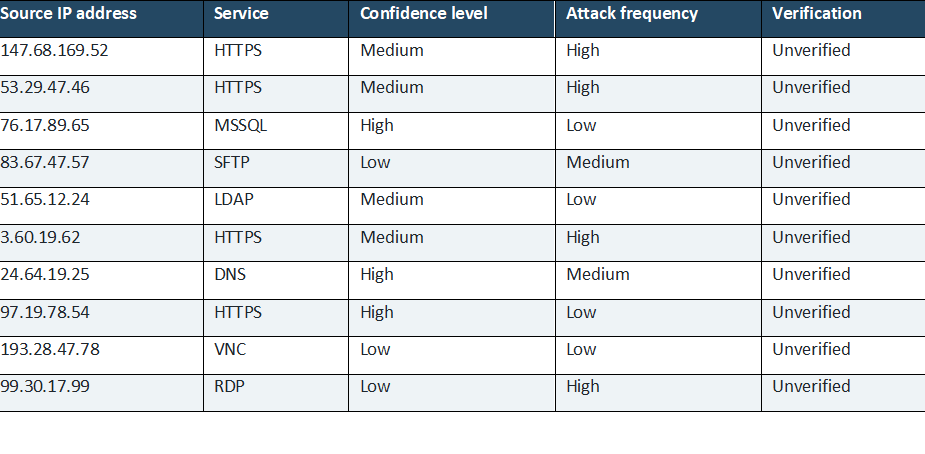
Exhibit 3 --- Malicious Activity Against Peers
Internal Security Operations Center --- Malicious Activity from Previous Month


Supplementary server evidence
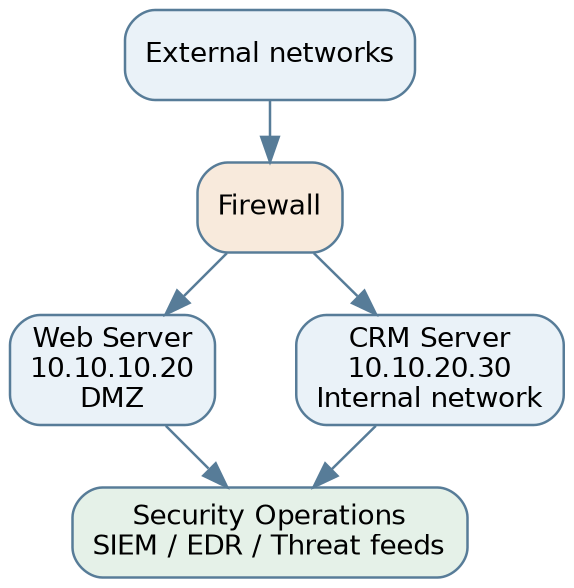
Exhibit 4 --- Network infrastructure

Generated network topology for the reconstructed banking scenario.
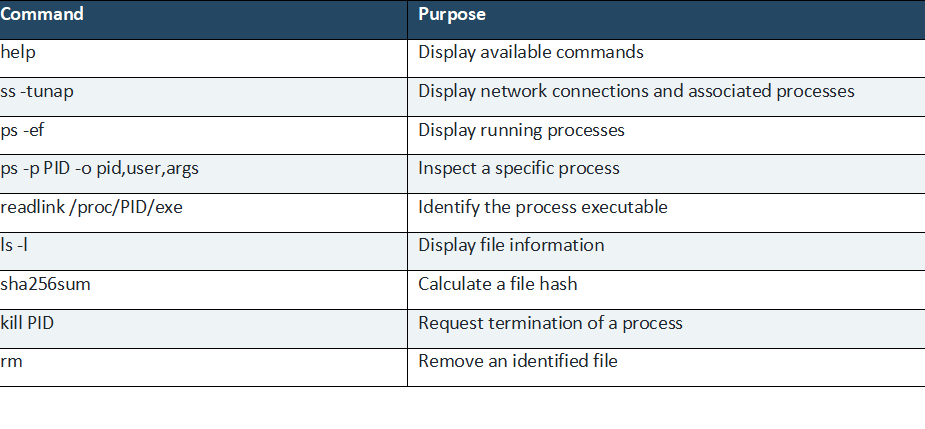
Exhibit 5 --- Available console commands

These are illustrative Linux commands. The original simulator may implement a different subset of commands.
Exhibit 6 --- Web server active network connections
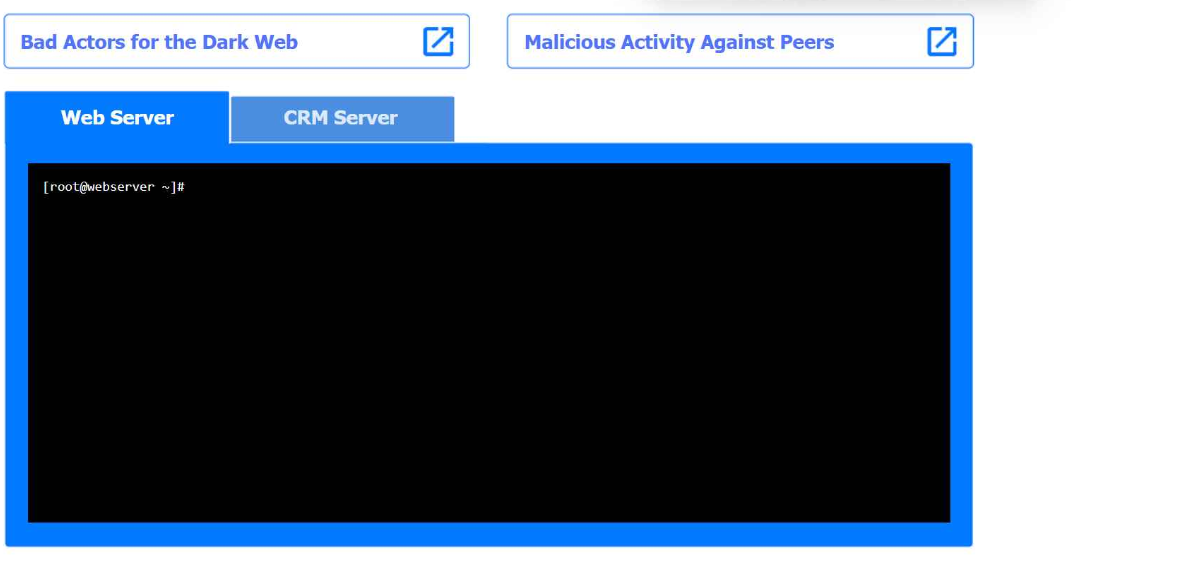
[root@webserver ~]# ss -tunap
State: ESTAB
Local: 10.10.10.20:443
Peer: 198.51.100.25:51022
Process: nginx, PID 812
State: ESTAB
Local: 10.10.10.20:51544
Peer: 110.12.213.189:443
Process: websync, PID 2458
State: ESTAB
Local: 10.10.10.20:49280
Peer: 10.10.30.10:443
Process: backup-agent, PID 1021
State: ESTAB
Local: 10.10.10.20:22
Peer: 10.10.40.15:56120
Process: sshd, PID 1190
[root@webserver ~]#
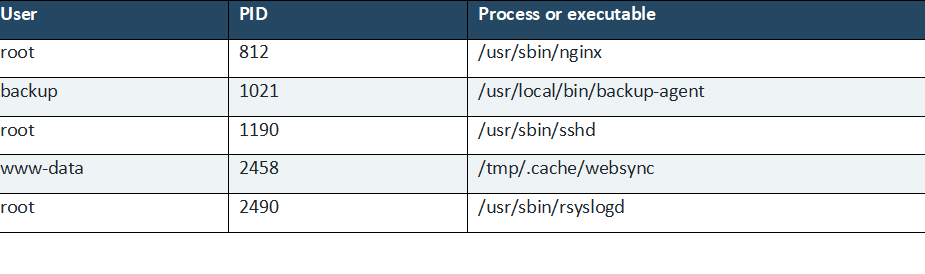
Exhibit 7 --- Web server running processes
Command executed: ps -ef

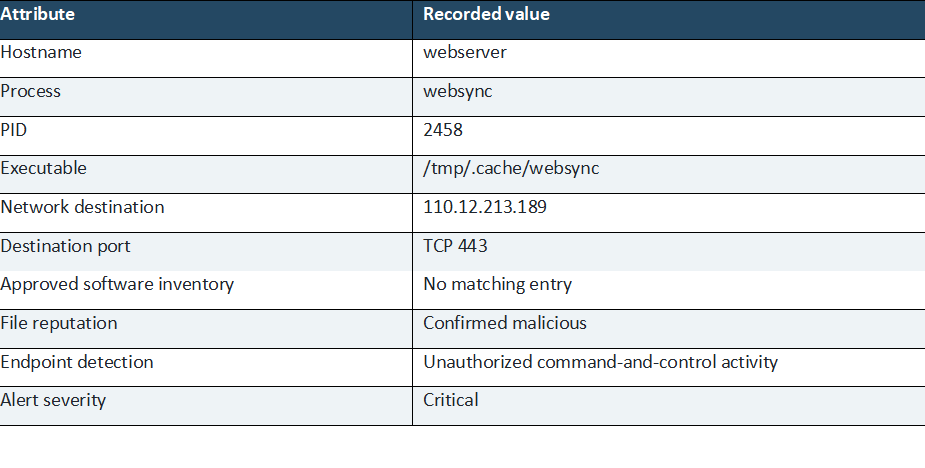
Exhibit 8 --- Web server endpoint security alert

The endpoint alert provides independent evidence that the suspicious network connection is associated with malicious activity.
Exhibit 9 --- CRM server active network connections
[root@crmserver ~]# ss -tunap
State: ESTAB
Local: 10.10.20.30:8443
Peer: 10.10.40.21:53120
Process: java, PID 1380
State: ESTAB
Local: 10.10.20.30:50211
Peer: 10.10.20.40:1433
Process: crm-service, PID 1450
State: ESTAB
Local: 10.10.20.30:51460
Peer: 110.12.213.189:1433
Process: crmupdate, PID 3176
State: ESTAB
Local: 10.10.20.30:22
Peer: 10.10.40.15:57011
Process: sshd, PID 1240
[root@crmserver ~]#

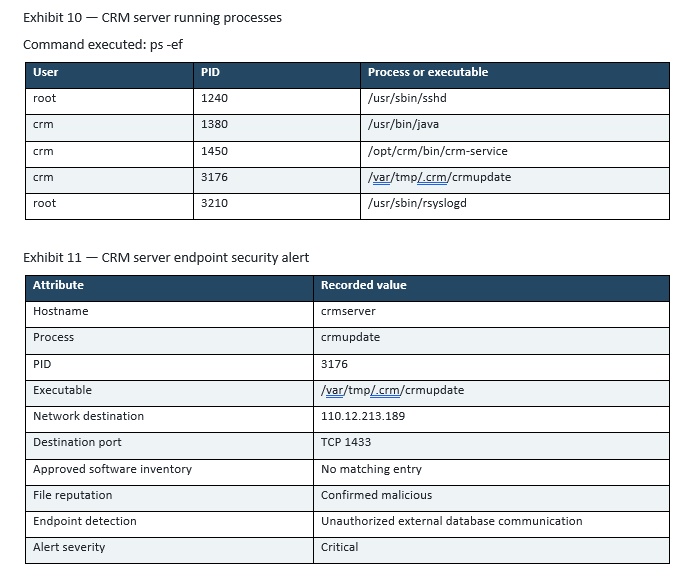
Although the initial MSSQL threat intelligence record has low confidence, the endpoint security evidence confirms that the associated process is malicious in this reconstructed scenario.
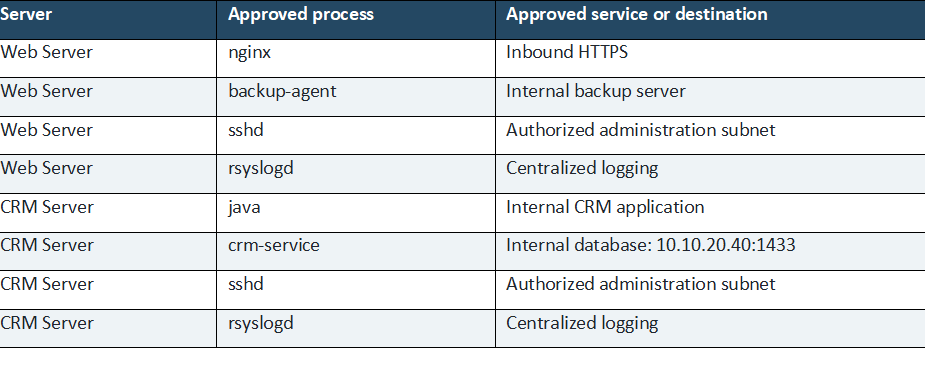
Exhibit 12 --- Approved services and destinations

Answer area --- Simulation console
Review the source threat intelligence and reconstructed console evidence. Select the malicious process and associated executable for each affected server.
Select the primary threat intelligence feed:
Bad Actors for the Dark Web --- Today's feed
Malicious Activity Against Peers --- Previous month

Answer : A
Step 1: Select the most relevant threat intelligence feed
Correct selection: Bad Actors for the Dark Web
The appropriate primary feed is today's updated threat intelligence because it provides current threat information and includes industry-specific classifications directly relevant to the banking organization.
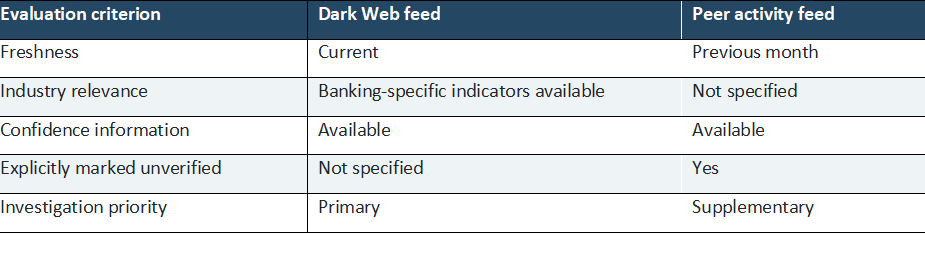
The previous month's peer activity report remains useful for supplementary investigation, but it is less suitable as the primary source when investigating current threats.
Step 2: Identify indicators relevant to banking infrastructure
Filter the current threat intelligence feed for banking-related activity.

The HTTPS indicator warrants priority investigation because it combines current intelligence, high confidence, and banking industry relevance.
The MSSQL indicator requires additional corroboration before remediation because its confidence level is low.
Confidence and attack frequency are different attributes. Low attack frequency does not necessarily indicate a low-impact threat, while high attack frequency does not independently establish that an indicator is accurate.
Also, the original feed identifies source IP addresses, whereas the reconstructed console shows the same address as an outbound destination. That correlation warrants investigation but is not independently sufficient to establish compromise.
Step 3: Investigate the web server
First, examine the network connections.
ss -tunap
Identify the following suspicious connection:
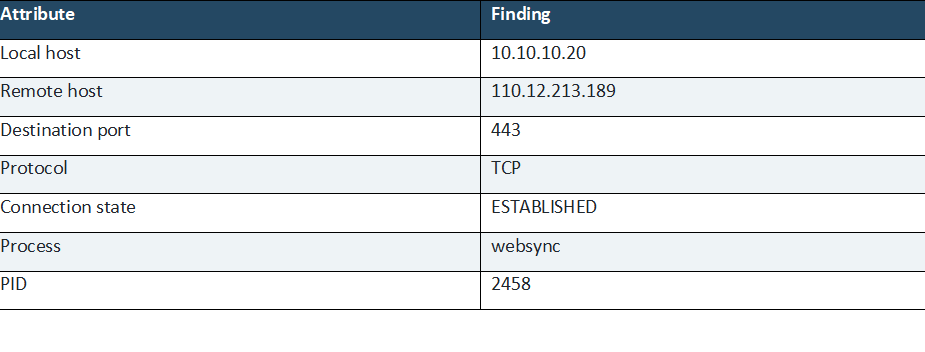
The remote IP address matches the high-confidence banking HTTPS threat intelligence record.
Inspect the associated process:
ps -p 2458 -o pid,user,args
Expected output:
PID USER COMMAND
2458 www-data /tmp/.cache/websync
Identify the executable:
readlink /proc/2458/exe
Expected output:
/tmp/.cache/websync
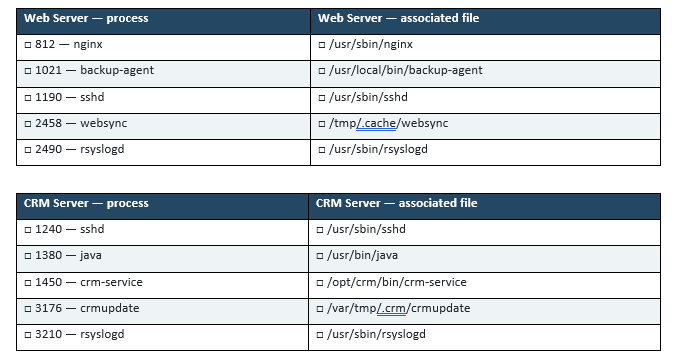
The executable is not part of the approved software inventory, and endpoint telemetry independently confirms malicious command-and-control activity.
Step 4: Remediate the web server
Preserve relevant endpoint alerts, connection records, executable hashes, and any evidence required by the organization's incident response policy before deleting the malicious file.
Calculate the file hash:
sha256sum /tmp/.cache/websync
After confirming the identity of the process, stop only the malicious process:
kill 2458
Verify that the process has terminated:
ps -p 2458
After evidence preservation and authorization, remove the malicious executable:
rm /tmp/.cache/websync
Verify that the suspicious network connection is no longer present:
ss -tunap
Web server remediation summary:
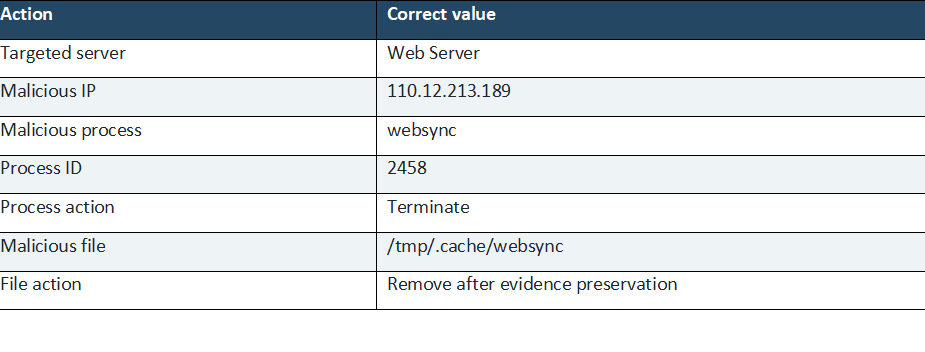
Do not terminate nginx, sshd, rsyslogd, or the approved backup agent.
Step 5: Investigate the CRM server
Examine the CRM server's current network connections.
ss -tunap
The following connection requires investigation:
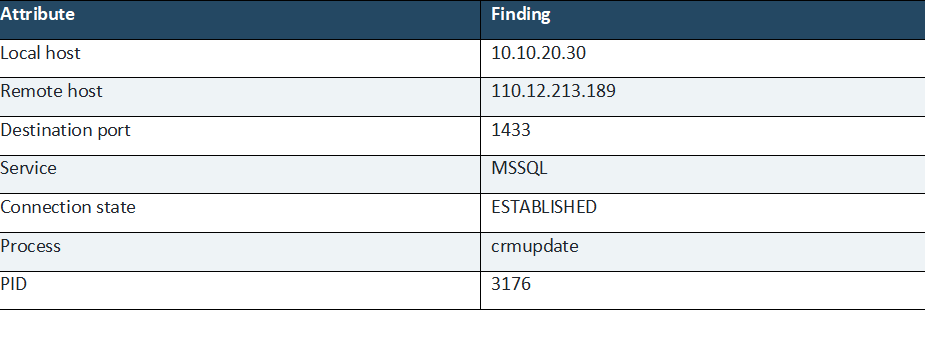
Port TCP 1433 is commonly associated with Microsoft SQL Server.
The CRM server's legitimate database is located at the internal address 10.10.20.40. The unauthorized external MSSQL communication is inconsistent with the approved connectivity policy.
Inspect the associated process:
ps -p 3176 -o pid,user,args
Expected output:
PID USER COMMAND
3176 crm /var/tmp/.crm/crmupdate
Identify the executable:
readlink /proc/3176/exe
Expected output:
/var/tmp/.crm/crmupdate
Although the threat feed assigns low confidence to the MSSQL indicator, the unauthorized executable, unexpected external connection, and corroborating endpoint alert collectively establish a confirmed compromise within the reconstructed scenario.
Step 6: Remediate the CRM server
Preserve the required forensic evidence before removing the file.
Calculate the malicious executable's hash:
sha256sum /var/tmp/.crm/crmupdate
Terminate only the confirmed malicious process:
kill 3176
Verify that the process has terminated:
ps -p 3176
Remove the malicious file after evidence preservation:
rm /var/tmp/.crm/crmupdate
Verify the network connection has been eliminated:
ss -tunap
Confirm that the legitimate internal database connection remains available.
CRM server remediation summary:
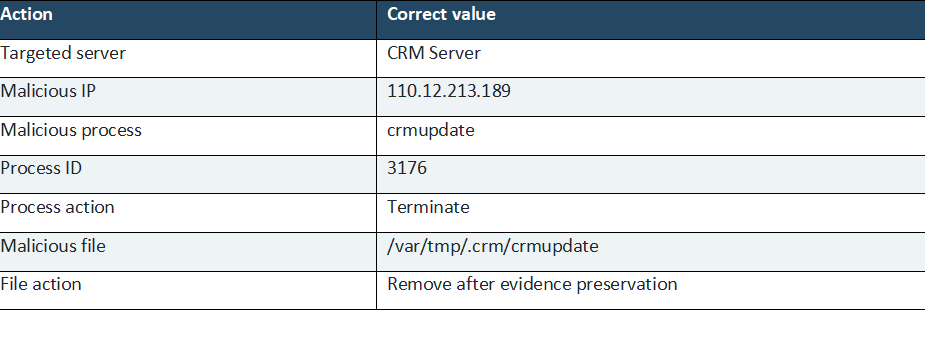
Do not terminate the legitimate crm-service process using PID 1450. Doing so could interrupt access to the organization's approved database.
Step 7: Verify the completed remediation
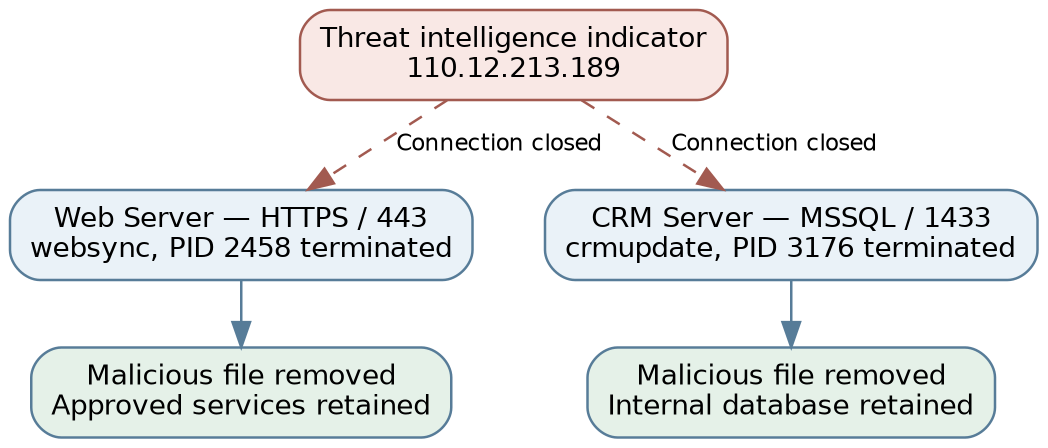
Completed answer exhibit
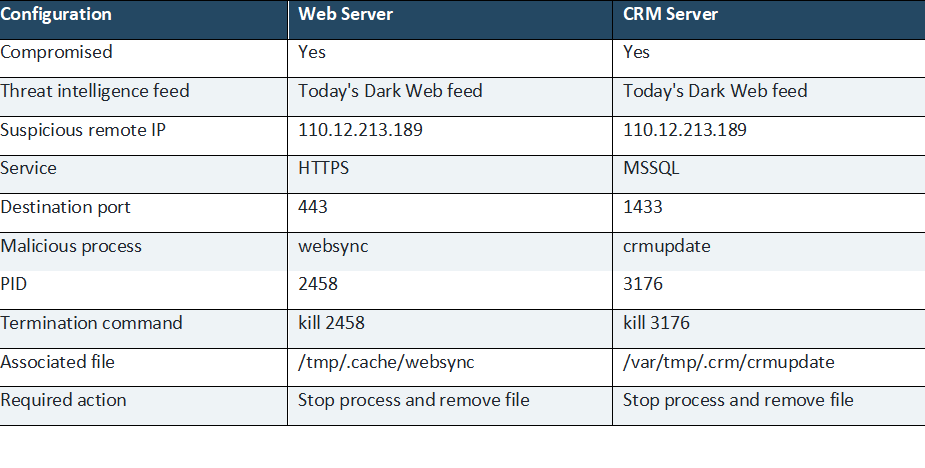
Web Server --- illustrative expected console results
[root@webserver ~]# kill 2458
[root@webserver ~]# rm /tmp/.cache/websync
[root@webserver ~]# ps -p 2458
PID TTY TIME CMD
Verification: process absent
Malicious connection: closed
Approved services: operational
CRM Server --- illustrative expected console results
[root@crmserver ~]# kill 3176
[root@crmserver ~]# rm /var/tmp/.crm/crmupdate
[root@crmserver ~]# ps -p 3176
PID TTY TIME CMD
Verification: process absent
Malicious connection: closed
Internal database: operational
Step 8: Perform post-remediation security checks
Terminating malicious processes and removing executable files satisfies the immediate simulation requirements. However, these actions alone do not establish that a compromised server has been fully restored to a trustworthy state.
The SOC should investigate persistence mechanisms, review privileged account activity, search for additional indicators of compromise, assess potential data exfiltration, validate system integrity, and determine whether recovery from a trusted system image is necessary.
Any containment decisions should minimize business disruption while preventing further unauthorized communications.
An organization refreshes the network infrastructure every 7 to 10 years. Which of the following should the organization consider to keep the new hardware suitable for the entire life cycle?
Answer : B
Capacity planning is the strategic process of evaluating current resource utilization and forecasting future requirements to ensure infrastructure remains capable of supporting organizational workloads throughout its expected operational life cycle.
When network equipment is replaced only every seven to ten years, administrators must consider anticipated increases in user populations, connected devices, application traffic, bandwidth consumption, processing requirements, and security inspection workloads. Purchasing equipment based exclusively on current utilization may result in performance limitations well before the next scheduled infrastructure refresh.
Effective capacity planning evaluates projected throughput requirements, available switch ports, uplink speeds, processing capabilities, memory, expansion options, vendor support periods, and compatibility with emerging technologies. These considerations help organizations select hardware that accommodates expected business growth while maintaining acceptable performance and security.
Scalability describes the ability of infrastructure to accommodate increased workloads through expansion or adjustment. Although scalability is an important consideration, capacity planning is the broader process used to determine anticipated resource requirements across the hardware's life cycle.
Disaster recovery focuses on restoring services following major disruptions, while high availability minimizes service interruptions through resilient infrastructure design.
Capacity planning most comprehensively addresses the organization's long-term hardware suitability requirement.