CSI - Big Savings Alert – Don’t Miss This Deal - Ends In 1d 00h 00m 00s Coupon code: 26Y30OFF
  1. Home
  2. CSI
  3. CSC1 Exam
  4. Free CSC1 Questions

Free Practice Questions for CSI CSC1 Exam

Pass4Future also provide interactive practice exam software for preparing CSI Canadian Securities Course Exam 1 (CSC1) Exam effectively. You are welcome to explore sample free CSI CSC1 Exam questions below and also try CSI CSC1 Exam practice test software.

Page:    1 / 14   
Total 100 questions

Question 1

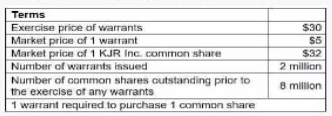
KJR made the following warrants offering:

What is the intrinsic value of 1 KJR inc, warrant?


Answer : D

The intrinsic value of a warrant is calculated as the difference between the current market price of the common share and the exercise price of the warrant, provided the market price of the share is higher than the exercise price.

IntrinsicValue=MarketPriceofCommonShareExercisePriceofWarrant\text{Intrinsic Value} = \text{Market Price of Common Share} - \text{Exercise Price of Warrant}IntrinsicValue=MarketPriceofCommonShareExercisePriceofWarrant

Using the values provided:

Market Price of 1 KJR Inc. Common Share = $32

Exercise Price of Warrants = $30

IntrinsicValue=3230=2\text{Intrinsic Value} = 32 - 30 = 2IntrinsicValue=3230=2

Since the market price of the share is greater than the exercise price, the intrinsic value is $2.

Explanation of Incorrect Options:

Option A ($0): This would be correct if the exercise price were greater than or equal to the market price of the common share.

Option B ($5): This incorrectly includes the market price of the warrant ($5), which is irrelevant to intrinsic value calculation.

Option D ($3): This is not derived from the given data and calculations.


Canadian Securities Course (CSC), Volume 1, Chapter 8: Equity Securities -- Common and Preferred Shares. Discussion on warrants, including intrinsic value calculations.

Question 2

What is the portion of annual profit held by a company after the payment expenses and the distribution of dividends?


Answer : A

Retained earnings represent the portion of a company's annual profit that is retained and not paid out as dividends. It is used to reinvest in the business or pay down debt.

B . Comprehensive income includes all changes in equity except those from owner contributions or distributions.

C . Share capital refers to funds raised by issuing shares.

D . Gross profit is revenue minus the cost of goods sold, not the portion retained.


Question 3

Haw are retail stock and bond transactions settled on a daily basis among dealers?


Answer : C

In Canada, retail stock and bond transactions are settled through a clearing corporation, such as the Canadian Depository for Securities (CDS). The clearing corporation ensures that transactions are accurately settled according to the dealers' records.

Exchanges facilitate the trading process but are not directly responsible for settling transactions (A, D).

The clearing corporation settles transactions based on dealer records, not exchange records (B).


Question 4

What order would an investor use to protect a short position?


Answer : A

A stop buy order is used to protect a short position. This type of order instructs the broker to purchase a security if its price rises to a specified level, limiting the short seller's potential loss. It is triggered when the price reaches or surpasses the set stop price, helping the short seller exit the position to avoid unlimited losses.

Study Document Reference:

Volume 1, Chapter 9: Order Types and Protecting Short Positions, discussing how stop buy orders function for short sellers.


Question 5

The consumer price index was 125.9 in December of last year and 123.0 in December of the year before What was the inflation rate last year?


Answer : A

The inflation rate is calculated using the formula:

InflationRate=CPIcurrentCPIpreviousCPIprevious100\text{Inflation Rate} = \frac{\text{CPI}_{\text{current}} - \text{CPI}_{\text{previous}}}{\text{CPI}_{\text{previous}}} \times 100InflationRate=CPIpreviousCPIcurrentCPIprevious100

Substitute the given values:

InflationRate=125.9123.0123.0100=2.9123.01002.36%\text{Inflation Rate} = \frac{125.9 - 123.0}{123.0} \times 100 = \frac{2.9}{123.0} \times 100 \approx 2.36\%InflationRate=123.0125.9123.0100=123.02.91002.36%

Why Other Options are Incorrect:

B . 2.30%: This is close but results from rounding errors or miscalculation.

C . 0.98% and D. 1.02%: These values are far below the correct inflation rate calculated using the formula.

Reference: CSC Volume 1, Chapter 4, 'Measuring Inflation -- Consumer Price Index' explains how to calculate inflation using CPI values.


Page:    1 / 14   
Total 100 questions