Pass4Future also provide interactive practice exam software for preparing Fortinet NSE 6 - LAN Edge 7.6 Architect (FCSS_LED_AR-7.6) Exam effectively. You are welcome to explore sample free Fortinet FCSS_LED_AR-7.6 Exam questions below and also try Fortinet FCSS_LED_AR-7.6 Exam practice test software.
Do you know that you can access more real Fortinet FCSS_LED_AR-7.6 exam questions via Premium Access? ()
Refer to the exhibits.

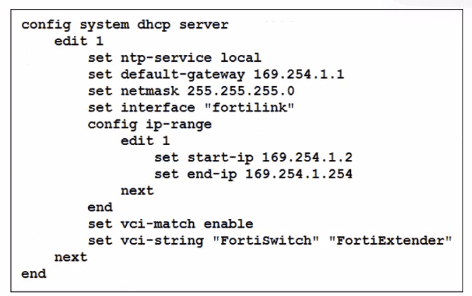
You've configured the FortiLink interface, and the DHCP server is enabled by default. The resulting DHCP server settings are shown in the exhibit. What is the role of the vci-string setting in this configuration?
Answer : C
The DHCP configuration shows:
set vci-match enable
set vci-string 'FortiSwitch' 'FortiExtender'
What this means
VCI = Vendor Class Identifier (DHCP option 60)
When vci-match is enabled, the DHCP server will only respond to DHCP requests from clients whose VCI string matches the configured vendor identifiers.
FortiSwitch and FortiExtender both send DHCP option 60 with:
'FortiSwitch'
'FortiExtender'
This is used in FortiLink deployments so only these devices receive IP addresses on the FortiLink network.
Therefore:
C . To connect, devices must match the VCI string; otherwise, they will not receive an IP address.
Correct.
This perfectly matches FortiGate FortiLink DHCP behavior.
Summary of incorrect options
A --- Ignore FortiSwitch/FortiExtender
Opposite behavior.
B --- Restrict based on hostname
VCI does NOT check hostname.
D --- Reserve IPs
No reservation occurs; it's filtering, not reserving.
Which FortiGuard licenses are required for FortiLink device detection to enable device identification and vulnerability detection?
Answer : D
FortiLink device detection relies on FortiGate'sDevice IdentificationandIoT Detectioncapabilities to classify devices connected to FortiSwitch ports.
To enabledevice identificationandvulnerability detectionfor IoT/endpoint devices in LAN Edge deployments, FortiGate must subscribe to the correct FortiGuard services.
1. Required FortiGuard License for Device Identification (IoT Detection)
The FortiOS documentation clearly states:
''IoT detection service... requires anAttack Surface Security Rating service licenseto download the IoT signature package.''
Additionally:
''The following settings are required for IoT device detection:
A validAttack Surface Security Rating service licenseto download the IoT signature package.''
This service provides:
IoT signature package
IoT device classification
Device behavior profiling
This makesAttack Surface Securitymandatory for FortiLink device detection.
2. Required FortiGuard License for Device Vulnerability Detection
FortiOS further clarifies that IoT vulnerabilities require theIoT Detection license, which is included under the same Attack Surface service entitlement:
''To detect IoT vulnerabilities the FortiGate must have a validIoT Definitions license...''
The IoT Definitions license comeswith the Attack Surface Security Rating serviceand is used for:
Scanning connected devices
Identifying IoT/endpoint vulnerabilities
Reporting vulnerability severity
Enabling NAC-based remediation (VLAN steering, port isolation)
In LAN Edge Architect, this license combination is emphasized as a foundational requirement for:
FortiSwitch NAC
FortiLink device profiling
Automated quarantine actions
IoT device classification
Vulnerability-based segmentation
3. Why the Correct Answer Is Option D
OptionDlists:
FortiGuard Attack Surface Security
FortiGuard IoT Detection
These are exactly the services required per FortiOS 7.4.1:
Attack Surface Security Rating provides IoT signature package + vulnerability data
IoT Detection (Definitions) enables actual device-type and vulnerability identification
Together they powerFortiLink Device DetectionandIoT Vulnerability Detection, which are essential LAN Edge security functions.
4. Why Other Options Are Incorrect
A . Vulnerability Management + Endpoint Protection
Not used for FortiLink device detection; Endpoint detection relies on IoT service, not FortiClient.
B . Threat Intelligence + IoT Detection
Threat Intelligence (ThreatIntel DB) is used for FAZ IOC, not LAN Edge device detection.
C . Threat Intelligence + Endpoint Protection
Same issue---does not provide IoT device classification or vulnerability scanning.
LAN Edge 7.6 Architect Context Summary
In LAN Edge designs:
FortiGate acts as the controller for FortiSwitch via FortiLink.
Device detection is done at the FortiGate level using NAC/IoT signature capabilities.
Vulnerability detection enables dynamic segmentation decisions (e.g., move device to quarantine VLAN).
To support this, two licenses aremandatory:
Attack Surface Security(includes Security Rating + IoT Detection DB)
IoT Detection(part of the same entitlement, but explicitly required for vulnerability detection)
Thus the verified answer aligns perfectly with LAN Edge operational requirements and Fortinet documentation.
Refer to the exhibits.

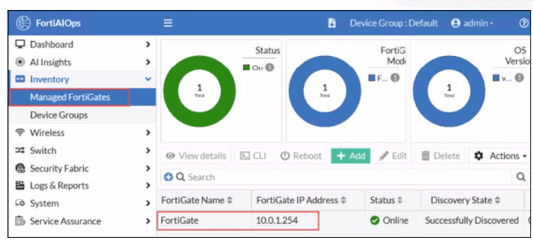
FortiGate has been added to FortiAIOps for management.
Which step must be performed on FortiAIOps to add a FortiSwitch device connected to the recently added FortiGate?
Answer : C
In a LAN Edge deployment:
FortiSwitch is managedthrough FortiGate via FortiLink.
FortiAIOps integrates withFortiGateas the single managed device; from there it gains visibility intoall Fabric and LAN-edge devices(FortiSwitch, FortiAP) that are registered to that FortiGate.
Once the FortiGate is successfully added to FortiAIOps (as shown in the exhibit, statusOnline / Successfully Discovered), all FortiSwitches managed by that FortiGate are:
Discovered automatically through the FortiGate--FortiAIOps connection
Shown under the appropriate inventory / switch views withno separate onboarding stepfor each switch.
This is why no extra IP, serial number, or credential entry is required for FortiSwitch.
So:
AandBsuggest manual per-switch onboarding, which is not how FortiAIOps works with LAN Edge.
Dsimilarly assumes direct FortiSwitch management, but FortiAIOps talks toFortiGate, not the switch.
Therefore the correct behavior is that theFortiSwitch is added automatically (C)once its managing FortiGate is connected to FortiAIOps.
In addition to requiring a FortiAnalyzer device to configure the Security Fabric, which license must be added to FortiAnalyzer to use Indicators of Compromise (IOC) rules?
Answer : D
FortiAnalyzer requires a specific license to evaluateIndicators of Compromise (IOC).
From theFortiAnalyzer 7.4.1 Administration Guide:
IOC identification requires theThreat Detection Servicelicense on FortiAnalyzer.
This license enables:
IOC database updates
Compromised host detection
Event correlation based on FortiGuard threat intelligence
Fabric-wide IOC automation triggers
Why the other answers are incorrect:
A: IoT Security add-on is unrelated to IOC rules.
B: There isnoIOC subscription license type for FortiAnalyzer.
C: FAZ-Basic license doesNOTinclude IOC detection.
Which statement about generating a certificate signing request (CSR) for a CER certificate is true?
Answer : A
The FortiOS documentation explicitly states that a CSR used for certificate signing must contain accurate and valid fields, especially:
Common Name (CN)
Organization (O)
Country (C)
Public key parameters
According to the FortiGate certificate section:
Incorrect CSR field information can cause the CA to reject the request.
Reasons include:
The CA validates identity and organizational information.
Missing or malformed data invalidates PKI requirements.
The CSR is not corrected automatically by the CA.
Therefore:
A is correct.
Options B--D contradict PKI principles:
B is false: CAs do not issue certificates with mismatched identity fields for public trust.
C is false: CSR fields are not only for internal use; they define certificate identity.
D is false: CAs do not auto-correct CSR fields.