These Fortinet NSE7_SSE_AR-26 sample questions are a small glimpse of our full set of Fortinet NSE7_SSE_AR-26 actual questions. They give you a preview of what the real NSE7_SSE_AR-26 exam might look like and the contents of Pass4Future's premium Fortinet NSE7_SSE_AR-26 product. You must not underestimate the value of Fortinet NSE7_SSE_AR-26 practice exam questions, as they allow you to understand the actual Fortinet NSE 7 - SASE 26 Architect exam in greater depth. Using them will save your time and money otherwise wasted in Fortinet NSE 7 - SASE 26 Architect exam reattempts. Study guides and tutorials provide you with theoretical details about the NSE7_SSE_AR-26 exam; these NSE7_SSE_AR-26 practice exam questions prepare you to pass the exam. Get Pass4Future's premium access to continue your NSE7_SSE_AR-26 exam practice with the complete set of Fortinet NSE7_SSE_AR-26 realistic questions. Our Fortinet NSE7_SSE_AR-26 practice questions come in various formats; make sure to check out the details and free demo of each format.
Do you know that you can access more real Fortinet NSE7_SSE_AR-26 exam questions via Premium Access? ()
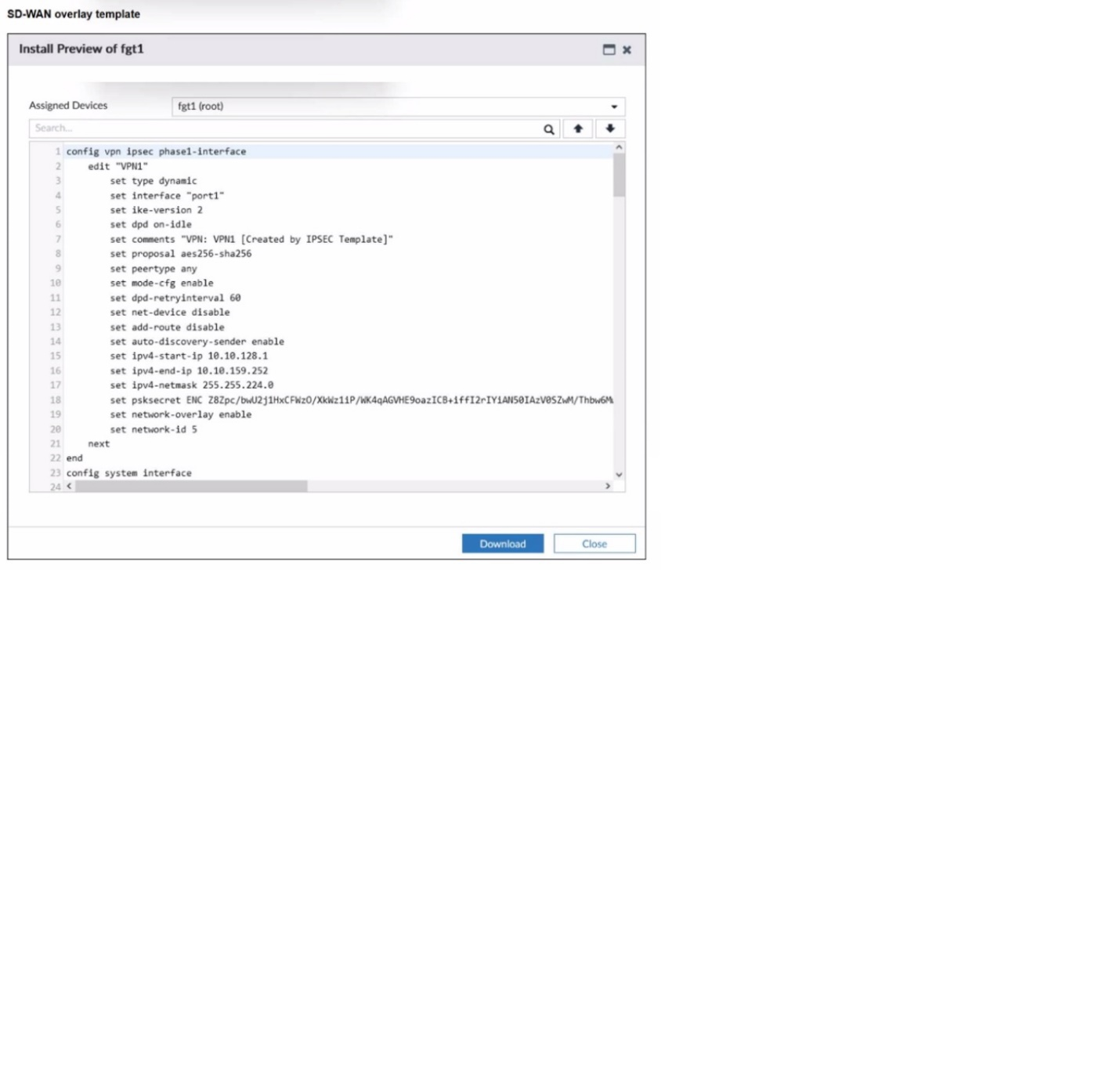
Refer to the exhibit. The administrator used the SD-WAN overlay template to prepare an IPsec tunnels configuration for a hub-and-spoke SD-WAN topology. The exhibit shows the FortiManager installation preview for one FortiGate device. Based on the exhibit, which statement best describes the configuration applied to the FortiGate device?

Exhibit 1
Answer : B
The FortiManager SD-WAN overlay template preview, as described in the document, indicates:'When the device is acting as a hub, the configuration enables the sending of ADVPN shortcut offers to spokes. This means the hub can facilitate on-demand dynamic shortcut tunnel creation between spokes, improving performance for branch-to-branch communication by bypassing the hub for inter-branch traffic after initial discovery.'Such a role is critical in scalable ADVPN topologies, enabling hub devices to optimize overlays dynamically. An operational review should distinguish the rule that matches the traffic from the interface that is ultimately selected. Valid forwarding also depends on destination route eligibility, current member state and the applicable SLA or quality-selection algorithm. A diagnostic showing configured members alone is not conclusive evidence that all those members will carry a particular flow. When troubleshooting, correlate the configured SD-WAN service with diagnose sys sdwan service4, the live session entry and the routing table. An application signature, an IP route and a health-check result describe different decision stages; treating them as interchangeable can produce incorrect conclusions about the egress interface.
==========
What are three characteristics of the provisioning templates available on FortiManager? (Choose three.)
Answer : C, D, E
FortiManager provisioning templates provide centralized, standardized, and scalable configuration management across FortiGate devices. They are particularly valuable in Secure SD-WAN deployments involving multiple branches, hubs, and overlay networks.
Option C is correct because a provisioning template group can contain both a system template and an SD-WAN template. System templates configure device-level settings, while SD-WAN templates define interfaces, zones, performance SLAs, and traffic-steering rules. FortiManager coordinates their installation according to configuration dependencies.
Option D is correct because CLI template groups support different template types, specifically standard CLI scripts and Jinja scripts. CLI scripts contain FortiOS commands, while Jinja templates support dynamic configuration generation using variables and conditional logic.
Option E is correct because CLI templates within a group are processed sequentially, from top to bottom. Administrators can organize their execution order to ensure prerequisite configurations are established before dependent settings.
Option A is incorrect because current FortiManager releases support CLI and Jinja scripts, not Perl scripts as a provisioning-template type.
Option B is incorrect because a standard template group supports one IPsec tunnel template assignment, not three separate IPsec templates.
Refer to the exhibits.

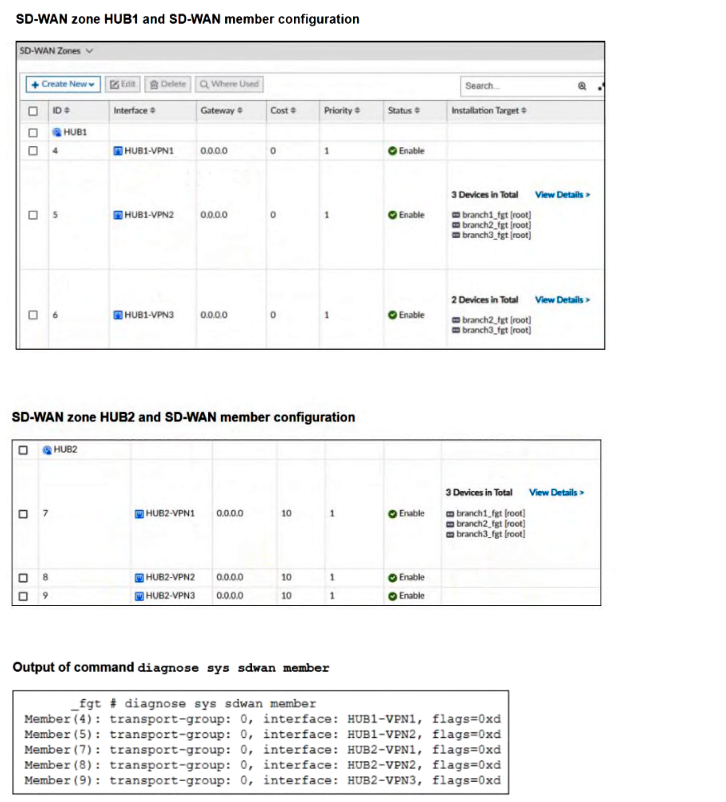
The exhibits show an SD-WAN zone HUB1 and SD-WAN member configuration from an SD-WAN template and the output of command diagnose sys sdwan member collected on a FortiGate device.
Which statement best describes what the diagnose output shows?
Answer : B
Comprehensive and Detailed Explanation From Fortinet SD-WAN 7.6 Architect / Course Guide:
FortiManager SD-WAN provisioning templates allow administrators to define installation targets for individual SD-WAN members. This enables a common template to accommodate branch devices with different WAN interfaces or overlay tunnel configurations.
Option B is correct because the diagnostic output corresponds to branch1_fgt, based on the configured installation targets and the absence of SD-WAN member ID 6.
The HUB1 zone configuration shows:
HUB1-VPN1 (ID 4): No installation target restriction; deployed to all assigned devices.
HUB1-VPN2 (ID 5): Assigned to branch1_fgt, branch2_fgt, and branch3_fgt.
HUB1-VPN3 (ID 6): Assigned only to branch2_fgt and branch3_fgt.
The diagnostic output lists members 4, 5, 7, 8, and 9, but member 6 is absent.
This matches branch1_fgt because HUB1-VPN3 is not included in that device's installation targets.
Option A is incorrect because branch2_fgt should have member 6 installed.
Option C is incorrect because the absence of a member from the diagnostic output does not establish that it is dead; it may not be configured on that device.
Option D is incorrect because the output is consistent with the template's device-specific configuration.
The determining principle is that FortiManager installs SD-WAN members according to their installation targets, and an empty installation target applies the member to all devices assigned to the template.
Which component, typically categorized under network edge connectivity rather than cloud-delivered security controls, is incorporated as a foundational element within a secure access service edge (SASE) architecture but is not considered part of a security service edge (SSE) framework?
Answer : B
Secure Access Service Edge combines enterprise network connectivity with cloud-delivered security services to provide consistent protection and optimized application access across distributed environments.
Option B is correct because Software-Defined WAN represents the networking component of SASE. It provides intelligent WAN connectivity, application-aware path selection, transport abstraction, and centralized traffic steering.
Security Service Edge, by contrast, focuses specifically on delivering security services from distributed cloud enforcement points. It does not inherently include the SD-WAN networking functions that form part of the broader SASE architecture.
Option A is incorrect because SWG is a core SSE capability that protects users against malicious websites, unwanted content, and web-based attacks.
Option C is incorrect because ZTNA is another fundamental SSE component. It implements explicit, identity-based access to authorized applications rather than granting unrestricted network connectivity.
Option D is incorrect because CASB provides visibility, governance, and security controls for cloud applications, making it part of SSE.
Fortinet implements the networking portion of unified SASE through FortiGate Secure SD-WAN and delivers SSE capabilities through FortiSASE.
Together, they provide secure internet access, secure private access, and secure SaaS access while maintaining consistent enterprise security policies across users and branch locations.
==========
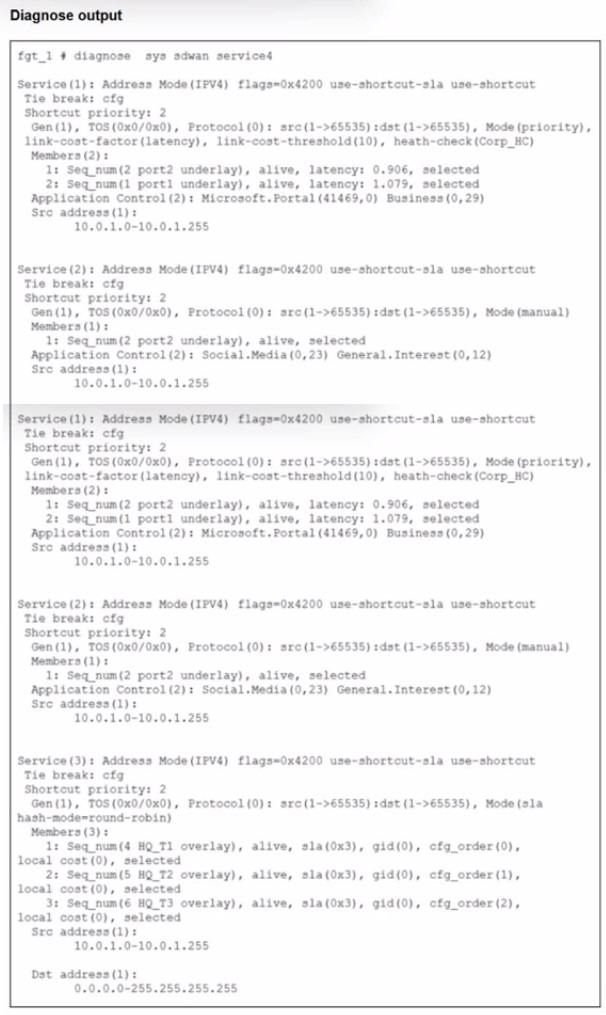
Refer to the exhibit. The exhibit shows output of the command diagnose sys sdwan service4 collected on a FortiGate device. The administrator wants to know through which interface FortiGate will steer traffic from local users on subnet 10.0.1.0/255.255.255.192 and with a destination of the social media application Facebook. Based on the exhibits, which two statements are correct? (Choose two.)

Exhibit 1
Answer : C, D
Application-based SD-WAN rules enable intelligent traffic steering. The FortiOS behavior is: 'If a flow is identified as belonging to a defined application category (such as social media), FortiGate will match it to the corresponding service rule (rule 2) and route it through the specified interface, such as port2. However, if the application is not recognized during the session setup, the system defaults to load balancing the traffic using the available tunnels according to the policy for unclassified traffic, ensuring continuous connectivity while waiting for application classification.'This guarantees both performance and resilience. An operational review should distinguish the rule that matches the traffic from the interface that is ultimately selected. Valid forwarding also depends on destination route eligibility, current member state and the applicable SLA or quality-selection algorithm. A diagnostic showing configured members alone is not conclusive evidence that all those members will carry a particular flow. When troubleshooting, correlate the configured SD-WAN service with diagnose sys sdwan service4, the live session entry and the routing table. An application signature, an IP route and a health-check result describe different decision stages; treating them as interchangeable can produce incorrect conclusions about the egress interface.
==========