Pass4Future also provide interactive practice exam software for preparing HPE Campus Access Switching Expert Written (HPE7-A06) Exam effectively. You are welcome to explore sample free HPE7-A06 Exam questions below and also try HPE7-A06 Exam practice test software.
Do you know that you can access more real HPE7-A06 exam questions via Premium Access? ()
Which EAP methods arc supported when configuring The 802.1X supplicant feature on an AOS-CX switch? (Select two.)
Answer : A, D
The question asks which EAP (Extensible Authentication Protocol) methods are supported when configuring the 802.1X supplicant feature on an AOS-CX switch (i.e., the switch acting as the client authenticating to another device).
AOS-CX 802.1X Supplicant: Allows the switch itself to authenticate using 802.1X.
Supported EAP Methods: Switch implementations typically support a subset of common EAP methods for the supplicant role. Secure methods are preferred. AOS-CX documentation for the dot1x supplicant eap-method command typically lists supported types. Common secure methods found in documentation include EAP-TLS and EAP-PEAP (usually with MSCHAPv2). EAP-MD5 is often supported but insecure.
Analysis of Options (Select Two):
A . EAP-TLS: A secure, certificate-based method commonly supported by enterprise supplicants. Likely supported.
B . EAP-TTLS: Another secure tunneled method, but PEAP is sometimes more common in switch supplicants. Support needs verification in specific AOS-CX docs.
C . EAP-MD5: Simple challenge-response, but insecure. Often supported for legacy reasons.
D . EAP-PEAP: Secure tunneled method using server-side certificate and typically username/password (MSCHAPv2) inside. Commonly supported.
E . EAP-TEAP: A newer tunneled method, less likely to be supported than PEAP/TLS in switch supplicants.
Conclusion: Based on typical enterprise requirements and likely AOS-CX capabilities documented for the supplicant feature, the secure methods EAP-TLS (A) and EAP-PEAP (D) are the most probable supported options among the choices.
Exhibit.


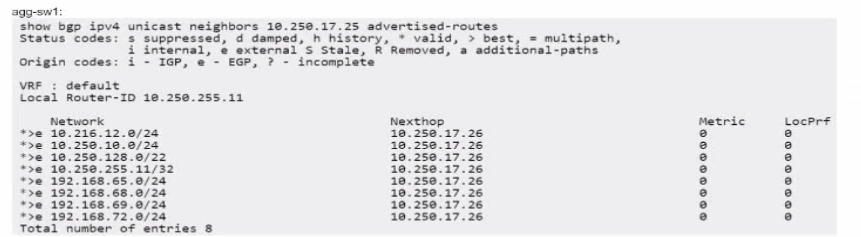
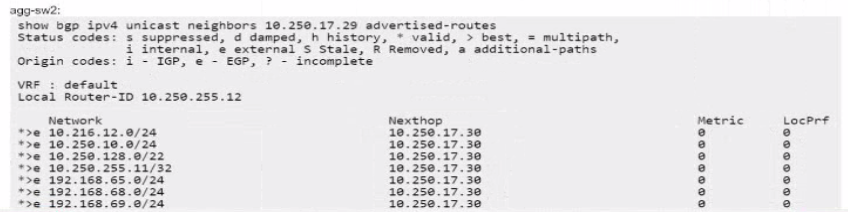
AGG-SW1 and AGG-SW2 are configured with iBGP and eBGP to AS65000. Both agg-sw1 and agg-sw2 use route-map BGP-EXPORT and ip-prefix list local-export in the bgp configuration.
What must be done on agg-swl for the adjacent router to prefer to route all exported routes by agg-sw2?
Answer : B
The goal is to make the adjacent router prefer routes exported by AGG-SW2 over AGG-SW1 for iBGP and eBGP routes to AS65000. Both switches use a route-map BGP-EXPORT with an ip-prefix list local-export. BGP path selection uses attributes like local preference, AS path length, and metric to determine the preferred route.
Analysis of Options:
Option A: Setting local-preference 200 affects iBGP route selection within the same AS but has no impact on eBGP peers (external AS65000), as local preference is not advertised externally.
Option B: Prepending the AS path with 65345 65345 65345 65345 increases the AS path length for routes exported by AGG-SW1, making them less preferred by the adjacent router (both iBGP and eBGP peers) compared to AGG-SW2's routes, which have a shorter AS path.
Option C: Setting metric 200 affects the MED (Multi-Exit Discriminator), which is used for eBGP route selection within the same AS but is less influential than AS path length and not applicable for iBGP.
Option D: Incorrect syntax (set as-path without prepend) and does not achieve the desired effect.
Why Option B is Correct: BGP route selection prioritizes the shortest AS path for both iBGP and eBGP. By prepending AS 65345 multiple times to AGG-SW1's exported routes, AGG-SW1's routes appear less attractive due to a longer AS path, causing the adjacent router to prefer AGG-SW2's routes. This is a standard BGP traffic engineering technique.
Relevance to Certification Objectives:
Routing (16%): Involves designing and troubleshooting BGP routing topologies, including manipulating path attributes like AS path.
Troubleshooting (10%): Includes remediating BGP routing issues by adjusting route-maps.
HPE Aruba Networking AOS-CX Configuration Guide: BGP Configuration, covering route-maps and AS path prepending.
HPE7-A06 Study Guide: Details BGP path selection and traffic engineering.
HPE Aruba Networking Technical Documentation: BGP Route Manipulation, explaining AS path prepending for route preference.
Refer to the exhibit which illustrates the current configuration of Router-1.

Clients of VLAN 10 require access to services hosted in the 10.1.100.0/24 subnet. This 'equites one 01 more routes to be added to Rculer-1 that do not currently exist.
Which script would install a route from 10.2.10.0/24 to 10.1.100.0/24 on Router-1? A return path is not required as part of this answer.
Answer : D
The goal is to add a static route on Router-1 to allow clients in VLAN 10 (subnet 10.2.10.0/24, presumably in VRF 'IoT-Medical' based on options) to reach services in the 10.1.100.0/24 subnet. The exhibit indicates interface 1/1/1 (IP 10.255.101.10/24) is in VRF 'service', and the likely next hop towards the destination is Core-1 at 10.255.101.11 (also implied to be reachable via VRF 'service'). This requires adding a route in the source VRF ('IoT-Medical') pointing towards the destination via the next hop in the 'service' VRF.
Static Route Syntax (with VRF): ip route <destination_prefix> <next-hop-ip> [vrf <source-vrf>]
Analysis of Options:
A: Claims Core-1 isn't in VRF 'service', contradicting the likely setup.
B: Uses unusual interface:ip syntax (1/1/1:10.255.101.11). Defines the route in VRF 'IoT-Medical'.
C: Uses interface 1/1/1 as the next hop. This is less specific than using the IP address and relies on the interface being point-to-point or having proxy ARP enabled. Defines the route in VRF 'IoT-Medical'.
D: ip route 10.1.100.0/24 10.255.101.11 vrf IoT-Medical. This uses the standard syntax to define a static route for the destination 10.1.100.0/24 via the next-hop IP 10.255.101.11 within the context of the IoT-Medical VRF. The successful function of this route depends on inter-VRF routing (route leaking) being configured between 'IoT-Medical' and 'service' VRFs, but the command itself correctly defines the desired static route.
Conclusion: Option D provides the correct and standard command syntax to configure the required static route within the specified source VRF ('IoT-Medical').
An administrator is monitoring third-party WLAN transmitters m HPE Aruba Networking Central and some of them are classified as rogue and suspected rogue How are suspected rogues classified when using the default classification method for the rule "Suspected AP On-Prem" in HPE Aruba Networking Central?
Answer : A
The question asks how suspected rogue APs are classified using the default classification method for the ''Suspected AP On-Prem'' rule in HPE Aruba Networking Central.
Analysis of Options:
Option A: Correct. Suspected rogues are classified with a signal level of -65 dBm (indicating proximity) and WLAN classification of ''On-Prem'' (indicating they are on the premises).
Option B: Incorrect. A signal level of -55 dBm is too strong, and ''Interfering'' is not specific to on-premises rogues.
Option C: Incorrect. A signal level of -50 dBm is even stronger, and ''Interfering'' is incorrect.
Option D: Incorrect. ''On Wire'' classification applies to wired rogue detection, not wireless on-premises APs.
Why Option A is Correct: In HPE Aruba Networking Central, the ''Suspected AP On-Prem'' rule identifies rogue APs based on their signal strength and location. A signal level of -65 dBm indicates the AP is close enough to be on the premises, and the ''On-Prem'' classification confirms it's detected within the managed network's environment. This default rule helps identify potential security threats by flagging unauthorized APs with moderate to strong signals, distinguishing them from interfering or distant APs, as per Aruba's wireless security framework.
Relevance to Certification Objectives:
WLAN (9%): Designing and troubleshooting RF attributes and wireless security functions.
Security (10%): Troubleshooting and identifying rogue APs in customer networks.
Troubleshooting (10%): Analyzing wireless issues using Aruba Central tools.
HPE Aruba Networking Central User Guide: Rogue AP Detection and Classification.
HPE7-A06 Study Guide: Covers wireless security and rogue AP management.
HPE Aruba Networking Technical Documentation: Wireless Security and Rogue Detection Best Practices.
Which is a best practice for configuring GBP?
Answer : D
The question asks for a best practice when configuring Group-Based Policy (GBP). GBP simplifies policy management by assigning users/devices to roles and defining policies between these roles, often leveraging dynamic assignment from an authentication server.
GBP Concepts: Policies are typically defined based on source and destination roles. Roles can be assigned statically on the switch or dynamically via an authentication server like ClearPass.
Analysis of Options:
A & C: Policies define interactions between roles (source role to destination role). These roles can be the same (intra-role policy) or different (inter-role policy). Neither option represents a singular 'best practice' for all configurations.
B: Using Static User Roles (SUR) is possible but less flexible and scalable than dynamic assignment for large or complex environments.
D: Using Downloadable User Roles (DUR) is generally considered a best practice. DUR allows roles and associated policies (including GBP attributes like GPID) to be centrally defined on an authentication server (e.g., ClearPass) and dynamically assigned to users/devices upon successful authentication. This provides scalability, consistency, and easier management.
Conclusion: Leveraging Downloadable User Roles (DUR) from a central authentication server like ClearPass is a best practice for implementing scalable and manageable Group-Based Policies.