These HPE7-A10 sample questions are a small glimpse of our full set of HPE7-A10 actual questions. They give you a preview of what the real HPE7-A10 exam might look like and the contents of Pass4Future's premium HPE7-A10 product. You must not underestimate the value of HPE7-A10 practice exam questions, as they allow you to understand the actual HPE Network Security Expert Written Exam in greater depth. Using them will save your time and money otherwise wasted in HPE Network Security Expert Written Exam reattempts. Study guides and tutorials provide you with theoretical details about the HPE7-A10 exam; these HPE7-A10 practice exam questions prepare you to pass the exam. Get Pass4Future's premium access to continue your HPE7-A10 exam practice with the complete set of HPE7-A10 realistic questions. Our HPE7-A10 practice questions come in various formats; make sure to check out the details and free demo of each format.
Do you know that you can access more real HPE7-A10 exam questions via Premium Access? ()
Refer to the exhibit.

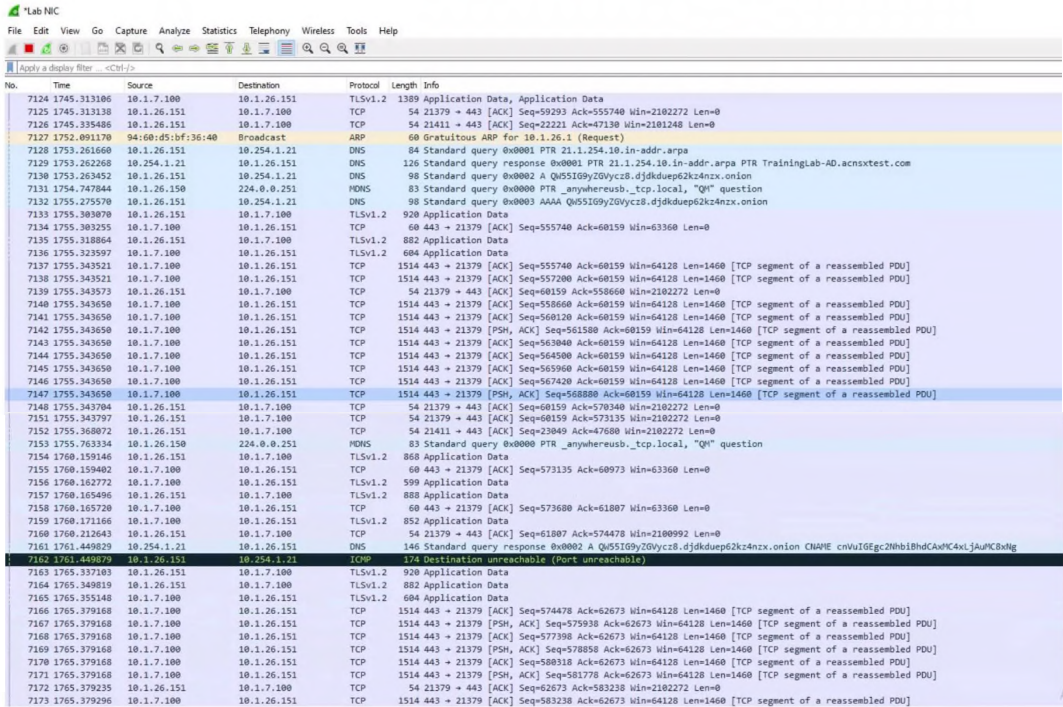
Frame 7128: 10.1.26.151 -> 10.254.1.21 DNS Standard query 0x0001 PTR 21.1.254.10.in-addr.arpa
Frame 7130: 10.1.26.151 -> 10.254.1.21 DNS Standard query 0x0002 A Qw5SIG9yZGvycz8.djdkduep62kz4nzx.onion
Frame 7147: 10.1.26.151 -> 10.1.7.100 TCP 443 -> 21379 [PSH, ACK]
Frame 7162: 10.1.26.151 -> 10.254.1.21 ICMP Destination unreachable (Port unreachable)
Which IP address should be recorded as a potentially compromised client?
Answer : B
In network traffic forensic analysis, identifying a compromised host involves evaluating packet flows for known malicious patterns, such as command-and-control (C2) beaconing, protocol anomalies, and Tor network resolution.
Reviewing the exhibit's packet capture reveals that host `10.1.26.151` is the source of multiple anomalous requests:
1. In Frame 7130, host `10.1.26.151` initiates a standard DNS query destined for server `10.254.1.21` attempting to resolve a cryptographic Tor hidden service domain (`*.onion`). Standard endpoints do not resolve Tor `.onion` addresses through enterprise DNS servers unless running malicious payloads or unauthorized anonymizing proxy software.
2. The packet trace shows ongoing outbound TCP sessions between `10.1.26.151` and internal/external endpoints with high packet lengths and continuous push acknowledgments.
IP `10.254.1.21` acts as the enterprise DNS server responding to queries, `10.1.26.1` represents the local default gateway (as evidenced by gratuitous ARP), and `10.1.7.100` represents an internal destination peer. Therefore, the internal endpoint initiating the anomalous traffic is `10.1.26.151`.
A customer operates an HPE Aruba Networking ClearPass cluster. The customer has AOS-CX switches that use 802.1X authentication with HPE Aruba Networking ClearPass Policy Manager (CPPM).
The switches use local port-access policies. The customer wants to begin tunneling wired clients that pass only user authentication to an HPE Aruba Networking gateway cluster. The gateway cluster must assign these clients the eth-internet role. The gateway must also assign the clients to VLAN 20.
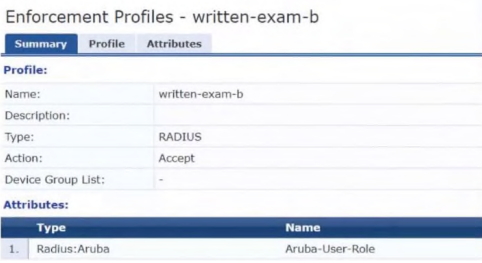
The intended enforcement policy and profiles are shown below:
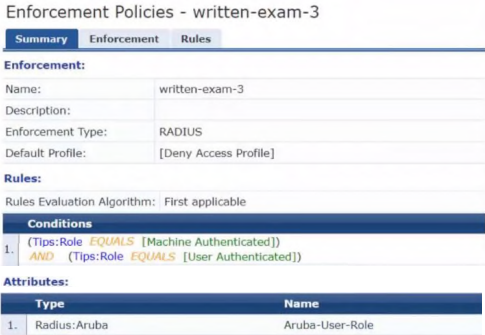
* Policy: `written-exam-3`
* Profile: `written-exam-b`
The gateway cluster contains two gateways with the following IP addresses:
Gateway 1: VLAN 4085 (system IP) = 10.20.4.21 | VLAN 20 (users) = 10.20.20.1 | VLAN 4094 (WAN) = 198.51.100.14
Gateway 2: VLAN 4085 (system IP) = 10.20.4.22 | VLAN 20 (users) = 10.20.20.2 | VLAN 4094 (WAN) = 198.51.100.12 | VRRP on VLAN 20 = 10.20.20.254
The customer needs high availability for tunnels between the switches and the gateway cluster. If one gateway fails, the other gateway must take over its tunnels. The switch must also be able to discover the gateway cluster even if one gateway in the cluster is unavailable.
Refer to the scenario. Assume that `myzone` is the name used for the UBT zone.
Which option is a valid minimal configuration for the AOS-CX port-access roles?
Answer : B
In an AOS-CX Dynamic Segmentation architecture using User-Based Tunneling (UBT) in Local VLAN / Reserved VLAN mode, the role assignment and forwarding plane are split between the switch and the gateway cluster.
When a client authenticates via 802.1X, ClearPass sends a RADIUS Access-Accept returning the AOS-CX local port-access role (e.g., `internet-only`). Within the AOS-CX role definition, the command:
`port-access role internet-only gateway-zone zone myzone gateway-role eth-internet` instructs the switch to redirect the client's traffic into the UBT tunnel bound to `myzone` and pass the gateway-role token `eth-internet` to the gateway cluster.
VLAN 20 must not be configured in the switch's local role definition (`vlan access 20`). In Local VLAN mode, the gateway terminates the GRE tunnel, assigns the client to VLAN 20, and handles Layer 3 routing and firewall filtering. Assigning VLAN 20 locally on the switch edge port creates a configuration conflict with the local UBT transport VLAN. Therefore, the minimal and accurate role configuration specifies the gateway-zone and gateway-role without local VLAN access assignment.
Your company has an HPE Aruba Networking infrastructure that includes a variety of HPE Aruba Networking APs and gateways. The company has recently added HPE Aruba Networking SSE. The company needs to enhance security for branch users behind an HPE Aruba Networking SD-WAN gateway.
You need to control users' actions across various SaaS applications. What is included in the setup?
Answer : C
HPE Aruba Networking Security Service Edge (SSE) provides cloud-delivered security services, including Cloud Access Security Broker (CASB), Secure Web Gateway (SWG), and Zero Trust Network Access (ZTNA). Controlling user actions inside SaaS applications (such as preventing file uploads to personal OneDrive while allowing enterprise SharePoint access) requires CASB inline inspection and deep SSL decryption.
To apply SSE policies to on-premises branch users situated behind an HPE Aruba Networking SD-WAN Gateway, branch internet traffic must be steered to the nearest HPE Aruba Networking SSE cloud enforcement node. HPE Aruba Networking Central orchestrates this connectivity by establishing automated primary and secondary IPsec tunnels directly from the branch gateways to the SSE points of presence (PoPs). Once the Central-orchestrated IPsec tunnels are active, routing and policy rules direct designated SaaS traffic into the tunnel, where the cloud SSE policy engine applies granular user- and tenant-level access restrictions.
A customer is migrating from on-premises AD to Microsoft Entra ID (Azure AD) as its only domain solution. The customer also manages wired and wireless devices with Microsoft Endpoint Manager (Intune).
The customer wants to strengthen network-edge security. You are assisting with the design of an HPE Aruba Networking ClearPass deployment for this purpose. HPE Aruba Networking devices will authenticate wireless and wired clients to a ClearPass Policy Manager (CPPM) cluster that uses version 6.10.
The customer has several authentication requirements. Clients should pass EAP-TLS authentication only when a query to Microsoft Entra ID (Azure AD) confirms that they have accounts in Microsoft Entra ID (Azure AD). To further refine client privileges, ClearPass must also use information gathered by Intune to make access-control decisions.

Extension Configuration:
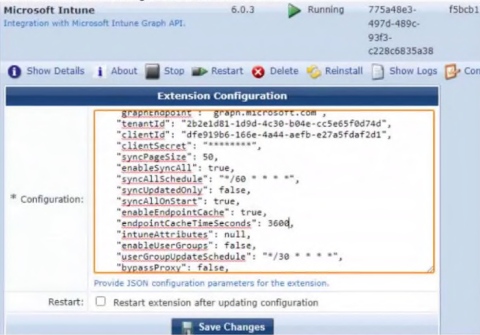
graphEndpoint: graph.microsoft.com
syncPageSize: 50
enableSyncAll: true
syncAllSchedule: "*/60 * * * *"
syncUpdatedOnly: false
syncAllOnStart: true
enableEndpointCache: true
endpointCacheTimeSeconds: 3600
enableUserGroups: false
Refer to the scenario.
The Intune extension is configured as shown in this exhibit.
The customer wants to reduce the overhead of polling information from Intune to CPPM, but requires client information to be current at least once per hour. What should you recommend?
Answer : D
The ClearPass Microsoft Intune Extension synchronizes device posture, compliance status, and hardware attributes from Microsoft Graph API into ClearPass Policy Manager's local database.
In the exhibited configuration, `syncUpdatedOnly` is set to `false`, and `syncAllSchedule` is set to poll every 60 minutes (`*/60 * * * *`). With `syncUpdatedOnly` disabled, the extension executes a full synchronization on every hourly interval, pulling the entire inventory of Intune endpoints. This generates significant network overhead, consumes excessive Graph API throttling limits, and creates unnecessary database write cycles on ClearPass.
Changing `syncUpdatedOnly` to `true` activates delta querying via the Microsoft Graph delta API. Under this setting, the extension queries and downloads only endpoint records that have changed, updated, or enrolled since the previous synchronization run. Because the synchronization schedule remains configured for once every hour, the data remains fully refreshed at least hourly while drastically reducing API calls, processing latency, and server overhead.
Refer to the exhibit.

Packet trace display:
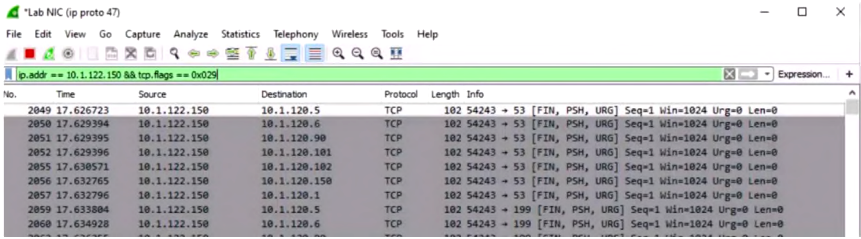
Source: 10.1.122.150 -> Destination: 10.1.120.5 TCP 54243 -> 53 [FIN, PSH, URG] Seq=1 Win=1024 Urg=0 Len=0
Source: 10.1.122.150 -> Destination: 10.1.120.6 TCP 54243 -> 53 [FIN, PSH, URG] Seq=1 Win=1024 Urg=0 Len=0
Source: 10.1.122.150 -> Destination: 10.1.120.90 TCP 54243 -> 53 [FIN, PSH, URG] Seq=1 Win=1024 Urg=0 Len=0
Source: 10.1.122.150 -> Destination: 10.1.120.101 TCP 54243 -> 53 [FIN, PSH, URG] Seq=1 Win=1024 Urg=0 Len=0
Source: 10.1.122.150 -> Destination: 10.1.120.5 TCP 54243 -> 199 [FIN, PSH, URG] Seq=1 Win=1024 Urg=0 Len=0
What does this indicate?
Answer : A
The Wireshark display filter tcp.flags == 0x029 isolates TCP packets where the FIN (bit 0x001), PSH (bit 0x008), and URG (bit 0x020) control bits are simultaneously set (0x001 + 0x008 + 0x020 = 0x029). In network security and reconnaissance analysis, this combination of flags is the definition of a TCP Xmas Tree Scan.
Under RFC 793 specifications, any closed TCP port receiving a packet that lacks a SYN, ACK, or RST bit must respond with a TCP RST frame, whereas an open listening port is required to silently drop the packet. Scanning tools (such as Nmap) utilize Xmas scans to probe target operating systems and determine port states while attempting to bypass stateless access control lists and legacy firewalls.
The exhibit demonstrates host 10.1.122.150 sequentially transmitting Xmas probes to multiple consecutive host IP addresses (10.1.120.5, 10.1.120.6, 10.1.120.90, etc.) across various destination ports (such as port 53 and port 199). This confirms active network reconnaissance attempting to identify open services on subnet 10.1.120.0/24.