Pass4Future also provide interactive practice exam software for preparing HP Advanced HPE Storage Integrator Solutions Written (HPE7-J02) Exam effectively. You are welcome to explore sample free HPE7-J02 Exam questions below and also try HPE7-J02 Exam practice test software.
Do you know that you can access more real HPE7-J02 exam questions via Premium Access? ()
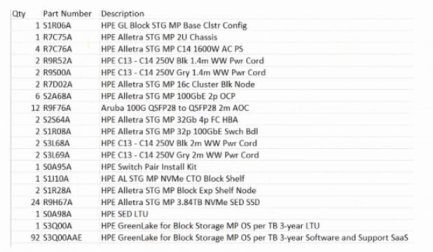
Refer to the exhibit.

Your customer had an unexpected failure of their current storage array, causing them to lose some of their critical dat
a. As a result, they are looking for a storage array with a guarantee of 100% data availability to prevent this failure and loss in the future.
They need 80TB raw and two new 25GbE top-of-rack switches to connect to their environment.
They expect 5% annual growth.
Which correction should be made to the configuration in the exhibit to meet the customer's requirements?
Answer : A
Detailed Explanatio n:
Rationale for Correct Answe r:
The exhibit shows the use of 32Gb FC HBAs and 100GbE switches (Aruba 100G). However, the customer specifically requires 25GbE top-of-rack switches. Therefore, the configuration needs to be corrected to 25GbE networking. The HPE Alletra MP B10000 guarantees 100% data availability SLA, so the primary correction is networking alignment, not drives or financial model.
Distractors:
B: Reducing drives reduces raw capacity below 80TB requirement.
C: GreenLake is a consumption model but not the technical correction required.
D: Aruba 8325 is a core switch option; customer only asked for ToR 25GbE.
Key Concept: Networking alignment with requirements.
Your organization is implementing a new high-performance computing (HPC) cluster to support advanced scientific simul-ations. The cluster will consist of several hundred nodes that require rapid access to shared datasets. The storage is Vast/GL4F.
The application is very sensitive to latency and minimizing CPU overhead during data transfers is critical to achieving the desired performance levels.
Which access protocol should the organization implement to enhance NFS performance by reducing storage latency and increasing I/O operations?
Answer : B
Detailed Explanatio n:
Rationale for Correct Answe r:
For HPC and AI/ML workloads, NFS over RDMA (Remote Direct Memory Access) provides significantly lower latency and reduced CPU overhead compared to standard NFS over TCP. This allows direct memory-to-memory data transfers between storage and compute nodes, bypassing the kernel network stack. In VAST Data (underpinning GreenLake for File Storage), NFS over RDMA is explicitly supported to accelerate shared dataset access in HPC and AI environments.
Distractors:
A: Standard NFS introduces more latency due to kernel TCP/IP stack overhead.
C: RoCE (RDMA over Converged Ethernet) is a transport layer technology --- useful, but the protocol chosen for the file system must be NFS over RDMA, not just RoCE.
D: iSER (iSCSI Extensions for RDMA) enhances iSCSI block storage, not NFS file workloads.
Key Concept: NFS over RDMA for HPC/AI shared datasets.
A global financial services company is looking to enhance its disaster recovery (DR) capabilities. They operate VMware workloads across multiple data centers and a mix of AWS and Azure cloud workloads. They need a solution that can replicate data with near-zero recovery point objectives (RPOs) and orchestrate rapid recovery of critical applications in case of a site-wide failure.
Answer : A
Detailed Explanatio n:
Rationale for Correct Answe r:
Zerto, now part of HPE, provides continuous data protection (CDP) with near-zero RPOs and very low RTOs. It supports VMware workloads, as well as hybrid cloud deployments with AWS and Azure. Zerto is specifically designed for disaster recovery orchestration, enabling automated failover, failback, and application-consistent protection across sites and cloud environments.
Distractors:
B (CommVault): Primarily a backup/recovery and data management platform --- RPOs are not near-zero.
C (Cohesity): Strong in backup, secondary storage, and ransomware recovery, but not near-zero RPO DR orchestration.
D (SimpliVity): Hyperconverged infrastructure with built-in backup, but not optimized for large-scale multi-cloud DR.
Key Concept: Continuous Data Protection (Zerto) for hybrid/multi-cloud disaster recovery.
Your customer is deploying HPE Morpheus Enterprise Software as a single orchestration platform for compute and storage resources. To achieve a high-availability deployment in a single site, how many VMs must be deployed if distributed databases are not required?
Answer : C
Detailed Explanatio n:
Rationale for Correct Answe r:
HPE Morpheus can run as a single VM in non-critical environments, but for high availability (HA) without distributed databases, the recommendation is to deploy 3 VMs in a cluster. This ensures quorum and redundancy across application nodes, protecting against single VM failure. Distributed database mode requires more VMs, but is not needed in this scenario.
Distractors:
A: 4 VMs are required only if distributed DB is enabled (PostgreSQL cluster), not here.
B/D: A single VM (with or without VMware HA) doesn't provide native Morpheus HA resilience.
Key Concept: Morpheus HA = 3-node cluster minimum without distributed DB.
A local startup company has grown rapidly and now needs block storage for enterprise workloads. They are virtualized with VMware and have a small IT staff. They are evaluating an HPE Alletra MP and a Pure FlashArray //X90R4.
Environment:
VMware 8.0
Cisco switches
Dell servers
HPE servers
What statement about HPE should you point out as a differentiator?
Answer : A
Detailed Explanatio n:
Rationale for Correct Answe r:
HPE Alletra with InfoSight provides end-to-end visibility from infrastructure through to virtual machines and applications. It offers prescriptive, AI-driven recommendations to simplify management --- a key differentiator for startups with small IT staff. Pure arrays do not offer the same level of integrated, cross-stack predictive analytics.
Distractors:
B: ''ActiveWorkload'' is not an HPE feature --- HPE uses Peer Persistence for stretch clusters.
C: Garbage collection is managed automatically in HPE arrays; disabling it is not supported.
D: Data tiering is not natively provided as ''software-only'' --- HPE uses GreenLake and Alletra services.
Key Concept: InfoSight = predictive analytics and app-to-infra visibility differentiator.