Pass4Future also provide interactive practice exam software for preparing Huawei HCIP-Security-CISN V3.0 (H12-721) Exam effectively. You are welcome to explore sample free Huawei H12-721 Exam questions below and also try Huawei H12-721 Exam practice test software.
Page: 1
/ 14 Total 217 questions
Do you know that you can access more real Huawei H12-721 exam questions via Premium Access? ()
Question 1
Site to Site IPSec VPN negotiation failed. Which of the following should be checked? 1. Network connectivity issues; 2. View the establishment of IKE phase 1 security associations and related configurations; 3. View the establishment of IKE phase 2 security associations and related configurations; 4. See if the security ACLs at both ends mirror each other.
Answer : A
Question 2
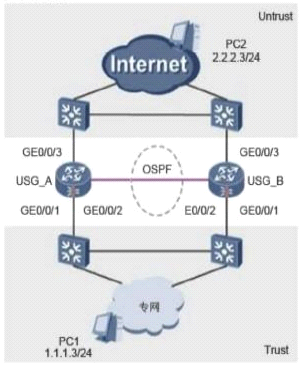
The USG_B status is HRP_M[USG_A], and the USG_B status is HRP_S[USG_B]. The status of the USG_A is HRP_M[USG_A]. However, all traffic did not pass USG_A completely, and half of the traffic also passed USG_B.
Answer : D
Question 3
If the IPSec policy is configured in the policy template and sub-policy mode, the firewall applies the policy template first and then applies the sub-policy.
Answer : B
Note: Choose template mode or non-template mode: There are three main modes depending on the characteristics of the peer device: First, remote mobile client access, do not know the client IP address, can not configure remote-address, can only be used Template mode + barbarian mode name authentication; second, communication between two branches, IP address is fixed, non-template mode is used; third, branch office is not fixed IP, then the headquarters uses policy template mode, branch use Strategy mode.
Question 4
In the active/standby mode of the USG dual-system hot backup, the service interface works at Layer 3, and the upstream and downstream routers are connected. The administrator checks that the USG_A state has been switched to HRP_M[USG_A] and the USG_B state is also HRP_M[USG_B]. What are the most likely reasons?
Answer : A, B
Question 5
USG A and USG B are configured with a static BFD session. The following is true about the process of establishing and tearing down a BFD session.
Answer : C, D
Note: 1. USG A and USG B each start the BFD state machine. The initial state is Down and the BFD packet is Down. For a static BFD session, the value of the Your Discriminator is specified by the user. For the dynamic BFD session, the value of the Your Discriminator is 0. 2. After receiving the BFD packet whose status is Down, the USG B switches to Init. And send a BFD packet with the status of Init. 3. If the local BFD state of USG B is Init, the packets of the received state are Down. 4. The BFD state of USG A is the same as that of USG B. 5. After receiving the BFD packet in the Init state, the local state is switched to Up. 6. The BFD status of USG A changes with USG B. 7. After the state transition of 'DOWN-->INIT' occurs on USG A and USG B, a timeout timer is started. If the BFD packet is in the Init or Up state, the local state is automatically switched back to Down.