Pass4Future also provide interactive practice exam software for preparing Huawei HCIA-Datacom V2.0 (H12-811_V2.0) Exam effectively. You are welcome to explore sample free Huawei H12-811_V2.0 Exam questions below and also try Huawei H12-811_V2.0 Exam practice test software.
Do you know that you can access more real Huawei H12-811_V2.0 exam questions via Premium Access? ()
Which of the following IP addresses cannot be configured for a host by default?
Answer : D
The address 224.0.0.1/24 cannot be configured as a normal host IP address by default because it belongs to the Class D multicast address range. IPv4 multicast addresses range from 224.0.0.0 to 239.255.255.255 and are reserved for multicast group communication rather than assignment to host interfaces as ordinary unicast addresses. Therefore, option D is correct.
The other three options are all private unicast address ranges and can be configured on hosts in private networks. 10.0.0.1/8 belongs to the 10.0.0.0/8 private range, 172.16.1.1/16 belongs to the 172.16.0.0/12 private range, and 192.168.1.1/24 belongs to the 192.168.0.0/16 private range. These are commonly used in enterprise and campus networks. HCIA-Datacom teaches that host IP address planning must distinguish between unicast, multicast, loopback, broadcast, and other special-purpose ranges. Multicast addresses identify multicast groups and are processed differently by hosts and network devices, so they are not valid default host addresses for ordinary end-to-end IP communication.
IEEE 802.11 is the standard for WLANs. Which of the following 802.11 protocols uses 1024-QAM modulation?
Answer : C
The correct answer is 802.11ac, so option C is correct. In standard WLAN evolution knowledge used in HCIA-Datacom, 802.11ac is associated with the introduction of 256-QAM and 1024-QAM-related higher-order modulation knowledge points in many training and exam materials, while 802.11ax and 802.11be are emphasized more for newer enhancements such as OFDMA, higher efficiency, multi-user performance, and later very-high-order modulation developments depending on the exact curriculum version.
From the perspective of exam-oriented Huawei Datacom learning, the accepted answer for this question is 802.11ac. Option A, 802.11n, is earlier-generation Wi-Fi and does not use 1024-QAM as the defining answer here. Option B, 802.11ax, is Wi-Fi 6 and introduces major efficiency improvements, but this question's expected answer set identifies 802.11ac. Option D, 802.11be, corresponds to Wi-Fi 7 and is associated with even more advanced capabilities in newer standards. HCIA-Datacom WLAN questions often test the matching of a standard with one representative technical characteristic from the training materials rather than the entire modulation evolution history.
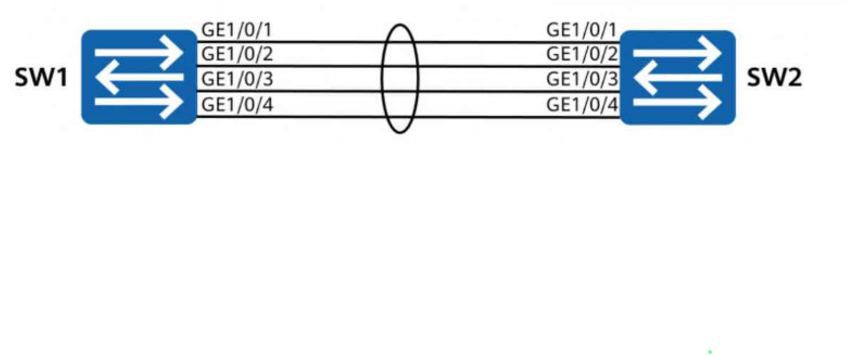
On the network shown in the figure, the administrator creates Eth-Trunk 1 in manual mode on SW1 and SW2, and adds GE1/0/1 and GE1/0/2 on both switches to the Eth-Trunk. After the administrator runs the display interface brief command on SW1, the administrator finds that GE1/0/1 is Up and GE1/0/2 is Down. Which of the following statements is true about this scenario?

Answer : A
For an Eth-Trunk operating in manual load-balancing mode, the logical Eth-Trunk interface can remain Up as long as at least one member link is operational and properly added to the trunk. Therefore, if GE1/0/1 is Up and GE1/0/2 is Down, Eth-Trunk 1 can still stay Up, making option A correct.
Option B is incorrect because member interfaces in a manual Eth-Trunk do not need to be in identical physical states for the trunk itself to remain operational. Option C is also incorrect because there is no inherent rule here that two-member trunks must have both links active unless a separate minimum-links mechanism has been explicitly configured. No such condition is stated in the question. Option D is false because one of the key purposes of Eth-Trunk is redundancy; requiring all member interfaces to be Up would defeat that design advantage. HCIA-Datacom teaches that Eth-Trunk enhances link reliability by allowing continued forwarding when part of the bundle fails, provided the trunk still has an active forwarding member.
On an STP network, an administrator wants SW2 to be elected as the root bridge. Which of the following methods can be used to achieve this goal?

Answer : C
In STP, the root bridge is elected based on the lowest bridge ID (BID). A BID is composed of the bridge priority and the MAC address of the switch. The device with the smallest BID becomes the root bridge. Therefore, if an administrator wants SW2 to become the root bridge, the most direct and correct method is to configure a lower system priority on SW2, making option C correct.
Option A is incorrect because port priority affects port-role selection in some tie-breaking scenarios, but it does not determine root-bridge election. Option B is the opposite of what is required, because a higher system priority makes the BID larger and reduces the chance of being elected as root. Option D is also incorrect because root path cost is used by non-root bridges to select the best path to the existing root bridge; it does not determine which switch becomes the root bridge in the first place. HCIA-Datacom stresses that bridge priority tuning is the standard administrative method used to control root bridge placement in campus networks for stable and predictable Layer 2 topology design.
R1 has four static routes, each of which has a reachable next hop. Given the following static route configuration, what is the next hop of the route to 20.0.0.0/30 in R1's routing table?
[R1] ip route-static 20.0.0.0 30 10.1.1.2
[R1] ip route-static 20.0.0.0 30 10.1.2.2 preference 70
[R1] ip route-static 20.0.0.0 30 10.1.3.2 preference 50
[R1] ip route-static 20.0.0.0 30 10.1.4.2 preference 100
Answer : D
When multiple static routes exist to the same destination prefix and all next hops are reachable, the device selects the route with the highest priority, which on Huawei devices means the lowest preference value. In this question, all four static routes point to the same destination network 20.0.0.0/30, but they have different preference values.
The route through 10.1.1.2 uses the default static route preference, which is 60 on Huawei devices. The route through 10.1.2.2 has a preference of 70, the route through 10.1.3.2 has a preference of 50, and the route through 10.1.4.2 has a preference of 100. Since 50 is the lowest value among them, the route via 10.1.3.2 is preferred and installed in the routing table. Therefore, option D is correct. HCIA-Datacom emphasizes that when prefix length is identical, route preference determines which route is active. This principle is widely used in route backup design, where primary and floating backup static routes are configured using different preference values to control failover behavior.