iSQI - Big Savings Alert – Don’t Miss This Deal - Ends In 1d 00h 00m 00s Coupon code: 26Y30OFF
  1. Home
  2. iSQI
  3. CTFL_Syll2018 Exam
  4. Free CTFL_Syll2018 Questions

Free Practice Questions for iSQI CTFL_Syll2018 Exam

Pass4Future also provide interactive practice exam software for preparing iSQI ISTQB Certified Tester Foundation Level (CTFL_Syll2018) Exam effectively. You are welcome to explore sample free iSQI CTFL_Syll2018 Exam questions below and also try iSQI CTFL_Syll2018 Exam practice test software.

Page:    1 / 14   
Total 365 questions

Question 1

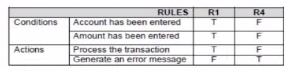
Decision table testing is being performed on transactions in a bank's ATM (Automated teller Machine) system. Two test cases have already been generated for rules 1 and 4, which are shown below:

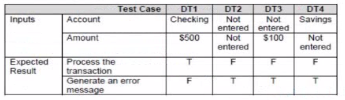
Given the following additional test cases:

Which two of the additional test cases would achieve fill coverage of the full decision table (when combined with the test cases that have already been generated for rules a and 4?


Answer : D

The correct answer is D, as DT1 and DT4 would achieve full coverage of the full decision table when combined with the test cases that have already been generated for rules 1 and 4.Decision table testing is a black-box test technique that uses a table to show combinations of inputs and their associated outputs1. In this case, the inputs are the account type, the amount entered, and the expected result. The outputs are the actions taken by the ATM system. The decision table has eight rules, each corresponding to a possible combination of inputs and outputs. The test cases that have already been generated for rules 1 and 4 are:

TC1: Account = Checking, Amount = $600, Expected Result = Process the transaction

TC4: Account = Savings, Amount = Not entered, Expected Result = Generate an error message

The additional test cases are:

DT1: Account = Checking, Amount = Not entered, Expected Result = Generate an error message

DT2: Account = Savings, Amount = $100, Expected Result = Process the transaction

DT3: Account = Checking, Amount = $100, Expected Result = Process the transaction

DT4: Account = Savings, Amount = $600, Expected Result = Generate an error message

To achieve full coverage of the full decision table, two more test cases are needed that cover the remaining six rules. DT1 and DT4 cover these rules, as shown in the table below:
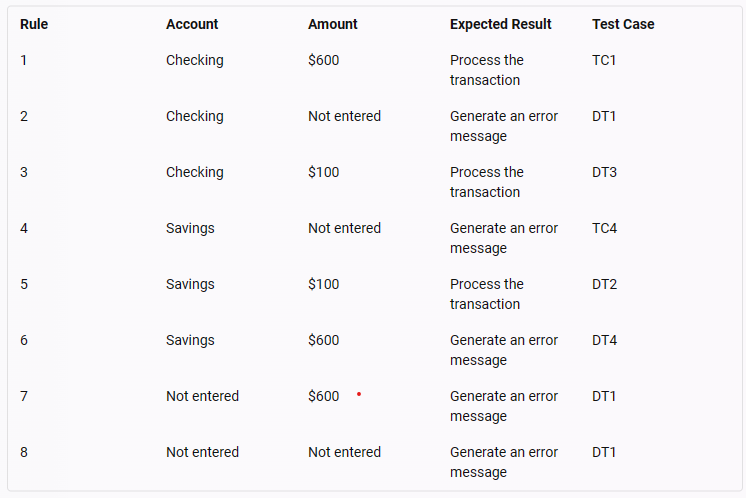
Therefore, option D is the correct answer.Options A, B, and C are incorrect, as they do not cover all the rules in the decision table. Reference:1, Section 4.2.5


Question 2

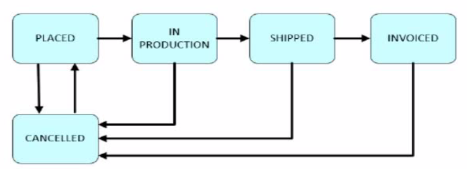
ISTQBw Certified Tester Foundation Level (Syllabus 2018. English) provided by iSOl GmbH, international Software Quality Institute Question 25 of 40 | Level: K3 | Number of correct answers: 1 I Credits: 1 Given the following stale model of sales order software:

Which of the following sequences of transitions provides the highest level of transition coverage for the model (assuming you can start in any state)?


Answer : C

it provides the highest level of transition coverage for the model.Transition coverage is a white-box test technique that focuses on the percentage of transitions that have been exercised by a test suite1. In this case, the model is a state transition diagram that shows the possible states and transitions of a sales order software. The diagram has five states: PLACED, IN PRODUCTION, SHIPPED, INVOICED, and CANCELLED. The diagram has nine transitions: PLACED to IN PRODUCTION, PLACED to CANCELLED, IN PRODUCTION to SHIPPED, IN PRODUCTION to CANCELLED, SHIPPED to INVOICED, SHIPPED to CANCELLED, INVOICED to CANCELLED, CANCELLED to PLACED, and CANCELLED to IN PRODUCTION. Option C covers all nine transitions in the following sequence:

IN PRODUCTION -> SHIPPED

SHIPPED -> INVOICED

INVOICED -> CANCELLED

CANCELLED -> PLACED

PLACED -> IN PRODUCTION

Option A covers only six transitions in the following sequence:

PLACED -> CANCELLED

CANCELLED -> PLACED

PLACED -> IN PRODUCTION

IN PRODUCTION -> CANCELLED

Option B covers only five transitions in the following sequence:

PLACED -> IN PRODUCTION

IN PRODUCTION -> SHIPPED

SHIPPED -> CANCELLED

CANCELLED -> PLACED

Option D covers only four transitions in the following sequence:

IN PRODUCTION -> CANCELLED

CANCELLED -> PLACED

PLACED -> IN PRODUCTION

Therefore, option C is the correct answer.Options A, B, and D are incorrect, as they do not cover all the transitions in the model. Reference:1, Section 4.2.2


Question 3

Which of the following statements BEST describes how test cases are derived from a use case?


Answer : B

It describes how test cases are derived from a use case.A use case is a description of a set of sequences of actions, including variants, that a system performs to yield an observable result of value to an actor1. An actor can be a human user or another system.Test cases are designed to cover various user behaviors, including basic, exceptional or alternative and error behaviors associated with each use case1.Option A is incorrect, as test cases derived from a use case are not based on non-functional requirements such as usability, but on functional requirements that describe what the system does1.Option C is incorrect, as test cases derived from a use case are not created using white-box test techniques, but using black-box test techniques that focus on the inputs and outputs of the system1.Option D is incorrect, as test cases derived from a use case are not based on pair testing, which is a technique that involves two testers working together to find defects1. Reference:1, Section 4.2.4


Question 4

Which of the following BEST describes error guessing?


Answer : A

The correct answer is A, as it describes error guessing.Error guessing is an experience-based test technique that involves designing tests based on experience, defect data, or common knowledge about why software fails1.Error guessing can be used to complement other more formal test techniques by focusing on areas that are more likely to contain defects1.Option B is incorrect, as error guessing does not involve building test cases based on the various experiences of developers, architects, users, and other stakeholders on project teams, but based on the tester's own experience and knowledge1.Option C is incorrect, as error guessing is not a suitable test technique that can be used effectively in place of more formal techniques, but a supplementary technique that can be used in addition to more formal techniques1.Option D is incorrect, as error guessing is not a valid and useful white-box test technique due to its high degree of statement coverage, but an experience-based test technique that does not rely on the structure of the software1. Reference:1, Section 4.2.6


Question 5

Which of the following BEST describes exploratory testing?


Answer : D

The correct answer is D, as it describes exploratory testing.Exploratory testing is an experience-based test technique that involves simultaneous learning, test design, and test execution1. Exploratory testing may be used within defined time periods, during which the tester may follow a test charter as a guide.A test charter is a document that specifies the scope, objective, and approach of an exploratory testing session1.Option A is incorrect, as exploratory testing is not a suitable test technique that may replace both black-box and white-box test techniques, but a complementary technique that can be used along with other techniques1.Option B is incorrect, as exploratory testing does not require both solid specifications and much project time available for test execution, but can be used in situations where specifications are incomplete or changing and where time is limited1.Option C is incorrect, as exploratory testing is not a valid and useful black-box test technique since it focuses on test cases related to the architecture and design of a system, but an experience-based test technique that focuses on learning about the system and its behavior1. Reference:1, Section 4.2.6


Page:    1 / 14   
Total 365 questions