These ISTQB ATM sample questions are a small glimpse of our full set of ISTQB ATM actual questions. They give you a preview of what the real ATM exam might look like and the contents of Pass4Future's premium ISTQB ATM product. You must not underestimate the value of ISTQB ATM practice exam questions, as they allow you to understand the actual Advanced Test Manager exam in greater depth. Using them will save your time and money otherwise wasted in Advanced Test Manager exam reattempts. Study guides and tutorials provide you with theoretical details about the ATM exam; these ATM practice exam questions prepare you to pass the exam. Get Pass4Future's premium access to continue your ATM exam practice with the complete set of ISTQB ATM realistic questions. Our ISTQB ATM practice questions come in various formats; make sure to check out the details and free demo of each format.
Do you know that you can access more real ISTQB ATM exam questions via Premium Access? ()
Based on the historical data of 5 past and similar projects, you have calculated these average numbers of defects detected in system testing.
- For each 10000 LOC (lines of code), 200 defects
- For each person-month of development team effort, 49 defects
You want to use this information to perform estimation for a new project.
The project manager tells you that he/she has estimated 20000 new LOC for this new project.
Four developers work for four months on this project before system testing.
During system testing, 797 defects are discovered.
Assume that the system test of this new project is using the same amount of work as spent in the past projects.
Based on this information only, which of the following statement is certainly true about this project? K3 3 credits
Answer : B
You are estimating the effort for the integration testing activities of a new project. Consider the following factors, which can affect that estimation:
Availability of re-usable test systems and documentation from previous, similar projects
Unexpected timing of components arrival
Stability of the integration test team (no turnover)
Many and geographically distributed sub-teams
Which of the following statements is true?
K2 1 credit
Answer : C
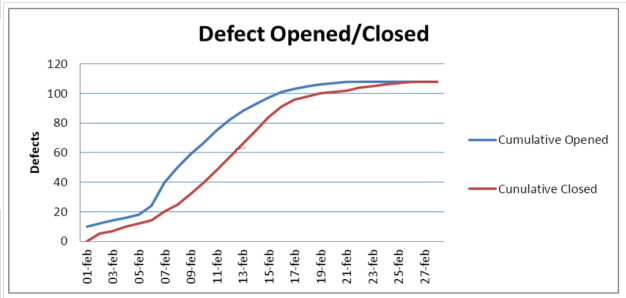
The following chart plots the cumulative number of defects opened against the cumulative number of defects closed during system testing of a software product.

Which of the following statements is true? K2 1 credit
Answer : D
Which one of the following metrics to be produced needs traceability between the test cases and each item in a proper test basis?
K2 1 credit
Answer : A
You are managing the system testing for a SOA based system. The integrated system consists of several subsystems:
- A SOA middleware
- A CRM (Customer Relationship Management) system
- A BRM (Billing and Revenue Management) system
- A SMS (Subscriber Management System) system and you performed a risk analysis based on these subsystems.

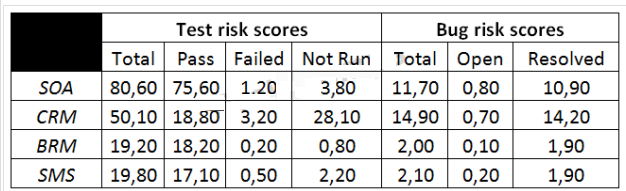
At the end of the scheduled period for test execution you produce a first classical report based on the traditional metrics of testing. Test pass/fail status and bug status (open/resolved) That table provides you a distorted picture of the quality risk, because there is no indication of the risk level of the failed tests, the tests not run, or the open bugs. Thus, you produce the following table to solve this distortion issue:
In the table above, where you have introduced the concept of risk weighting, the highest risk test or bug report has a score of 1, while the lowest risk test or bug report has a score of 0.04. Which of the following subsystems, based on the risk scores of the table, is most risky? K4 3 credits
Answer : B