Pass4Future also provide interactive practice exam software for preparing ISTQB Certified Tester Foundation Level v4.0 (ISTQB-CTFL) Exam effectively. You are welcome to explore sample free ISTQB-CTFL Exam questions below and also try ISTQB-CTFL Exam practice test software.
Do you know that you can access more real ISTQB-CTFL exam questions via Premium Access? ()
In Agile teams, testers closely collaborate with all other team members. This close collaboration could be problematic and result in testing-related organizational risks.
Which TWO of the following organization risks could be encountered?
I Testers lose motivation and fail at their core tasks.
ii. Close interaction with developers causes a loss of the appropriate tester mindset.
iii. Testers are not able to keep pace with incoming changes in time-constrained iterations.
iv. Testers, once they have acquired technical development or business skills, leave the testing team.
Answer : D
In Agile teams, close collaboration among testers and other team members can lead to organizational risks such as: ii. Close interaction with developers causes a loss of the appropriate tester mindset. iv. Testers, once they have acquired technical development or business skills, leave the testing team.
These risks highlight the potential issues of diminished testing perspective and team turnover when testers integrate closely with developers and other roles.
You are testing a system that is used in motor vehicles to warn the driver of an obstacle when re-versing. Output is provided by a series of LED lights (green, yellow, and red), each illuminated based on clearly defined conditions.
The following summary describes the functionality:
* Object within 10 metres, green LED lit.
* Object within 5 metres, yellow LED lit.
* Object within 1 metre, red LED lit.
* Setting sensitivity mode to "ON" will result in only the red LED being lit when the object is within 1 metre.
The following decision table describes the rules associated with the functioning of this proximity warning system:
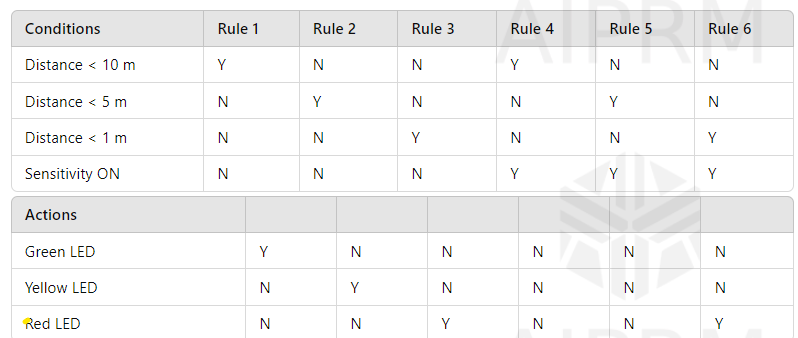
Which intended functionality is tested by Rule 5 in the decision table?
Answer : D
Rule 5 in the decision table indicates that when the object is within 5 metres of the vehicle and the sensitivity mode is switched 'on', no LED is lit. This matches the conditions and actions described in the decision table provided, ensuring that only the red LED is lit when the sensitivity mode is on and the object is within 1 metre, otherwise no LED is lit .
Select which of the following statements describe the key principles of software testing?
i. Testing shows the presence of defects, not their absence.
ii. Testing everything Is possible.
iii. Early testing Is more expensive and is a waste of time.
iv. Defects cluster together.
v. Testing is context dependent.
vi. Beware of the pesticide paradox.
vii. Absence of errors is a fallacy.
Select the correct answer:
Answer : A
The key principles of software testing include: i. Testing shows the presence of defects, not their absence. iv. Defects cluster together. v. Testing is context dependent. vi. Beware of the pesticide paradox. vii. Absence of errors is a fallacy. These principles highlight the importance of recognizing the limitations and context of testing, as well as the potential for repeated tests to become less effective.
Which statement is true regarding confirmation testing and regression testing?
Answer : C
Confirmation testing, also known as retesting, is conducted to verify that specific defects have been fixed. Regression testing, on the other hand, is performed to ensure that recent changes have not adversely affected existing features of the software. Both types of testing are crucial for maintaining the integrity and quality of the software after modifications.
Which of the following statements best describe Behavior-Driven Development (BDD)?
Answer : A
Behavior-Driven Development (BDD) is a collaborative approach that enhances communication among project stakeholders, including developers, testers, and business analysts. It involves defining how software should behave through examples written in a common language understandable by all stakeholders, often using the Given-When-Then format.