Pass4Future also provide interactive practice exam software for preparing Juniper Data Center, Associate (JN0-281) Exam effectively. You are welcome to explore sample free Juniper JN0-281 Exam questions below and also try Juniper JN0-281 Exam practice test software.
Do you know that you can access more real Juniper JN0-281 exam questions via Premium Access? ()
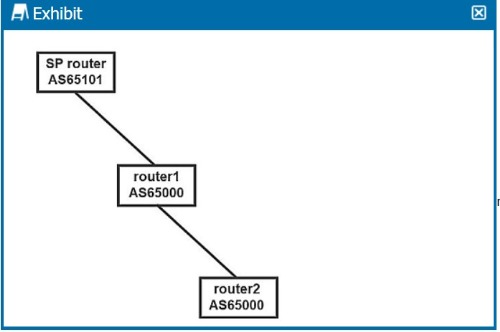
Exhibit:

Referring to the exhibit, which two statements are correct about default BGP advertisements? (Choose two.)
Answer : B, D
The exhibit shows a BGP peering scenario between three routers: router1 and router2 are part of the same AS (AS65000), while the SP router is in a different AS (AS65101). This indicates an EBGP (External BGP) peering between the SP router and router1, and IBGP between router1 and router2.
Step-by-Step Breakdown:
Next-Hop Behavior in BGP:
IBGP: In IBGP, the next-hop address is not modified when advertising routes within the same AS. Thus, when router1 advertises routes learned from router2 to the SP router, it will keep the next-hop address of router1, not router2.
EBGP: In EBGP, the next-hop address is modified. When router1 receives routes from the SP router, it will advertise them to router2 with the next-hop address of router1.
Route Propagation:
Routes received by router1 from router2 will be advertised to the SP router with router1 as the next hop.
Similarly, routes advertised by the SP router will be passed on to router2, with router1 remaining as the next hop.
Juniper Reference:
BGP Next-Hop: Juniper's BGP implementations follow standard BGP next-hop behavior, where the next-hop is modified in EBGP but not in IBGP, ensuring proper route advertisement across autonomous systems.
When considering bidirectional forwarding detection, which two statements are correct? (Choose two.)
Answer : B, C
Bidirectional Forwarding Detection (BFD) is a protocol used to detect faults in the forwarding path between two routers. It provides rapid failure detection, enhancing the performance of routing protocols like OSPF, BGP, and IS-IS.
Step-by-Step Breakdown:
Per Interface Configuration:
BFD can be configured on a per-interface basis within the protocol stanza (e.g., OSPF, BGP). This allows granular control over where BFD is enabled and the failure detection intervals for specific interfaces.
Minimum Interval and Multiplier:
BFD uses a minimum interval (the time between BFD control packets) and a multiplier (the number of missed packets before the path is declared down). The combination of these two defines the detection time for failures.
Juniper Reference:
BFD Configuration: In Juniper, BFD is configurable within routing protocol stanzas, with the failure detection mechanism always based on minimum intervals and multipliers.
How does OSPF calculate the best path to a particular prefix?
Answer : A
OSPF (Open Shortest Path First) calculates the best path based on the cost of the route, which is derived from the bandwidth of the interfaces along the path.
Step-by-Step Breakdown:
OSPF Path Selection:
OSPF assigns a cost to each link, typically based on the link's bandwidth (higher bandwidth equals lower cost).
The OSPF algorithm computes the shortest path to a destination by adding the costs of all links in the path. The path with the numerically lowest total cost is chosen as the best path.
Cost Calculation:
The OSPF cost can be manually adjusted or automatically calculated using the default formula:
Cost=Reference BandwidthLink Bandwidth\text{Cost} = \frac{\text{Reference Bandwidth}}{\text{Link Bandwidth}}Cost=Link BandwidthReference Bandwidth
Juniper Reference:
OSPF Best Path Selection: OSPF selects the path with the lowest cumulative cost, ensuring efficient use of higher-bandwidth links in Junos networks.
Which statement about switches is correct?
Answer : B
Each port on a modern switch creates a separate collision domain. This allows multiple devices to communicate simultaneously without collisions on different ports.
Step-by-Step Breakdown:
Collision Domain:
A collision domain is a network segment where data packets can collide if two devices send packets simultaneously.
On a switch, each port creates a separate collision domain, so collisions only occur if two devices connected to the same port (through a hub, for instance) try to send data at the same time.
Switches vs Hubs:
Unlike hubs, which have one large collision domain, switches isolate collisions to individual ports, improving performance.
Juniper Reference:
Switch Port Behavior: In Juniper switches, each port operates in its own collision domain, enhancing network efficiency by reducing the chances of packet collisions.
By default, which two statements are correct about BGP advertisements? (Choose two.)
Answer : A, D
BGP (Border Gateway Protocol) has specific rules for route advertisement between peers.
Step-by-Step Breakdown:
EBGP to IBGP Route Propagation:
BGP peers advertise routes learned from EBGP peers to IBGP peers within the same AS. This ensures that routes learned from external networks are propagated internally within the AS.
IBGP to EBGP Route Propagation:
Routes learned from IBGP peers can be advertised to EBGP peers, but when advertising these routes, the router uses its own IP address as the next hop.
IBGP Split Horizon:
By default, IBGP peers do not advertise routes learned from one IBGP peer to another IBGP peer. This rule (IBGP split horizon) prevents routing loops within an AS.
Juniper Reference:
BGP Advertisement Rules: Junos adheres to BGP standards, where IBGP peers do not propagate routes to other IBGP peers, but EBGP peers receive IBGP routes with the advertising router as the next hop.