Juniper - Big Savings Alert – Don’t Miss This Deal - Ends In 1d 00h 00m 00s Coupon code: 26Y30OFF
  1. Home
  2. Juniper
  3. JN0-352 Exam
  4. Free JN0-352 Questions

Free Practice Questions for Juniper JN0-352 Exam

Pass4Future also provide interactive practice exam software for preparing Juniper Enterprise Routing and Switching, Specialist (JN0-352) Exam effectively. You are welcome to explore sample free Juniper JN0-352 Exam questions below and also try Juniper JN0-352 Exam practice test software.

Page:    1 / 14   
Total 65 questions

Question 1

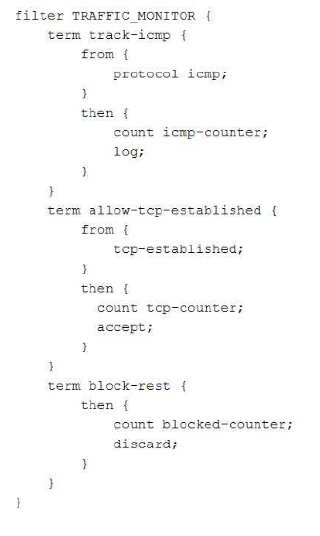
Refer to Exhibit:

You have applied a firewall filter as an ingress filter on the ge-0/0/0 interface of your Juniper Networks EX Series Switch as shown in the exhibit. An external host sends an ICMP ping packet to the router.

Which statement is correct about how this packet is processed?


Answer : A

Junos firewall filters evaluate terms sequentially from top to bottom, and a term is only terminal for a packet if its then clause contains an explicit terminating action such as accept, discard, reject, or next term without a match. The count and log actions used in track-icmp are non-terminating; they update statistics and generate a log entry but do not stop evaluation, so a matching ICMP packet falls through to the next term after being counted. The second term, allow-tcp-established, matches only TCP packets carrying the ACK or RST flags as defined by the tcp-established keyword; an ICMP echo request does not satisfy protocol tcp, so this term is skipped entirely and does not accept the packet. Evaluation therefore reaches the implicit catch-all term block-rest, which has no from conditions and matches every remaining packet, incrementing blocked-counter and discarding it. The net effect for the described ICMP ping is that icmp-counter is incremented by the first term, the packet is neither accepted nor rejected by the second term, and blocked-counter is incremented immediately before the packet is silently discarded by the final term. This layered-term behavior, where counting is independent of the accept/discard decision, is a frequently tested nuance of Junos firewall filter processing logic. Reference topics: Junos Enterprise Switching -- Layer 2 Security and Firewall Filters, Filter Term Evaluation Order.


Question 2

You are asked to deploy nonstop active routing (NSR) on a dual-Routing Engine platform. In this scenario, what are two additional requirements for proper operation? (Choose two.)


Answer : B, D

Nonstop active routing is specifically engineered to be completely transparent to the rest of the network: rather than relying on neighboring routers to preserve state during a Routing Engine switchover the way graceful restart does, NSR keeps a fully synchronized instance of the routing protocol process (rpd) running continuously on the backup Routing Engine, mirroring protocol adjacencies, the RIB, and session state in real time. Because neighbors never observe a session reset or restart signal during an NSR-driven switchover, there is no dependency on those neighbors supporting or enabling graceful restart extensions at all --- this is the core architectural advantage that distinguishes NSR from GR and is precisely why the first and third answer choices are incorrect distractors. What NSR does require locally is Graceful Routing Engine Switchover (GRES) enabled first, since NSR is built as an extension on top of GRES and depends on it to synchronize kernel and interface state between the two Routing Engines before protocol-level synchronization can occur. Additionally, Juniper's official guidance mandates that both Routing Engines run the identical Junos OS software version; mismatched versions between the primary and backup Routing Engine can introduce incompatible internal data structures or feature behavior during state replication, jeopardizing the integrity of a switchover and is explicitly called out as a hard operational requirement rather than a mere best practice. Reference topics: Junos Enterprise Routing -- High Availability, Nonstop Active Routing Requirements and GRES Dependency.


Question 3

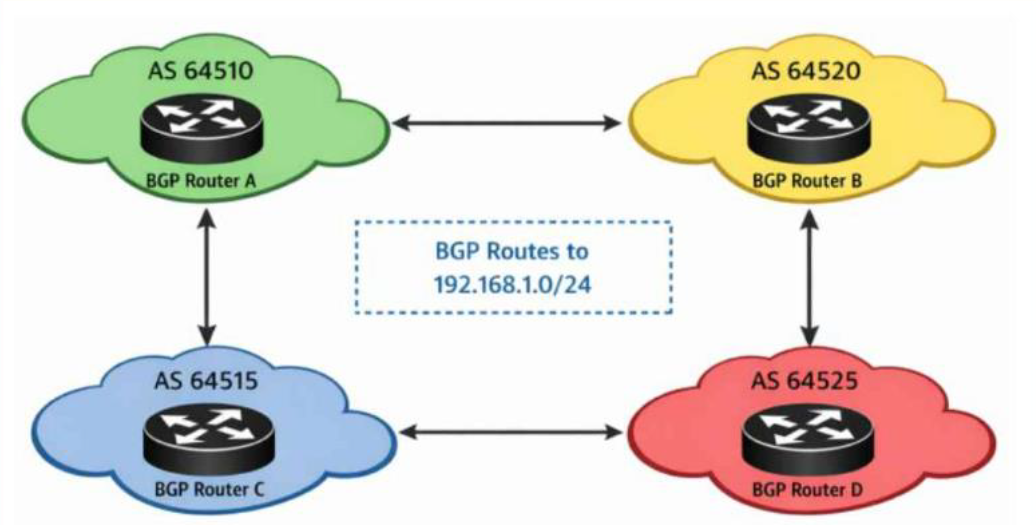
[Exhibit]

Click the Exhibit button.

A network includes several autonomous systems that exchange routing information using BGP. Multiple BGP routes exist for the same prefix.

Referring to the exhibit, which attribute would BGP use first when selecting a preferred route?


Answer : A

The Junos BGP path selection algorithm proceeds through a strict, ordered sequence of comparison steps, and once next-hop reachability and route preference (administrative distance) have been confirmed as equal, local preference is the very first BGP-specific path attribute evaluated in the decision process. A route carrying a higher local preference value is always chosen over a competing route to the same prefix with a lower local preference, and this comparison takes absolute precedence over every subsequent attribute in the algorithm; if local preference values differ between candidate paths, the selection process concludes at this step without ever needing to examine AS path length, origin type, or MED at all. Only when two or more competing paths share an identical local preference value does the algorithm proceed to its third step, comparing AS path length and preferring the shortest, and only after a further tie does it move on to origin type (preferring IGP-origin over EGP-origin, and EGP-origin over incomplete), followed by MED comparison (preferring the lowest value, and only among routes learned from the same neighboring AS by default). Because local preference is evaluated strictly before all three of the other listed attributes, it is the attribute BGP consults first among the choices given, making it the deciding factor in scenarios such as this exhibit where multiple autonomous systems advertise competing paths toward the same 192.168.1.0/24 prefix. Reference topics: Junos Enterprise Routing -- BGP, Understanding BGP Path Selection Order.


Question 4

A switch uses the factory-default storm control configuration. A sudden unknown-unicast burst causes packet loss for only 4-5 seconds before stabilizing.

Which statement describes why normal operation resumes automatically?


Answer : D

The factory-default storm control configuration on EX Series switches operates in a purely rate-limiting mode rather than an interface-shutdown mode. When broadcast, multicast, or unknown-unicast traffic on a port exceeds the configured bandwidth-percentage threshold, the default action is simply to police the offending traffic type and silently drop only the packets that exceed that threshold, while all traffic within the allowed rate continues to be forwarded normally and the interface itself remains administratively and operationally up throughout the event. This explains the observed symptom precisely: during the burst of unknown-unicast frames, the switch dropped the excess volume above the configured limit, producing a brief period of packet loss, but as soon as the burst subsided and traffic fell back under the threshold, storm control simply stopped dropping packets and normal forwarding resumed automatically --- no administrative shutdown, recovery timer, or manual intervention was ever involved, because the interface was never taken down in the first place. This default drop-only behavior is distinct from the optional interface-shutdown action, which must be explicitly configured if an administrator wants storm control to disable a port outright on violation (as seen in a related scenario requiring the clear ethernet-switching recovery-timeout command). Storm control by default covers broadcast, multicast, and unknown-unicast traffic types together, not multicast alone, and it has no functional relationship to GRES, which governs Routing Engine redundancy rather than Layer 2 traffic policing. Reference topics: Junos Enterprise Switching -- Storm Control, Default Drop Behavior Versus Interface Shutdown Action.


Question 5

You need to configure a Juniper Networks EX Series Switch to be able to accept both tagged and untagged traffic on the same access port.

Which feature will allow you to accomplish this task?


Answer : D

Voice VLAN is the Junos feature specifically designed to allow a single access port to simultaneously handle two distinct traffic streams: untagged data traffic from a PC or workstation using the port's normal access VLAN, and separately tagged voice traffic generated by an IP telephone that is typically daisy-chained between the switch port and the connected PC. When voice VLAN is configured on an access interface, the switch instructs the attached IP phone (commonly via LLDP-MED) which VLAN ID to tag its voice traffic with, and the switch is then able to correctly classify and prioritize that tagged voice traffic into its designated voice VLAN while simultaneously continuing to treat any untagged frames arriving on that same physical port as belonging to the port's regular, untagged access VLAN --- precisely satisfying the requirement to accept both tagged and untagged traffic together on one access port. Native VLAN, by contrast, is a trunk-port-only concept that designates which VLAN untagged frames on a trunk should be associated with; it has no applicability to an access port and does not enable simultaneous tagged traffic acceptance there. Default VLAN simply refers to the VLAN an interface belongs to absent other configuration and carries no dual-traffic capability. IRB interfaces provide Layer 3 gateway functionality for a VLAN and are unrelated to how tagged versus untagged frames are accepted at Layer 2 on a given physical port. Reference topics: Junos Enterprise Switching -- VLANs, Configuring Voice VLAN on Access Interfaces.


Page:    1 / 14   
Total 65 questions