Juniper - Big Savings Alert – Don’t Miss This Deal - Ends In 1d 00h 00m 00s Coupon code: 26Y30OFF
  1. Home
  2. Juniper
  3. JN0-637 Exam
  4. Free JN0-637 Questions

Free Juniper Security, Professional (JN0-637) Practice Questions

These Juniper JN0-637 sample questions are a small glimpse of our full set of Juniper JN0-637 actual questions. They give you a preview of what the real JN0-637 exam might look like and the contents of Pass4Future's premium Juniper JN0-637 product. You must not underestimate the value of Juniper JN0-637 practice exam questions, as they allow you to understand the actual Security, Professional exam in greater depth. Using them will save your time and money otherwise wasted in Security, Professional exam reattempts. Study guides and tutorials provide you with theoretical details about the JN0-637 exam; these JN0-637 practice exam questions prepare you to pass the exam. Get Pass4Future's premium access to continue your JN0-637 exam practice with the complete set of Juniper JN0-637 realistic questions. Our Juniper JN0-637 practice questions come in various formats; make sure to check out the details and free demo of each format.

Juniper JN0-637 Sample Exam Questions

Page:    1 / 14   
Total 115 questions

Question 1

You have a multinode HA default mode deployment and the ICL is down.

In this scenario, what are two ways that the SRX Series devices verify the activeness of their peers? (Choose two.)


Answer : A, D

Comprehensive Detailed Step-by-Step Explanation with All Juniper Security Reference

Understanding the Scenario:

Multinode HA Default Mode Deployment:

In a chassis cluster, two SRX devices operate together to provide high availability.

ICL (Inter-Cluster Link) is Down:

The control and fabric links between the nodes are not operational.

Objective:

Determine how the SRX devices verify each other's activeness without the ICL.

Option A: Custom IP addresses may be configured for the activeness probe.

When the control link is down, SRX devices use an ICMP ping-based activeness probe to check the peer's status.

Custom IP addresses can be configured as probe targets to verify the peer's activeness.


'You can configure the SRX Series device to send activeness probes to a configured IP address to verify the peer's state when the control link is down.'

Source: Juniper Networks Documentation - Control Link Failure Detection

Option D: Each peer sends a probe with the virtual IP address as the source IP address and the upstream router as the destination IP address.

The SRX devices send ICMP probes to an upstream device using the redundancy group's virtual IP address as the source.

This helps determine if the peer node is still active by verifying network reachability.

'When the control link fails, each node sends ICMP pings to the configured probe addresses using the redundancy group's virtual IP address as the source.'

Source: Juniper Networks Documentation - Chassis Cluster Control Link Failure

Why Options B and C are Incorrect:

Option B: Fabric link heartbeats cannot be used because the ICL (which includes the fabric link) is down.

Option C: Probes are sent to upstream devices, not using the virtual IP address as the destination.

Conclusion:

The correct options are A and D because they accurately describe how SRX devices verify activeness without the ICL.

Question 2

Which two elements are necessary to configure a rule under an APBR profile? (Choose Two)


Answer : B, C

Here's why those elements are necessary for configuring a rule under an APBR profile:

B . Match condition: This defines the criteria for matching traffic to the APBR rule. It can include:

Applications: Match based on specific applications or application groups.

URL categories: Match based on URL categories provided by a web filtering service.

Other criteria: You can also match based on source/destination IP addresses, ports, protocols, etc.

C . Then action: This specifies the action to take when traffic matches the rule. The primary action in APBR is:

routing-instance: This redirects the matching traffic to a specific routing instance, allowing you to steer traffic through different paths based on the application or URL category.

Why other options are incorrect:

A . Instance type: While routing instances are used in APBR, the 'instance type' itself is not configured within the APBR rule. You define the instance type separately when configuring the routing instance.


Question 3

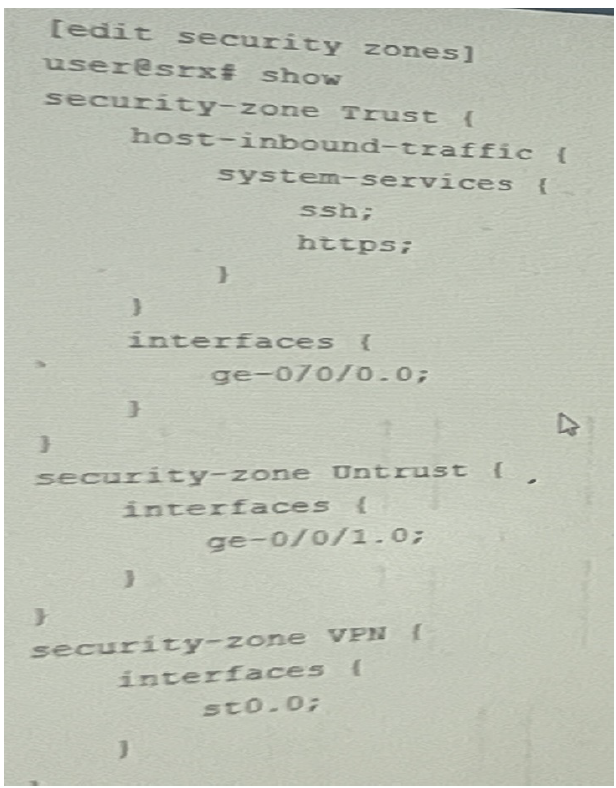
Referring to the exhibit, you are attempting to set up a remote access VPN on your SRX series devices.

However you are unsure of which system services you should allow and in which zones they should be allowed to correctly finish the remote access VPN configuration

Which two statements are correct? (Choose two.)


Answer : A, C


Question 4

What are three configurable monitor components for a service redundancy group? (Choose two)


Answer : A, D, E


Question 5

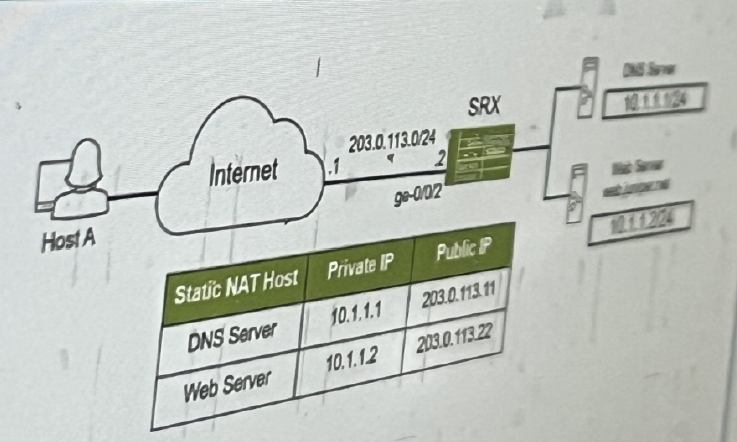
The SRX series device is performing static NAT. you want to ensure that host A can reach the

internal webserver www.juniper.net using domain name.

Referring to the exhibit, which two Junos features are required to accomplish this task? (Choose two.)


Answer : A, B


Page:    1 / 14   
Total 115 questions