Free Nokia Optical Diagnostics and Troubleshooting (4A0-265) Practice Questions
These Nokia 4A0-265 sample questions are a small glimpse of our full set of Nokia 4A0-265 actual questions. They give you a preview of what the real 4A0-265 exam might look like and the contents of Pass4Future's premium Nokia 4A0-265 product. You must not underestimate the value of Nokia 4A0-265 practice exam questions, as they allow you to understand the actual Nokia Optical Diagnostics and Troubleshooting exam in greater depth. Using them will save your time and money otherwise wasted in Nokia Optical Diagnostics and Troubleshooting exam reattempts. Study guides and tutorials provide you with theoretical details about the 4A0-265 exam; these 4A0-265 practice exam questions prepare you to pass the exam. Get Pass4Future's premium access to continue your 4A0-265 exam practice with the complete set of Nokia 4A0-265 realistic questions. Our Nokia 4A0-265 practice questions come in various formats; make sure to check out the details and free demo of each format.
Nokia 4A0-265 Sample Exam Questions
Page: 1
/ 14 Total 40 questions
Do you know that you can access more real Nokia 4A0-265 exam questions via Premium Access? ()
Question 1
A "Power Adjustment Required" alarm was raised on the ingress amplifier in slot 1/10. Which of the following commands should be entered to manually adjust the related amplifier optical power levels?
Answer : D
A ''Power Adjustment Required'' alarm is raised when the optical power levels of an amplifier are out of the expected range and need to be adjusted. To manually adjust the related amplifier optical power levels, the commandconfig powermgmt ingress 1/10 adjustshould be entered. This command will initiate a power adjustment process for the ingress amplifier in slot 1/10, which is the input port for the optical line signal. The command will also display the status and results of the power adjustment, such as success, failure, or conditional success. The other commands are incorrect because they either do not initiate a power adjustment process or have invalid syntax.Reference:Nokia Optical Diagnostics and Troubleshooting Course,OAM and Diagnostics Guide
Question 2
On a bidirectional optical amplifier configuration, which of the following are Wavelength Tracker detection points?
Answer : C
On a bidirectional optical amplifier configuration, the Wavelength Tracker detection points are the LINE and SIG interfaces. The Wavelength Tracker is a feature that monitors the wavelength of each channel on the optical amplifier and provides feedback to the control system. The Wavelength Tracker can detect wavelength drifts, channel failures, or channel additions or removals on both directions of the optical amplifier. The LINE interface is the input/output port for the optical line signal, while the SIG interface is the input/output port for the optical signal from/to the transponder. The other options are incorrect because the LINEOUT and SIGOUT interfaces are not Wavelength Tracker detection points, and an optical amplifier has Wavelength Tracker detection points.Reference:Nokia Optical Diagnostics and Troubleshooting Course,OAM and Diagnostics Guide
Question 3
Which of the following statements best describes the output of the command: show xc 1?
Answer : B
The commandshow xc 1displays a list of cross-connections, including A-end, Z-end, frequency, ID number, OCH trail name, and administrative/operational states. A cross-connection is a logical connection between two ports on an optical network element that allows the transmission of an optical signal from one port to another. The command can be used to view the configuration and status of the cross-connections on a node or a network. The other options are incorrect because they either describe a different command or provide incorrect information.Reference:Nokia Optical Diagnostics and Troubleshooting Course,OAM and Diagnostics Guide
Question 4
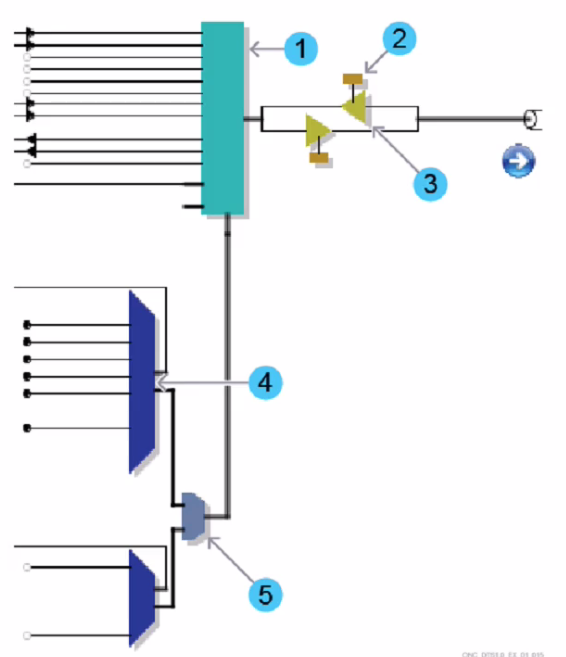
Consider the exhibit which shows part of an EPT Schematic View. Which number refers to the Wavelength Router (WR8-88) block?
Answer : A
The Wavelength Router (WR8-88) block is a device that can route optical signals based on their wavelengths. It can also perform wavelength conversion, multiplexing, and demultiplexing functions.The Wavelength Router (WR8-88) block is part of the Nokia 1830 PSS-8x platform, which is optimized for metro aggregation switching applications in optical transport networks1. In the exhibit, the number 1 refers to the Wavelength Router (WR8-88) block, as indicated by the label WR8-88AF. The other numbers refer to different components of the system, such as transponders, amplifiers, and switches.Reference:Nokia Optical Diagnostics and Troubleshooting Course,DWDM 1830 PSS-8 WR8-88AF Board
Question 5
Suppose a network operator needs to configure the 10GbE client interface 1/7/C1 with a GFP-F encapsulation mode. Which command should be used?
Answer : C
The command that should be used to configure the 10GbE client interface 1/7/C1 with a GFP-F encapsulation mode isconfig interface 1/7/C1 encmode 10client gfp-f. This command will set the encapsulation mode of the interface to GFP-F, which is a frame-mapped generic framing procedure that encapsulates Ethernet frames with a GFP header. The command also specifies that the interface is a 10GbE client interface, which means that it supports 10 Gigabit Ethernet LAN signals. The other commands are incorrect because they either have invalid syntax or use incorrect parameters for the interface or the encapsulation mode.Reference:Nokia Optical Diagnostics and Troubleshooting Course,OAM and Diagnostics Guide