These Nokia 4A0-C03 sample questions are a small glimpse of our full set of Nokia 4A0-C03 actual questions. They give you a preview of what the real 4A0-C03 exam might look like and the contents of Pass4Future's premium Nokia 4A0-C03 product. You must not underestimate the value of Nokia 4A0-C03 practice exam questions, as they allow you to understand the actual Nokia NRS II Composite Exam: IS-IS version exam in greater depth. Using them will save your time and money otherwise wasted in Nokia NRS II Composite Exam: IS-IS version exam reattempts. Study guides and tutorials provide you with theoretical details about the 4A0-C03 exam; these 4A0-C03 practice exam questions prepare you to pass the exam. Get Pass4Future's premium access to continue your 4A0-C03 exam practice with the complete set of Nokia 4A0-C03 realistic questions. Our Nokia 4A0-C03 practice questions come in various formats; make sure to check out the details and free demo of each format.
Do you know that you can access more real Nokia 4A0-C03 exam questions via Premium Access? ()
Which statement about Hierarchical VPLS is FALSE?
Answer : B
Hierarchical Virtual Private LAN Service (H-VPLS) improves the scalability of traditional VPLS by organizing service connectivity into hierarchical access and aggregation domains.
A conventional fully meshed VPLS requires pseudowire connectivity between participating provider edge routers. As the number of routers increases, the number of required pseudowires can grow significantly.
H-VPLS reduces this complexity by using spoke SDP bindings to connect access or subsidiary VPLS domains to the appropriate aggregation infrastructure.
Core VPLS domain: PE1, PE2, PE3 connected by mesh SDPs. Metro A, Metro B, Metro C access VPLS domains are connected via spoke SDPs.
Hierarchical VPLS using mesh connectivity within the core and spoke connectivity to access domains.
Mesh SDPs commonly provide full-mesh connectivity within the core VPLS domain, where split-horizon forwarding prevents traffic received from one mesh SDP from being forwarded to another.
Spoke SDPs provide the hierarchical interconnection between access networks and aggregation nodes.
This architecture reduces the number of pseudowires required when adding access devices and enables Ethernet services to extend across multiple metropolitan networks.
Therefore, option B is false because it incorrectly identifies mesh SDPs as the conventional hierarchical interconnection mechanism.
Which of the following statements regarding an ERO in an RSVP PATH message is FALSE?
Answer : B
The Explicit Route Object (ERO) is an RSVP-TE signaling object used to specify the sequence of network nodes through which a Label Switched Path (LSP) must pass. It enables the ingress Label Edge Router (LER) to influence or explicitly determine the path followed by an MPLS tunnel.
An ERO contains a series of subobjects representing strict or loose hops. A strict hop requires direct connectivity to the specified next node, whereas a loose hop permits intermediate routers between the specified nodes.
The ERO does not distribute MPLS label bindings. Label distribution occurs through the RSVP signaling process. The ingress router includes a LABEL_REQUEST object in the PATH message, and downstream routers allocate and advertise labels through the LABEL object carried in the RESV message.
As the PATH message progresses downstream, routers process the applicable ERO subobjects to determine the next signaling hop. An ERO is optional in RSVP-TE signaling.
Therefore, the statement that the ERO contains MPLS label information is false.
On a Nokia 7750 SR, which statement about IES interfaces is FALSE?
Answer : A
Internet Enhanced Service (IES) is a Nokia SR OS Layer 3 service that provides customers with routed connectivity to the provider's IP network.
An IES service can contain multiple logical IP routing interfaces under a single service identifier. Each interface provides an appropriate Layer 3 attachment point and can use a SAP or a supported spoke SDP termination mechanism.
For example, an IES service could contain multiple customer-facing interfaces associated with different IP subnetworks.
ies 'Internet-Service' { service-id 100 customer 'Customer-A' interface 'Site-A' { ... } interface 'Site-B' { ... } }
Unlike a VPRN, an ordinary IES operates within the base routing instance rather than creating a separate customer VRF.
Because IES operates at Layer 3, IPv4 fragmentation can be supported when forwarding conditions permit it, including the outgoing MTU and the state of the IPv4 Don't Fragment bit.
Operational Layer 3 interfaces normally require appropriate IP addressing, although Nokia also supports specialized unnumbered interface configurations.
Multiple interfaces are explicitly supported within an individual IES service.
Consequently, the assertion that an IES can contain only one interface is false.
Technical clarification: IP addressing is configured at the interface level rather than directly on the IES service object. IPv6 routers do not perform transit packet fragmentation.
Which statement best characterizes the protocol stack IS-IS routers use to exchange control messages?
Answer : C
IS-IS was originally developed as a routing protocol for Connectionless Network Protocol (CLNP) networks and subsequently extended to support IP routing through Integrated IS-IS.
Unlike routing protocols such as OSPF and BGP, IS-IS does not rely on IP as the transport mechanism for its routing control messages. Instead, IS-IS Protocol Data Units are transmitted directly using the underlying data-link layer.
On Ethernet networks, IS-IS uses dedicated multicast MAC addresses to distribute its control messages.
The principal multicast destinations are:
IS-IS destination
Ethernet MAC address
All Level 1 Intermediate Systems
01:80:C2:00:00:14
All Level 2 Intermediate Systems
01:80:C2:00:00:15
IS-IS Protocol Data Unit IEEE 802.2 LLC Ethernet multicast frame
No IP, TCP or UDP transport header is required.
The exchange of IS-IS Hello messages, Link State PDUs, Complete Sequence Number PDUs, and Partial Sequence Number PDUs therefore occurs without requiring an IP transport header.
This architectural separation enables IS-IS to carry routing information for both IPv4 and IPv6 using the same fundamental protocol machinery.
Option C correctly describes IS-IS control-plane communication over Ethernet.
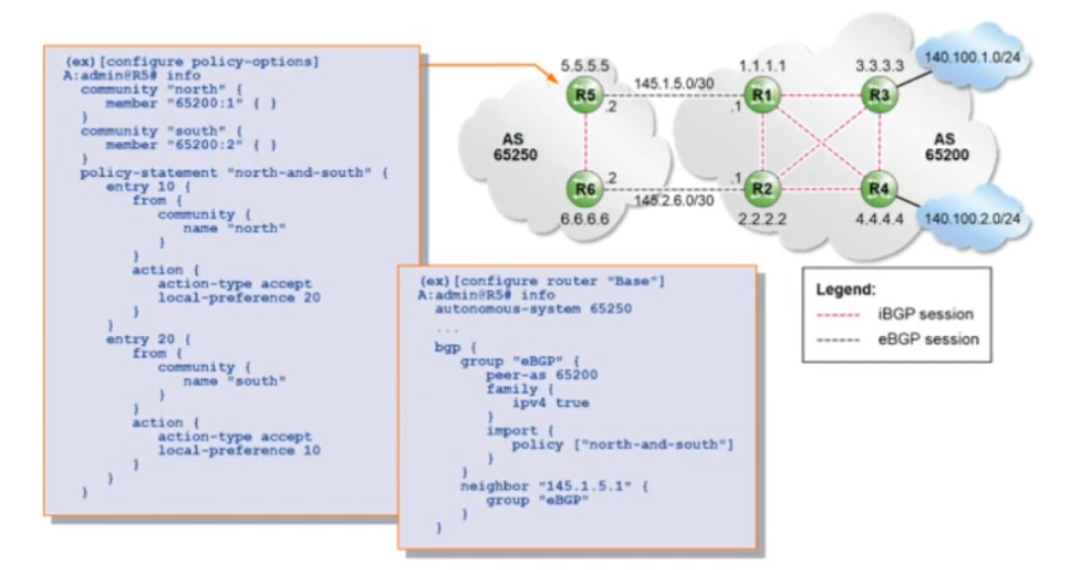
The BGP import policy north-and-south is applied on router R5. Router R1 advertises prefix 140.100.1.0/24 with its community set to 65200:1. Which statement about R5's processing of the received route update for prefix 140.100.1.0/24 is TRUE?
Exhibit:

[ex][configure policy-options] A:admin@R5# info community "north" { member "65200:1" { } } community "south" { member "65200:2" { } } policy-statement "north-and-south" { entry 10 { from { community { name "north" } } action { action-type accept local-preference 20 } } entry 20 { from { community { name "south" } } action { action-type accept local-preference 10 } } }
Answer : B
Nokia SR OS routing policies allow BGP route advertisements to be evaluated against configured match criteria and modified through associated policy actions.
The north-and-south import policy contains separate entries matching the BGP communities named north and south.
The route advertised by R1 contains community 65200:1, which matches the community definition named north.
Received BGP route: 140.100.1.0/24 (Community: 65200:1) Policy entry 10 (Matches community 'north') Set LOCAL_PREF = 20 Accept route (Community remains 65200:1).
Once the route matches the first policy entry, the configured action accepts the route and sets its BGP LOCAL_PREFERENCE attribute to 20.
The LOCAL_PREFERENCE attribute influences BGP best-path selection within the local autonomous system. When otherwise eligible routes are compared, higher local-preference values are preferred.
The configured policy entry does not contain any community deletion, addition, or replacement action. Therefore, the original community value remains unchanged.
The second policy entry matches community 65200:2 and does not apply to this advertisement.
Consequently, the advertised prefix is accepted with its local preference set to 20, making option B correct.