Pass4Future also provide interactive practice exam software for preparing Nutanix Certified Professional - Multicloud Infrastructure v7.5 (NCP-MCI) Exam effectively. You are welcome to explore sample free Nutanix NCP-MCI Exam questions below and also try Nutanix NCP-MCI Exam practice test software.
Do you know that you can access more real Nutanix NCP-MCI exam questions via Premium Access? ()
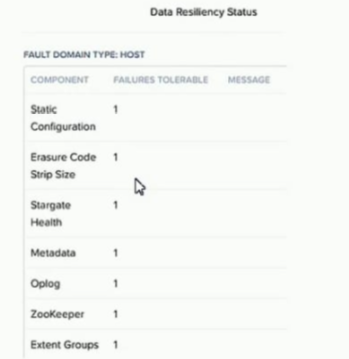
Refer to Exhibit.

An administrator increases the cluster RF to 3. The containers are not modified.
What will the new values in the data resiliency dashboard be for FAILURES TOLERABLE for the Zookeeper and Extent Groups components?
Answer : C
According to the web search results, the cluster redundancy factor (RF) determines how many copies of the cluster metadata and configuration data are stored on different nodes. By default, the cluster RF is 2, which means that there are three copies of the Zookeeper and Cassandra data on the cluster.If the cluster RF is increased to 3, then there will be five copies of the Zookeeper and Cassandra data on the cluster12.This means that the Zookeeper component can tolerate two failures, as it can still operate with a quorum of three nodes out of five3.
However, the container replication factor (RF) determines how many copies of the VM data and oplog are stored on different nodes. The container RF can be set independently for each container, and it can be different from the cluster RF.For example, a container can have RF 2 even if the cluster has RF 34. In this case, the container will only have two copies of the VM data and oplog on the cluster, regardless of the cluster RF.This means that the Extent Groups component can only tolerate one failure, as it needs at least one copy of the VM data and oplog to be available5.
Therefore, if the administrator increases the cluster RF to 3, but does not modify the containers, then the new values in the data resiliency dashboard will be Zookeeper = 2 and Extent Groups = 1.
Which three configuration scenarios are valid for the deployment of Prism Central? (Choose three.)
Answer : A, B, C
Prism Central is a multi-cluster manager that provides a single, centralized management interface for Nutanix environments1. Prism Central can be deployed in different configuration scenarios, depending on the network and security requirements of the environment. Some of the valid scenarios are:
Environments use Network Address Translation (NAT): NAT is a method of mapping one IP address space to another by modifying network address information in IP datagram packet headers while they are in transit across a traffic routing device2.NAT can be used to enable communication between Prism Central and Prism Elements that are in different networks or subnets3.For example, Prism Central can be deployed in a public cloud and use NAT to access Prism Elements that are in a private data center3.
Prism Elements and Prism Central are in different subnets: A subnet is a logical subdivision of an IP network that allows multiple networks to share a single physical network4.Prism Elements and Prism Central can be in different subnets as long as they can communicate with each other through routing or NAT3.For example, Prism Central can be deployed in a management subnet and access Prism Elements that are in different application subnets3.
Environments do not have Internet access: Internet access is not required for the deployment of Prism Central, as long as the environment meets the prerequisites and considerations for installing or upgrading Prism Central. For example, Prism Central can be deployed in a dark site, which is an environment that does not have Internet access or has restricted Internet access. In this case, the administrator needs to manually enable microservices infrastructure and download the required software packages from another source.
An administrator is adding a node with a higher AOS release to an existing cluster.
What is the most efficient action an administrator should take to ensure it is in a supported state?
Answer : C
According to the web search results, the most efficient action an administrator should take to ensure a supported state when adding a node with a higher AOS release to an existing cluster is to perform a standalone reimage of the new node and then add it to the cluster1. This way, the new node will have the same AOS version as the existing nodes, and there will be no compatibility issues or downtime. Therefore, option C is correct, while options A, B, and D are not.
An administrator is configuring cross-hypervisor DR from an ESXi cluster to a new AHV cluster. When the administrator migrates a protection domain to the AHV cluster, the VMs fail to boot.
What should the administrator do to correct this problem?
Answer : C
According to the web search results, one of the requirements for cross-hypervisor disaster recovery (CHDR) is to install and configure Nutanix Guest Tools (NGT) on all the VMs2. NGT configures the VM with all the required drivers for VM portability. Without NGT, the VMs may fail to boot after being migrated to a different hypervisor type.
A customer has a newly-deployed AHV cluster with nodes that have 2.x 10 GBE and 2.x interface. The customer wants to use all available network interfaces to provide connectivity to the VMs.
Which option should the administrator use to achieve this while remaining consistent with Nutanix recommendations?
Answer : D
According to the web search results, one of the best practices for Nutanix AHV networking is to create a second bridge on each host and assign the 1GbE interfaces to it3. This way, the customer can use both 10GbE and 1GbE interfaces for VM traffic, and also benefit from network isolation and redundancy.