OMG - Big Savings Alert – Don’t Miss This Deal - Ends In 1d 00h 00m 00s Coupon code: 26Y30OFF
  1. Home
  2. OMG
  3. OMG-OCUP2-ADV300 Exam
  4. Free OMG-OCUP2-ADV300 Questions

Free Practice Questions for OMG-OCUP2-ADV300 Exam

Pass4Future also provide interactive practice exam software for preparing OMG Certified UML Professional 2 (OCUP 2) - Advanced Level (OMG-OCUP2-ADV300) Exam effectively. You are welcome to explore sample free OMG-OCUP2-ADV300 Exam questions below and also try OMG-OCUP2-ADV300 Exam practice test software.

Page:    1 / 14   
Total 90 questions

Question 1

Choose the correct answer:

Which statement is correct about a Decision Node?


Answer : C

In the context of UML 2.0 and the specifications around Decision Nodes, option C is the correct choice. According to the UML 2.5 specification, when a Decision Node has an incoming control flow and a decisionInput, the decisionInput must have a single input parameter (in Parameter). This ensures that the decision node can evaluate the decision input using the value passed through the incoming control flow. This mechanism is crucial for decision-making processes within activity diagrams where decisions are made based on dynamic data provided at runtime.


UML 2.5 Specification: The specification details the properties and behaviors of Decision Nodes within activity diagrams, particularly emphasizing how decision inputs and their parameters are handled.

Question 2

Choose the correct answer:

What happens when an Exception Handler completes execution?


Answer : C

For question number 50, the correct answer is C: Control tokens are offered on the outgoing Control Flows of the ExceptionHandler. According to the UML 2.5 specification, when an Exception Handler completes its execution, it does not halt the execution of the thread or retain control tokens internally; instead, it passes control tokens along the outgoing Control Flows. This behavior allows the activity to continue processing other behaviors or activities, based on the exception handling outcome.


UML 2.5 Specification: Provides a detailed description of the behavior of Exception Handlers within activity diagrams, including how control tokens are managed upon the completion of an exception handling sequence.

Question 3

Choose the correct answer:

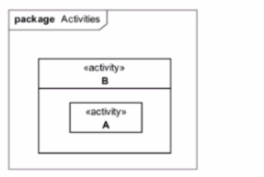
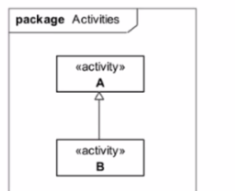
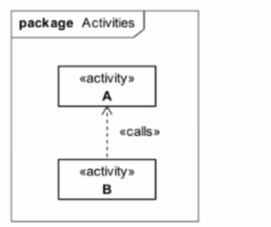
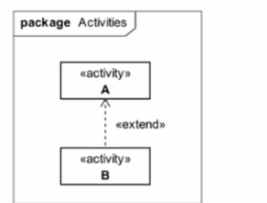
A behavior A is specified by an Activity. A specialized version B of the behavior shall also be specified

Which is a correct approach to model that scenario?

A)

B)

C)


Answer : A

In UML, a specialized behavior that is an extension or modification of a more general behavior is typically shown using the generalization relationship. Option A correctly models this scenario by showing behavior B as a specialization of behavior A, which is indicated by the containment within the package and a nesting of B inside A without any stereotype on the relationship. This representation implies that B inherits the characteristics of A while potentially adding or overriding some aspects of it.


UML 2.5 Specification: Generalization is defined in the UML 2.5 Specification, where a more specific classifier may override the behaviors of a more general classifier.

Question 4

Choose the correct answer:

What happens when an exception is raised by an Action within an Activity that has been invoked asynchronously?


Answer : D

For asynchronous invocations in UML, when an exception is thrown and there is no matching exception handler within the activity, the exception is effectively lost because there is no direct mechanism to propagate it back to the caller. This reflects the nature of asynchronous communication where the calling process does not wait for the completion of the called process and, thus, may not be designed to handle exceptions that occur during the called process.


UML 2.5 Specification: The UML specification describes the behavior of actions within activities and how exceptions are handled, or not handled, in the case of asynchronous calls. It specifically states that for asynchronous calls, the exception is not propagated back to the caller as there is no return flow defined for such invocations.

Question 5

Choose the correct answer:

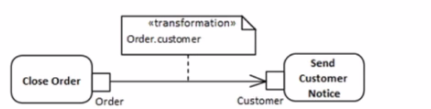
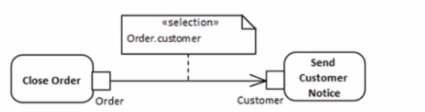
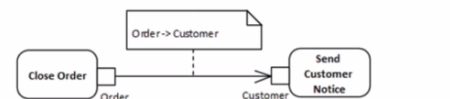
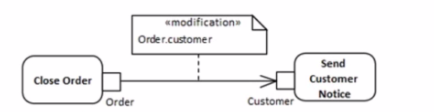
When an Order is closed, a Customer of that Order must be notified

Which diagram fragment correctly models this scenario?

A)

B)

C)


Answer : C

The correct answer is C, which uses a transformation edge to indicate that when an order is closed, information is transformed or processed to notify the customer. This is expressed in UML with an object flow that has a transformation property, which specifies how an object is transformed from one state to another as it flows along the edge. This is appropriate for a scenario where closing an order leads to the creation of a customer notice, implying some form of transformation or processing of the order information to generate the notice.


UML 2.5 Specification: The UML 2.5 specification details how object flows with transformations can be used to show that one piece of data is transformed into another as it flows from one action to another.

Page:    1 / 14   
Total 90 questions