Pass4Future also provide interactive practice exam software for preparing Pure Storage FlashArray Architect Associate (FAAA_004) Exam effectively. You are welcome to explore sample free Pure Storage FAAA_004 Exam questions below and also try Pure Storage FAAA_004 Exam practice test software.
Do you know that you can access more real Pure Storage FAAA_004 exam questions via Premium Access? ()
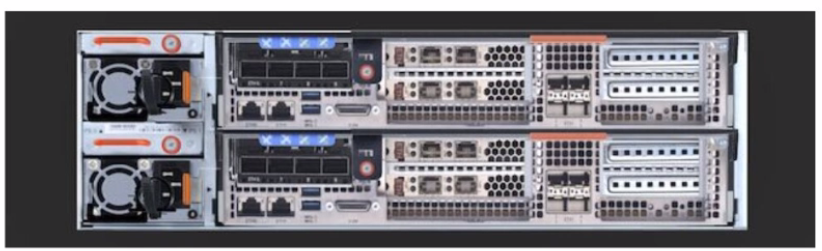
Refer to the exhibit.

Which FlashArray controller(s) does the exhibit show?
Answer : A
Exhibit controllers of a Pure Storage FlashArray , specifically labeled as CT1 (top) and CT2 (bottom). This labeling is consistent with Pure Storage's naming convention for its controllers.
Why This Matters:
Controller Identification:
Pure Storage FlashArray controllers are typically labeled as CT1 and CT2 to distinguish between the two controllers in an active/active architecture.
Both controllers work together to provide high availability and redundancy, ensuring seamless operation even if one controller is offline for maintenance or upgrades.
Active/Active Architecture:
In an active/active design, both controllers share the workload equally. If one controller is taken offline, the other seamlessly handles all I/O operations without impacting performance or availability.
Why Not the Other Options?
B . Top: Primary, Bottom: Secondary:
Pure Storage does not use 'Primary' and 'Secondary' labels for its controllers. Instead, it uses specific identifiers like CT1 and CT2 to refer to the controllers.
C . Top: CTO, Bottom: CT1:
The label 'CTO' is not a valid designation for FlashArray controllers. Pure Storage consistently uses CT1 and CT2 to identify the controllers.
Key Points:
Controller Labels: Pure Storage FlashArray controllers are labeled as CT1 and CT2.
Active/Active Design: Both controllers operate simultaneously to ensure high availability and performance.
Redundancy: The dual-controller architecture provides fault tolerance and minimizes downtime during maintenance or failures.
Pure Storage FlashArray Documentation: 'Understanding FlashArray Controller Architecture'
Pure Storage Knowledge Base: 'Identifying FlashArray Controllers'
Pure Storage Whitepaper: 'Active/Active Controller Design for High Availability'
A customer has deployed an ActiveCluster solution with Uniform Configuration. The customer wants to make sure that all host connections are configured to the array according to best practices.
What Fibre Channel connections should the architect recommend for the customer to use?
Answer : A
For an ActiveCluster solution with Uniform Configuration , the architect should recommend dual connections from each controller through two fabrics to ensure high availability and redundancy in Fibre Channel connectivity.
Why This Matters:
Dual Connections:
Each controller should have dual connections to provide redundancy and fault tolerance. If one connection fails, the other ensures uninterrupted communication between the host and the array.
Two Fabrics:
Using two independent Fibre Channel fabrics (e.g., Fabric A and Fabric B) ensures that there is no single point of failure in the network infrastructure. This aligns with best practices for ActiveCluster deployments.
Why Not the Other Options?
B . A single connection from each controller through two fabrics:
A single connection per controller does not provide sufficient redundancy. If the connection fails, the host may lose access to the array.
C . Crossed connections from each controller through a single fabric:
Using a single fabric introduces a single point of failure. Additionally, 'crossed connections' are not a standard or recommended configuration for ActiveCluster.
D . A single connection from each controller through a single fabric:
This configuration lacks both redundancy at the connection level and at the fabric level, making it highly vulnerable to failures.
Key Points:
Redundancy: Dual connections and two fabrics ensure fault tolerance and high availability.
Best Practices: Aligns with Pure Storage's recommendations for ActiveCluster deployments.
Uniform Configuration: Ensures consistent and reliable connectivity across all hosts in the cluster.
Pure Storage FlashArray Documentation: 'ActiveCluster Best Practices for Fibre Channel Connectivity'
Pure Storage Whitepaper: 'Designing High-Availability Solutions with ActiveCluster'
Pure Storage Knowledge Base: 'Configuring Host Connections for ActiveCluster'
What is the fastest way to duplicate volume data for a test/dev environment?
Answer : D
The fastest way to duplicate volume data for a test/dev environment is to mount the snapshot to a development host . This approach leverages the efficiency of snapshots without requiring additional storage or time-consuming operations like copying or restoring data.
Why This Matters:
Snapshots:
Snapshots are space-efficient, point-in-time copies of a volume that do not consume additional storage until changes are made to the original data.
Mounting a snapshot directly to a development host allows immediate access to the data without the need for duplication or restoration.
Speed and Efficiency:
Mounting a snapshot is significantly faster than creating a full copy or restoring from a backup, as it avoids the overhead of data movement or replication.
Why Not the Other Options?
A . Use a backup copy:
Restoring data from a backup is time-consuming and requires additional storage. It is not the fastest method for duplicating data.
B . Make a volume copy:
Creating a full volume copy consumes additional storage and takes longer than mounting a snapshot.
C . Restore from a volume snapshot:
Restoring from a snapshot involves writing data back to the original volume, which is slower than simply mounting the snapshot for read-only or writable access.
Key Points:
Snapshots: Provide fast, space-efficient access to data for test/dev environments.
Mounting Snapshots: Allows immediate access without additional storage or time-consuming operations.
Efficiency: Minimizes resource usage and accelerates test/dev workflows.
Pure Storage FlashArray Documentation: 'Using Snapshots for Test/Dev Environments'
Pure Storage Whitepaper: 'Best Practices for Managing Test/Dev Workloads'
Pure Storage Knowledge Base: 'Mounting Snapshots to Hosts'
A controller receives a write request.
If it generates a hash that is already recorded in the hash table, what happens next?
Answer : C
When a controller generates a hash for an incoming write request and finds that the hash already exists in the hash table, the next step is to compare the new block to the existing block to confirm they are duplicates .
Why This Matters:
Hash Collision Handling:
Hash functions can sometimes produce the same hash value for different data blocks (a 'hash collision'). To ensure data integrity, the system must verify that the new block is identical to the existing block before deduplication occurs.
Data Integrity:
Comparing the blocks ensures that only true duplicates are deduplicated, preventing data corruption or loss due to hash collisions.
Why Not the Other Options?
A . The next incoming block is then hashed to see if it can be deduplicated:
Hashing the next block is unnecessary at this stage. The focus is on verifying whether the current block is a duplicate.
B . Deep level compression is then applied to the newly hashed block:
Compression is a separate process from deduplication and does not occur immediately after hashing.
D . Purity//FA will expand the block to see if it can deduplicate a larger dataset:
Expanding the block is not part of the deduplication process. Deduplication operates on individual blocks, not larger datasets.
Key Points:
Hash Table Lookup: Identifies potential duplicates based on hash values.
Block Comparison: Confirms that the new block matches the existing block to ensure data integrity.
Deduplication: Eliminates redundant data to optimize storage efficiency.
Pure Storage FlashArray Documentation: 'Understanding Deduplication in Purity//FA'
Pure Storage Whitepaper: 'Data Reduction Techniques in FlashArray'
Pure Storage Knowledge Base: 'How Deduplication Works in FlashArray'
Which FlashArray feature allows snapshots to be sent to a public cloud target?
Answer : B
The FlashArray feature that allows snapshots to be sent to a public cloud target is CloudSnap .
Why This Matters:
CloudSnap:
CloudSnap is a feature that offloads snapshots to cloud storage providers like AWS S3 or Azure Blob.
It provides a cost-effective and scalable solution for storing backups or archival data in the cloud, ensuring offsite protection and long-term retention.
Public Cloud Integration:
By leveraging public cloud storage, customers can reduce on-premises storage costs while maintaining secure and accessible backups.
Why Not the Other Options?
A . Cloud Block Store:
Cloud Block Store is a cloud-native block storage solution that runs in public clouds (e.g., AWS, Azure). It does not involve sending snapshots to a public cloud target.
C . ActiveCluster:
ActiveCluster provides synchronous replication between two sites for high availability. It does not involve offloading snapshots to the cloud.
Key Points:
CloudSnap: Offloads snapshots to public cloud storage for cost-effective and scalable backups.
Offsite Protection: Ensures data is securely stored in the cloud for disaster recovery or archival purposes.
Integration: Seamlessly integrates with popular cloud providers like AWS and Azure.
Pure Storage FlashArray Documentation: 'CloudSnap for Offsite Backups'
Pure Storage Whitepaper: 'Cost-Effective Backup Strategies with FlashArray'
Pure Storage Knowledge Base: 'Using CloudSnap to Offload Snapshots'