Pass4Future also provide interactive practice exam software for preparing Python Institute PCPP1 - Certified Professional in Python Programming 1 (PCPP-32-101) Exam effectively. You are welcome to explore sample free Python Institute PCPP-32-101 Exam questions below and also try Python Institute PCPP-32-101 Exam practice test software.
Do you know that you can access more real Python Institute PCPP-32-101 exam questions via Premium Access? ()
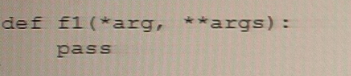
Analyze the following snippet and select the statement that best describes it.

Answer : B
The provided code snippet defines a functionf1that accepts variable-length arguments using the*argsand**kwargssyntax. The*argsparameter allows for an arbitrary number of unnamed arguments to be passed to the function as a tuple, while the**kwargsparameter allows for an arbitrary number of named arguments to be passed to the function as a dictionary.
Therefore, the correct statement that best describes the code is:
1. The*argsparameter holds a list of unnamed parameters, while the**kwargsparameter holds a dictionary of named parameters.
Official Python documentation on Function definitions:https://docs.python.org/3/tutorial/controlflow.html#defining-functions
Thearg parameter holds a list of unnamed parameters. In the given code snippet, thef1function takes two arguments:*argand**kwarg. The*argsyntax in the function signature is used to pass a variable number of non-keyword (positional) arguments to the function. Inside the function,argis a tuple containing the positional arguments passed to the function. The**kwargsyntax in the function signature is used to pass a variable number of keyword arguments to the function. Inside the function,kwargis a dictionary containing the keyword arguments passed to the function.
What is true about type in the object-oriented programming sense?
Answer : C
In Python,typeis the built-in metaclass that serves as the base class for all new-style classes. All new-style classes in Python, including built-in types likeintandstr, are instances of thetypemetaclass and inherit from it.
Select the true statement related to PEP 257.
Answer : B
The true statement related to PEP 257 isOption B. According to PEP 257, string literals occurring elsewhere in Python code may also act as documentation. They are not recognized by the Python bytecode compiler and are not accessible as runtime object attributes (i.e. not assigned todoc), but two types of extra docstrings may be extracted by software tools: String literals occurring immediately after a simple assignment at the top level of a module, class, orinitmethod are called ''attribute docstrings''.String literals occurring immediately after another docstring are called ''additional docstrings''1.
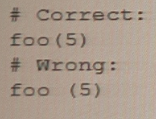
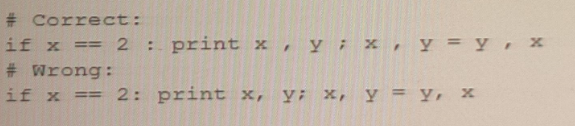
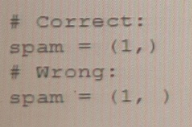
Look at the following code snippets and decide which ones follow PEP 8 recommendations for whitespaces in expressions and statements (Select two answers.)
A)
No whitespace immediately before the opening parenthesis that starts the list of arguments of a function call:

B)
A whitespace immediately before a comma, semicolon, and colon:

C)
No whitespace between a trailing comma and a following closing parenthesis:

D)
A whitespace immediately after the opening parenthesis that starts indexing or slicing:

Answer : A, C
Option A is true because PEP 8 recommends avoiding extraneous whitespace immediately inside parentheses, brackets or braces1.
Option C is true because PEP 8 recommends avoiding extraneous whitespace between a trailing comma and a following close parenthesis1.
What is true about the unbind () method? (Select two answers.)
Answer : B, D
Option B is true because theunbind()method is invoked from within a widget's object1.
Option D is true because theunbind()method needs the event name as an argument1.
Theunbind()method in Tkinter is used to remove a binding between an event and a function. It can be invoked from within a widget's object when a binding is no longer needed. The method requires the event name as an argument to remove the binding for that specific event. For example:
button = tk.Button(root, text='Click me')
button.bind('<Button-1>', callback_function) # bind left mouse click event to callback_function
button.unbind('<Button-1>') # remove the binding for the left mouse click event