Pass4Future also provide interactive practice exam software for preparing Real Estate Licensing New Jersey Real Estate Salesperson (New Jersey Real Estate Salesperson) Exam effectively. You are welcome to explore sample free Real Estate Licensing New Jersey Real Estate Salesperson Exam questions below and also try Real Estate Licensing New Jersey Real Estate Salesperson Exam practice test software.
Do you know that you can access more real Real Estate Licensing New-Jersey-Real-Estate-Salesperson exam questions via Premium Access? ()
A prospective buyer calls a licensed New Jersey salesperson to inquire about a property listed with that salesperson's brokerage. During the first substantive discussion about the property's price and terms, the salesperson must
Answer : A
Under New Jersey Real Estate Commission (NJREC) Regulations, licensed brokers and salespersons are required to provide the Consumer Information Statement (CIS) to clients and customers at the first substantive discussion about the price, terms, or motivation regarding a specific property.
The purpose of the CIS is to disclose to the consumer the various types of business relationships available in New Jersey (seller's agent, buyer's agent, disclosed dual agent, and transaction broker) and to clarify how the licensee intends to work with them.
Important rules from N.J.A.C. 11:5-6.9:
The CIS must be given before any confidential information is disclosed or before an offer is written, whichever occurs first.
A ''first substantive contact'' means when a buyer or seller begins discussing financial or personal motivation about the transaction.
Failing to provide the CIS at the proper time is considered a violation of agency disclosure requirements and can subject the licensee to disciplinary action by NJREC.
Therefore, the correct answer is A, because the CIS must be provided immediately at the first substantive discussion.
A buyer's agent is NOT permitted to tell a buyer that:
Answer : B
Under federal Fair Housing Law (1988 Amendments) and NJ Law Against Discrimination:
Licensees are prohibited from disclosing that a property was occupied by someone with HIV/AIDS. Such disclosure is considered discrimination against persons with disabilities.
Material defects (e.g., roof leaks) must be disclosed.
Stigmatized property issues (e.g., crime scenes) do not legally require disclosure in NJ, but agents may discuss if asked.
Disclosing the seller's willingness to accept less is allowed only with the seller's consent.
Correct prohibited disclosure = B.
Which of the following is a permitted free offering?
Answer : C
According to NJREC rules on inducements (N.J.A.C. 11:5-6.4):
Free offers to the general public (e.g., a dinner seminar or educational event) are permissible because they are not conditioned upon listing or buying.
Inducements like ''home warranty with every listing,'' ''discounted commissions,'' or ''moving vans for clients only'' are contingent on brokerage activity and are prohibited.
Thus, the permitted free offering is C.
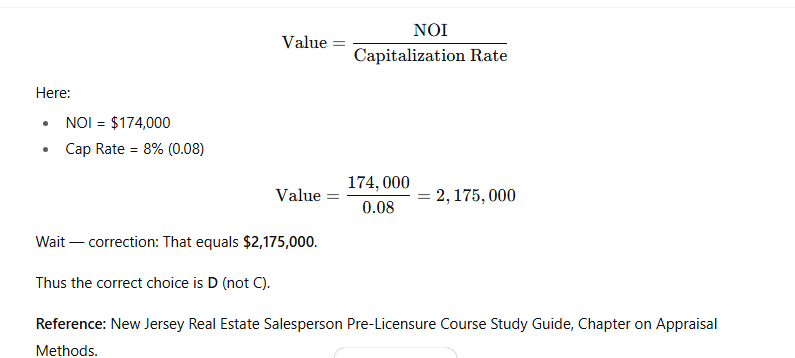
Last year, an apartment building had a net operating income of $174,000. If a potential buyer is looking for a capitalization rate of 8%, how much should the buyer be willing to pay for the building?
Answer : C

In a jurisdiction where the common law of agency applies, a broker has listed a home and then presented to the seller an offer from another client of the broker. The offer has been accepted. The broker has what type of agency relationship with the parties?
Answer : D
Under the common law of agency, when a broker represents both the seller and the buyer in the same transaction, the broker is acting as a dual agent.
The broker has a fiduciary duty to both parties.
This arrangement is only legal if both parties give informed, written consent.
A sub-agency relationship would apply if another agent brought the buyer as a subagent of the seller's broker, not if the buyer is directly the broker's own client.
Therefore, the correct agency type in this case is dual agency.