Salesforce - Big Savings Alert – Don’t Miss This Deal - Ends In 1d 00h 00m 00s Coupon code: 26Y30OFF
  1. Home
  2. Salesforce
  3. Salesforce-MuleSoft-Developer-II Exam
  4. Free Salesforce-MuleSoft-Developer-II Questions

Free Practice Questions for Salesforce Certified MuleSoft Developer II (Mule-Dev-301) Exam

Pass4Future also provide interactive practice exam software for preparing Salesforce Certified MuleSoft Developer II (Salesforce Certified MuleSoft Developer II (Mule-Dev-301)) Exam effectively. You are welcome to explore sample free Salesforce Certified MuleSoft Developer II (Mule-Dev-301) Exam questions below and also try Salesforce Certified MuleSoft Developer II (Mule-Dev-301) Exam practice test software.

Page:    1 / 14   
Total 60 questions

Question 1

Refer to the exhibit.

A developer generates the base scaffolding for an API in Anypoint Studio.

Which HTTP status code is returned while testing using the API Kit console if no values are entered in client-secret?


Answer : B

Based on the code snippet and schema.json file below, when testing using the API Kit console if no values are entered in client-secret, HTTP status code 403 (FORBIDDEN) is returned. This is because client-secret is defined as a required header parameter in schema.json file, which means that it must be present in every request. If no values are entered in client-secret, then it is equivalent to omitting this header parameter, which violates the schema and causes APIKit Router to return HTTP status code 403. Reference: https://docs.mulesoft.com/apikit/4.x/apikit-4-headers


Question 2

Refer to the exhibits.

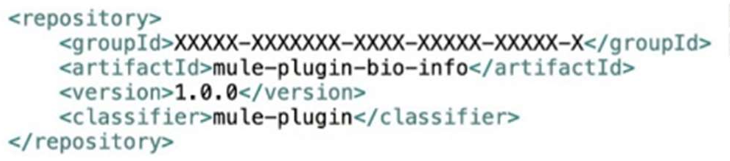
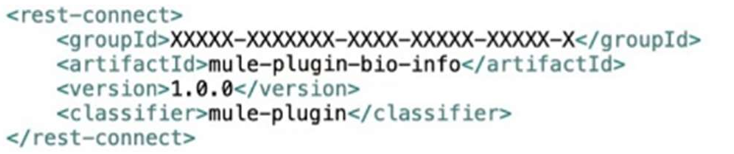
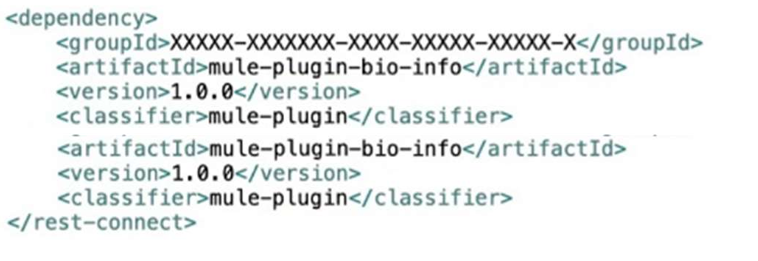
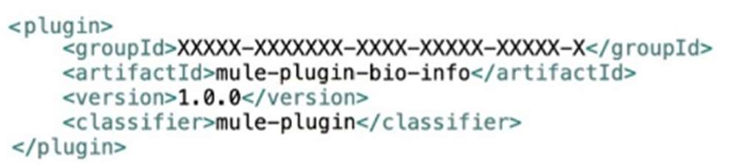
Bioinfo System API is implemented and published to Anypoint Exchange. A developer wants to invoke this API using its REST Connector.

What should be added to the POM?

A)

B)

C)

D)

E)


Answer : E

To invoke Bioinfo System API using its REST Connector, option E should be added to the pom.xml file. This option adds a dependency for Bioinfo System API REST Connector with its group ID, artifact ID, version, classifier, and type. The classifier specifies that it is a REST Connector (raml-client), and the type specifies that it is a Mule plugin (mule-plugin). Reference: https://docs.mulesoft.com/apikit/4.x/apikit-4-generate-from-rest-api-task#add-the-api-dependency-to-the-pom-file


Question 3

A Mule implementation uses a HTTP Request within an Unit Successful scope to connect to an API.

How should a permanent error response like HTTP:UNAUTHORIZED be handle inside Until Successful to reduce latency?


Answer : C

To handle a permanent error response like HTTP:UNAUTHORIZED inside Until Successful, the developer should put the HTTP Request inside a try scope in Unit Successful, and use On Error Continue to catch permanent errors like HTTP UNAUTHORIZED in the error handler. This way, the developer can avoid retrying requests that will always fail due to a permanent error, and reduce latency. On Error Continue allows the flow to continue processing after handling the error. Reference: https://docs.mulesoft.com/mule-runtime/4.3/until-successful-scope https://docs.mulesoft.com/mule-runtime/4.3/on-error-continue-concept


Question 4

A company deploys 10 public APIs to CloudHub. Each API has its individual health endpoint defined. The platform operation team wants to configure API Functional Monitoring to monitor the health of the APIs periodically while minimizing operational overhead and cost.

How should API Functional Monitoring be configured?


Answer : C

To configure API Functional Monitoring to monitor the health of 10 public APIs periodically while minimizing operational overhead and cost, the developer should use one public location with all 10 APIs in a single schedule. A public location is a worker that runs in a CloudHub shared environment, which is cheaper and easier to maintain than a private location. A single schedule allows running all 10 APIs tests at the same time and frequency, which reduces complexity and resource consumption. Reference: https://docs.mulesoft.com/functional-monitoring/fm-create-monitor#create-a-monitor


Question 5

An order processing system is composed of multiple Mule application responsible for warehouse, sales and shipping. Each application communication using Anypoint MQ. Each message must be correlated against the original order ID for observability and tracing.

How should a developer propagate the order ID as the correlation ID across each message?


Answer : D

To propagate the order ID as the correlation ID across each message using Anypoint MQ, the developer should wrap all Anypoint MQ Publish operations within a With CorrelationID scope from the Tracing module, setting the correlation ID to the order ID. The With CorrelationID scope allows setting a custom correlation ID for any event that occurs within it. The Tracing module also enables distributed tracing across different Mule applications and services using Anypoint Monitoring. Reference: https://docs.mulesoft.com/tracing-module/1.0/tracing-module-reference#with-correlation-id-scope https://docs.mulesoft.com/tracing-module/1.0/tracing-module-concepts


Page:    1 / 14   
Total 60 questions