Snowflake - Big Savings Alert – Don’t Miss This Deal - Ends In 1d 00h 00m 00s Coupon code: 26Y30OFF
  1. Home
  2. Snowflake
  3. ARA-R01 Exam
  4. Free ARA-R01 Questions

Free Practice Questions for Snowflake ARA-R01 Exam

Pass4Future also provide interactive practice exam software for preparing Snowflake SnowPro Advanced: Architect Recertification (ARA-R01) Exam effectively. You are welcome to explore sample free Snowflake ARA-R01 Exam questions below and also try Snowflake ARA-R01 Exam practice test software.

Page:    1 / 14   
Total 162 questions

Question 1

Database DB1 has schema S1 which has one table, T1.

DB1 --> S1 --> T1

The retention period of EG1 is set to 10 days.

The retention period of s: is set to 20 days.

The retention period of t: Is set to 30 days.

The user runs the following command:

Drop Database DB1;

What will the Time Travel retention period be for T1?


Answer : C

The Time Travel retention period for T1 will be 30 days, which is the retention period set at the table level. The Time Travel retention period determines how long the historical data is preserved and accessible for an object after it is modified or dropped. The Time Travel retention period can be set at the account level, the database level, the schema level, or the table level. The retention period set at the lowest level of the hierarchy takes precedence over the higher levels. Therefore, the retention period set at the table level overrides the retention periods set at the schema level, the database level, or the account level. When the user drops the database DB1, the table T1 is also dropped, but the historical data is still preserved for 30 days, which is the retention period set at the table level. The user can use the UNDROP command to restore the table T1 within the 30-day period. The other options are incorrect because:

10 days is the retention period set at the database level, which is overridden by the table level.

20 days is the retention period set at the schema level, which is also overridden by the table level.

37 days is not a valid option, as it is not the retention period set at any level.


Understanding & Using Time Travel

AT | BEFORE

Snowflake Time Travel & Fail-safe

Question 2

A global company needs to securely share its sales and Inventory data with a vendor using a Snowflake account.

The company has its Snowflake account In the AWS eu-west 2 Europe (London) region. The vendor's Snowflake account Is on the Azure platform in the West Europe region. How should the company's Architect configure the data share?


Answer : A

The correct way to securely share data with a vendor using a Snowflake account on a different cloud platform and region is to create a share, add objects to the share, and add a consumer account to the share for the vendor to access. This way, the company can control what data is shared, who can access it, and how long the share is valid. The vendor can then query the shared data without copying or moving it to their own account. The other options are either incorrect or inefficient, as they involve creating unnecessary reader accounts, users, roles, or database replication.

https://learn.snowflake.com/en/certifications/snowpro-advanced-architect/


Question 3

A company wants to Integrate its main enterprise identity provider with federated authentication with Snowflake.

The authentication integration has been configured and roles have been created in Snowflake. However, the users are not automatically appearing in Snowflake when created and their group membership is not reflected in their assigned rotes.

How can the missing functionality be enabled with the LEAST amount of operational overhead?


Answer : D

The best way to integrate an enterprise identity provider with federated authentication and enable automatic user creation and role assignment in Snowflake is to use SCIM (System for Cross-domain Identity Management). SCIM allows Snowflake to synchronize with the identity provider and create users and groups based on the information provided by the identity provider. The groups are mapped to roles in Snowflake, and the users are assigned the roles based on their group membership. This way, the identity provider remains the source of truth for user and group management, and Snowflake automatically reflects the changes without manual intervention. The other options are either incorrect or incomplete, as they involve using OAuth, which is a protocol for authorization, not authentication or user provisioning, and require additional configuration of authorization and resource servers.


Question 4

An Architect has designed a data pipeline that Is receiving small CSV files from multiple sources. All of the files are landing in one location. Specific files are filtered for loading into Snowflake tables using the copy command. The loading performance is poor.

What changes can be made to Improve the data loading performance?


Answer : B

According to the Snowflake documentation, the data loading performance can be improved by following some best practices and guidelines for preparing and staging the data files. One of the recommendations is to aim for data files that are roughly 100-250 MB (or larger) in size compressed, as this will optimize the number of parallel operations for a load. Smaller files should be aggregated and larger files should be split to achieve this size range. Another recommendation is to use a multi-cluster warehouse for loading, as this will allow for scaling up or out the compute resources depending on the load demand. A single-cluster warehouse may not be able to handle the load concurrency and throughput efficiently. Therefore, by creating a multi-cluster warehouse and merging smaller files to create bigger files, the data loading performance can be improved.Reference:

Data Loading Considerations

Preparing Your Data Files

Planning a Data Load


Question 5

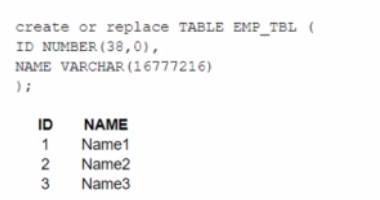
A table, EMP_ TBL has three records as shown:

The following variables are set for the session:

Which SELECT statements will retrieve all three records? (Select TWO).


Answer : B, E

The correct answer is B and E because they use the correct syntax and values for the identifier function and the session variables.

The identifier function allows you to use a variable or expression as an identifier (such as a table name or column name) in a SQL statement. It takes a single argument and returns it as an identifier. For example, identifier($tbl_ref) returns EMP_TBL as an identifier.

The session variables are set using the SET command and can be referenced using the $ sign. For example, $var1 returns Name1 as a value.

Option A is incorrect because it uses Stbl_ref and Scol_ref, which are not valid session variables or identifiers. They should be $tbl_ref and $col_ref instead.

Option C is incorrect because it uses identifier<Stbl_ref>, which is not a valid syntax for the identifier function. It should be identifier($tbl_ref) instead.

Option D is incorrect because it uses Cvarl, var2, and var3, which are not valid session variables or values. They should be $var1, $var2, and $var3 instead.Reference:

Snowflake Documentation: Identifier Function

Snowflake Documentation: Session Variables

Snowflake Learning: SnowPro Advanced: Architect Exam Study Guide


Page:    1 / 14   
Total 162 questions