Splunk - Big Savings Alert – Don’t Miss This Deal - Ends In 1d 00h 00m 00s Coupon code: 26Y30OFF
  1. Home
  2. Splunk
  3. SPLK-5003 Exam
  4. Free SPLK-5003 Questions

Free Splunk Certified Cybersecurity Defense Architect (SPLK-5003) Practice Questions

These Splunk SPLK-5003 sample questions are a small glimpse of our full set of Splunk SPLK-5003 actual questions. They give you a preview of what the real SPLK-5003 exam might look like and the contents of Pass4Future's premium Splunk SPLK-5003 product. You must not underestimate the value of Splunk SPLK-5003 practice exam questions, as they allow you to understand the actual Splunk Certified Cybersecurity Defense Architect exam in greater depth. Using them will save your time and money otherwise wasted in Splunk Certified Cybersecurity Defense Architect exam reattempts. Study guides and tutorials provide you with theoretical details about the SPLK-5003 exam; these SPLK-5003 practice exam questions prepare you to pass the exam. Get Pass4Future's premium access to continue your SPLK-5003 exam practice with the complete set of Splunk SPLK-5003 realistic questions. Our Splunk SPLK-5003 practice questions come in various formats; make sure to check out the details and free demo of each format.

Splunk SPLK-5003 Sample Exam Questions

Page:    1 / 14   
Total 120 questions

Question 1

Which of the following best describes how measuring the financial impact of a cybersecurity incident can help justify and obtain additional budget for the cybersecurity team?


Answer : A

Quantifying the financial consequences of cybersecurity incidents allows security leadership to connect technical investments with business risk reduction and measurable economic outcomes.

An incident's financial impact may include service disruption, lost revenue, incident-response expenses, forensic investigations, system restoration, legal costs, regulatory consequences, and reputational damage.

These costs can be incorporated into a risk-based financial analysis to evaluate the potential benefits of improved preventive, detective, and responsive controls.

For example, implementing improved endpoint detection and automated containment may reduce the expected duration and business impact of ransomware incidents.

Security architects can compare the estimated reduction in expected incident losses against implementation costs, operating expenditure, licensing, and personnel requirements.

This supports a defensible business case for additional funding.

The analysis should distinguish realized historical losses from modeled future risk. It should also account for uncertainty, control effectiveness, incident likelihood, and residual risk rather than assuming that every security investment produces guaranteed savings.

Options B, C, and D fail to establish a measurable relationship between security spending and organizational outcomes.

A strong cybersecurity budget proposal demonstrates how investment contributes to business continuity, operational resilience, and economically justified risk reduction.

Official reference / study topic: Splunk certification blueprint Objectives 6.4, 7.1--7.2, and 8.3: investment and risk justification.

===============


Question 2

Clara is responsible for how her organization's SIEM ingests and stores event data. The latest SIEM version now includes APIs to manage the data-ingestion pipelines. Clara wants to assess ways to programmatically manage those pipelines through her company's version-control and continuous-integration systems.

What benefits would this provide to the organization?

Choose three


Answer : A, B, D

Managing SIEM ingestion pipelines through version control and Continuous Integration (CI) introduces repeatability, auditability, and controlled change management into security data operations.

Approval workflows support governance by requiring designated reviewers to evaluate proposed changes before deployment. These reviews can identify incorrect routing, inappropriate filtering, privacy concerns, or unexpected impacts on security monitoring.

Source-control commits create traceability by recording the identities associated with changes, relevant timestamps, and configuration differences.

Splunk Cloud Platform provides a Data Management Service API that supports programmatic management of Edge Processor inventory, destinations, and SPL2 pipeline lifecycle operations.

The API documentation explicitly describes integration with CI/CD workflows and infrastructure-as-code tooling.

However, automation does not eliminate the need for data validation.

Changes to event parsing, field extraction, filtering, and routing can disrupt existing detections or discard important telemetry.

A mature deployment process should therefore include syntax validation, representative sample testing, regression tests, approval controls, and post-deployment monitoring.

Option C is incorrect because automated pipelines increase the importance of reliable validation rather than removing that requirement.

Official reference / study topic: Splunk Cloud Platform, Data Management Service API and Edge Processor Pipelines.

===============


Question 3

Which categories of SOAR playbooks are commonly used in a security operations center?

Choose three


Answer : B, C, D

Security Orchestration, Automation, and Response (SOAR) platforms organize automation workflows around common investigation, enrichment, and response use cases.

Endpoint playbooks automate activities involving workstations, servers, and endpoint security platforms. Examples include retrieving endpoint information, examining suspicious processes, collecting relevant artifacts, and isolating compromised devices.

Phishing playbooks support the investigation and containment of suspicious email messages. They may extract message artifacts, analyze attachments, inspect URLs, retrieve reputation information, and coordinate approved email-remediation actions.

Enrichment playbooks add contextual information to security observations. This may include IP reputation, domain intelligence, file-hash analysis, identity attributes, asset information, and related historical activity.

Splunk Security Content explicitly organizes published SOAR playbooks into use-case categories including Endpoint, Phishing, and Enrichment.

These categories provide reusable automation capabilities that can be integrated into larger security investigation and remediation workflows.

Although SOAR may automate responses to attacks, Attack is not one of the standard playbook categories in the relevant Splunk Security Content taxonomy.

The distinction is important because playbooks describe specific workflows and actions rather than merely naming the presence of hostile activity.

A mature SOAR implementation should combine these categories according to incident type, integration availability, operational requirements, and approved response procedures.

Official reference / study topic: Splunk Security Content, SOAR Use Cases: Endpoint, Phishing and Enrichment.

===============


Question 4

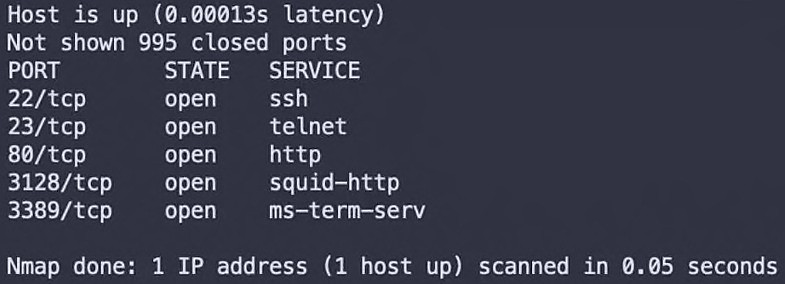
Review the output shown below.

What should be the first action taken to harden this host?


Answer : A

The exhibit shows an Nmap scan identifying five open TCP ports: 22 (SSH), 23 (Telnet), 80 (HTTP), 3128 (Squid HTTP proxy), and 3389 (Microsoft Terminal Services).

These open ports represent potentially accessible services that must be evaluated against the system's intended operational purpose.

The first hardening action should be to verify whether each running service is necessary.

This follows the principle of least functionality, which requires systems to provide only essential capabilities and restrict unnecessary services, ports, and protocols.

NIST SP 800-53 control CM-7 establishes this principle as part of secure configuration management.

Telnet is particularly concerning because conventional Telnet does not provide encryption for authentication credentials or session contents. If remote administration is required, SSH or another appropriately secured alternative should normally be preferred.

The Squid proxy service and remote desktop access should also be examined to determine whether they are authorized and appropriately restricted.

Implementing multifactor authentication for Telnet does not resolve the underlying insecure transport protocol.

Disabling file-integrity checking would remove a potentially valuable defensive control.

ModSecurity may provide additional HTTP protection, but implementing it before evaluating service necessity would be premature.

The correct initial process is to establish the required service baseline, disable unnecessary functionality, and then harden the remaining services.


Question 5

Which type of data does OpenTelemetry supply that the security team can use during an investigation?


Answer : D

OpenTelemetry is an open-source observability framework that enables applications and infrastructure to generate, collect, process, and export telemetry, including traces, metrics, and logs.

Distributed traces provide visibility into how individual requests move through interconnected application components and services.

A trace generally consists of related spans representing operations performed during a request's execution.

For example, a customer-facing transaction may generate spans associated with an API gateway, authentication service, application server, database, and downstream processing components.

During a security investigation, these traces can help analysts reconstruct execution paths, identify unusual service interactions, and correlate suspicious application behavior with other telemetry.

They can also reveal dependencies between services and help distinguish application failures from potentially unauthorized activities.

The OpenTelemetry specification defines traces through relationships between spans, enabling distributed request activity to be correlated across processing boundaries.

A Software Bill of Materials identifies software components and dependencies rather than runtime request execution.

Threat paths are typically derived from security graph analysis, exposure management, or adversary-path modeling.

Normalization refers to standardizing data representation and is not a distinct OpenTelemetry telemetry signal.

Therefore, traces are the appropriate selection.

OpenTelemetry traces should be correlated with identity, network, endpoint, and application security events to provide stronger investigative evidence.

Official reference / study topic: OpenTelemetry, Signals and Tracing Signal Specification.

===============


Page:    1 / 14   
Total 120 questions