Tableau - Big Savings Alert – Don’t Miss This Deal - Ends In 1d 00h 00m 00s Coupon code: 26Y30OFF
  1. Home
  2. Tableau
  3. Desktop-Certified-Associate Exam
  4. Free Desktop-Certified-Associate Questions

Free Practice Questions for Tableau Desktop Certified Associate Exam

Pass4Future also provide interactive practice exam software for preparing Tableau Desktop Certified Associate (Desktop Certified Associate) Exam effectively. You are welcome to explore sample free Tableau Desktop Certified Associate Exam questions below and also try Tableau Desktop Certified Associate Exam practice test software.

Page:    1 / 14   
Total 108 questions

Question 1

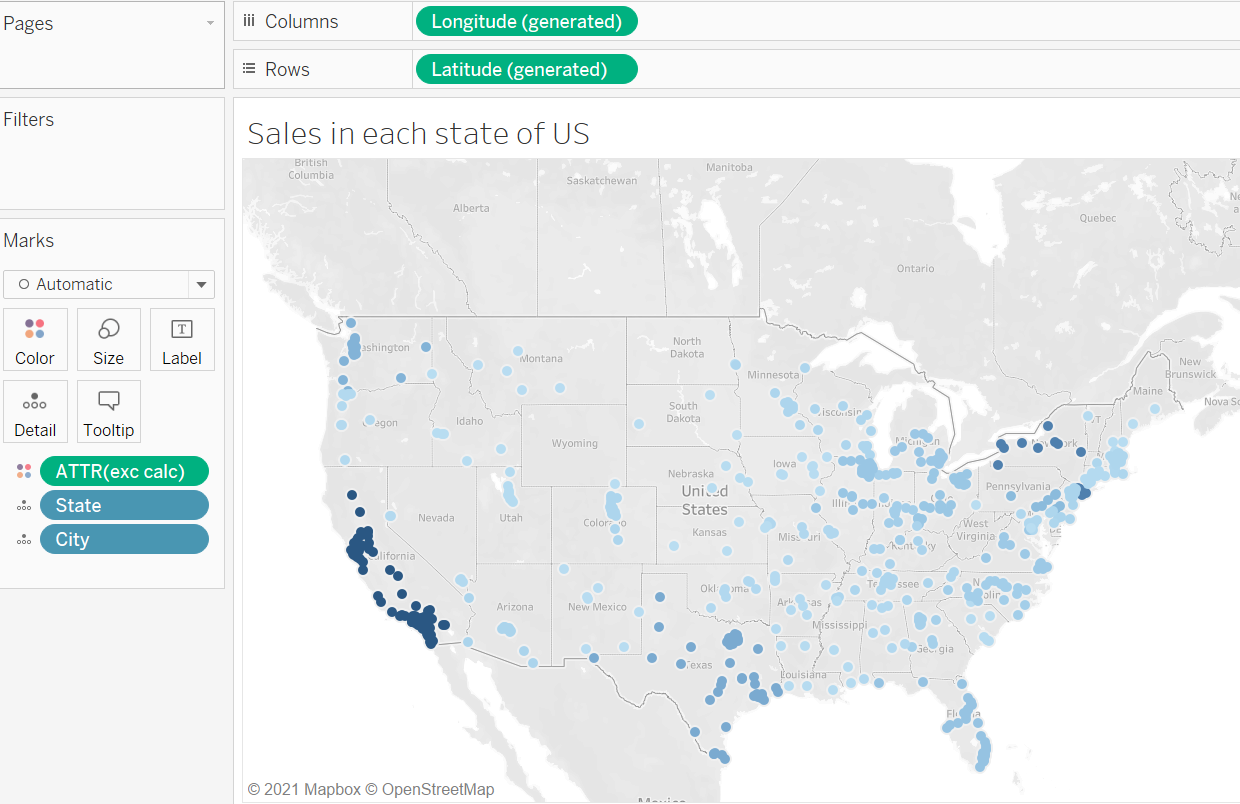
Which calculation will color the sales by state, while the city is on the Marks card, as shown in this view?

Larger image


Answer : B

{ Exclude [City] : SUM([Sales])} => using this calculation we can exclude the City dimension

from all the dimensions present in the view. So here SUM(sales) would be the aggregation of

sales in the state level only, even though city field is available in the view.


Question 2

Connect to the "Global Superstore" data source and use the Orders table. Find out how many new customers were acquired in the year 2014?


Answer : A

If customer first order is equal to the order date, then this is the new customer.

Create a calculated field to find the first order date:

Find If the order date is equal to the day of first purchase for that customer, flag that row as a

'New Customer'

Find the unique customers:

Drop the Order date to filter shelf and select the year 2014 to find out the new customer

acquired in 2014.

Drop New Customer field to Rows and Unique customer field to Text marks card.


Question 3

Connect to the "WorldBank Data" and use the Development Indicators table. Create a relationship between the avg. birth rate and avg. death rate using scatterplot aggregated at the region level, plot death rate on Y-axis and birth rate on X-axis. Add an exponential trendline and find out how many regions are above the trend line?


Answer : B

After following the steps mentioned in the question your view will look like this:

Here, 5 points are above the exponential trend line.


Question 4

Connect to the "World Cup Results" and use tables WorldCupMatches, WorldCups. Which of the following year had the highest percentage of Away goals? Consider only those years when the host country did not win the world cup.


Answer : A

In WorldCupMatches table, we have the information of Away goals, and in the WorldCups

table, we have the information of the Winner team and goal scored.

In WorldCups, there is only row for each year. But in WorldCupMatches, there is a separate

row for each match. This is the perfect example to use blend as here we need to first

aggregate the data from WorldCupMatches table.

Let's establish the blend relationship between these two data sources, on the basis of Country

and Year.

Let's use WorldCups as the primary data source, so add the field from this data source to the

view. Drop Year to Rows and change it discrete. Drop Country and Winner field as well to the

rows.

In WorldCupMatches data source, create a calculated field :

Drop this field to the Text, and format it so that it will be shown in percentage.

Out of the given options, only in 1934 host country won the world cup

2010 is the correct answer.


Question 5

Connect to the "World Cup Results" and use table WorldCups. Create a bar graph using the Year and Matches Played. For how many years the number of matches played was less than 70% of the median?


Answer : B

Drop the year to the Columns and change it Discrete. Drop the matches played to the Rows.

Go to the Analytics menu, drop the Distribution band to the view. Select scope as entire table.

Value Computation should be:

Your view will look like this:


Page:    1 / 14   
Total 108 questions