The Open Group - Big Savings Alert – Don’t Miss This Deal - Ends In 1d 00h 00m 00s Coupon code: 26Y30OFF
  1. Home
  2. The Open Group
  3. OGA-032 Exam
  4. Free OGA-032 Questions

Free Practice Questions for The Open Group OGA-032 Exam

Pass4Future also provide interactive practice exam software for preparing The Open Group ArchiMate 3 Part 2 (OGA-032) Exam effectively. You are welcome to explore sample free The Open Group OGA-032 Exam questions below and also try The Open Group OGA-032 Exam practice test software.

Page:    1 / 14   
Total 12 questions

Question 1

Please read this scenario prior to answering the question

ArchiCar is a specialized company that focuses on manufacturing luxury electric cars and powertrain components, along with producing battery-charging equipment. With its own distribution network and showrooms, ArchiCar adopts a direct-to-

customer sales model through online channels.

The manufacturing of ArchiCar's electric cars is carried out on fully automated assembly lines. Leveraging a cutting-edge manufacturing process, the company boasts an impressive ability to sell and deliver a vehicle within just one month from the

time of order placement. Anticipating significant growth, the CEO has set ambitious plans to increase annual production from 100,000 to 500,000 vehicles within a three-year timeframe.

To ensure the highest quality standards, ArchiCar relies on locally manufactured finished steel from the renowned ArchiMetal plant. ArchiMetal specializes in lightweight steels that allow ArchiCar to achieve a reduced vehicle weight without

compromising strength and crash performance. The finished steel is efficiently transported by rail to ArchiCar's production plant, where it is stored in a dedicated warehouse until required for the automated car assembly process. Conveyor belts

facilitate the seamless transfer of the finished steel from the warehouse to the assembly plant.

At the ArchiCar assembly plant, an optimized and streamlined assembly process is implemented, resulting in the production of 12 vehicles per hour. Once assembled, the cars are transported to a nearby distribution center using specialized trucks.

These vehicles are then stored at the distribution center until they are ready for delivery to their eagerly awaiting new owners.

Refer to the Scenario

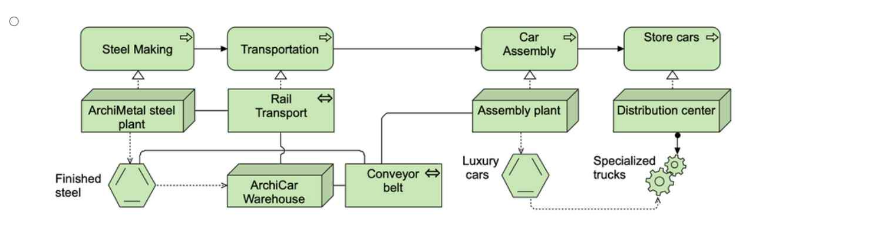
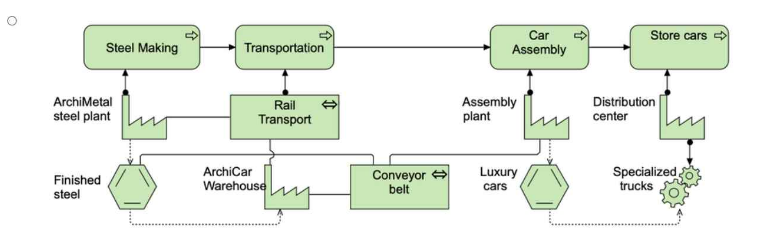
You are a consultant to the CIO. She has asked you to illustrate the end-to-end technology processes at ArchiCar from raw materials to assembled cars ready for delivery.

Which of the following answers provides the best description?

A.

B.

C.

D.


Answer : D

In this scenario, the task is to model the end-to-end technology processes at ArchiCar, showing how raw materials (finished steel) are processed through the company's manufacturing, transportation, and distribution system, ultimately resulting in fully assembled cars ready for delivery.

Key ArchiMate 3.2 Concepts Applied:

Business Processes:

Steel Making: ArchiMetal manufactures finished steel, a key raw material for ArchiCar's production.

Transportation: The finished steel is transported by rail from the ArchiMetal steel plant to ArchiCar's warehouse.

Storage: The finished steel is stored in the ArchiCar Warehouse until it is required for the assembly process.

Car Assembly: The conveyor belt moves the steel from the warehouse to the assembly plant, where cars are assembled on automated lines.

Transportation (Specialized Trucks): Once assembled, the cars are transported to a distribution center using specialized trucks.

Storage (Distribution Center): The finished cars are stored in the distribution center, awaiting delivery to customers.

Application and Technology Components:

Conveyor Belt: The transfer of finished steel between the warehouse and assembly plant is automated via the conveyor belt.

Rail Transport and Specialized Trucks: Rail transport handles the movement of steel, and specialized trucks are used for car transportation to the distribution center.

End-to-End Flow:

The model needs to clearly depict the full process flow from the production of steel, through its transportation and storage, to the automated assembly of luxury cars and their eventual transportation to the distribution center.

The relationships between processes (e.g., steel making, transportation, car assembly, and storage) must be clear and follow the logical flow of operations.

Why Option D is Correct:

Option D provides a clear and accurate representation of the end-to-end process as described in the scenario.

It begins with the steel-making process at the ArchiMetal steel plant and follows through with the transportation of the finished steel to the warehouse by rail transport.

The process of moving steel via the conveyor belt from the warehouse to the assembly plant for car manufacturing is clearly depicted.

Once cars are assembled, they are transported to the distribution center using specialized trucks and are then stored until delivery, completing the end-to-end flow.

The relationships between processes and supporting components (e.g., conveyor belt, transportation methods) are clearly illustrated, following ArchiMate standards.

Why Other Options Are Incorrect:

Option A is incorrect because it misses some key elements of the process. It does not fully clarify the role of the warehouse or how the finished steel is transported between locations.

Option B misrepresents the process flow, particularly the storage and assembly process. The connection between steel production and car assembly is not as clearly illustrated.

Option C also lacks clarity in how the finished steel is moved from the warehouse to the assembly plant, and it does not accurately capture the flow of transportation and storage after car assembly.

Conclusion:

Option D is the best answer because it provides the most complete and clear description of the end-to-end technology processes at ArchiCar, from raw materials (finished steel) to assembled luxury cars ready for delivery. It aligns well with the scenario and adheres to ArchiMate 3.2 modeling standards, showing all necessary relationships between business processes and supporting components.


Question 2

Please read this scenario prior to answering the question

ArchiCar has been a market leader in the premium priced luxury car sector for the last decade. Its product leadership strategy has brought superior products to market, and enabled ArchiCar to achieve premium prices for its cars. This strategy has

been widely successful in the past, but recently competitors have been offering comparable products and taking significant market share. The governing board of ArchiCar has identified opportunities in emerging markets where the ArchiCar brand

is associated with luxury and high performance products, but is thought to be too expensive for mass-market success. Based on this assessment, the board has made the decision to setup a subsidiary company to mass-produce affordable cars

locally. This will be achieved by focusing on a strategy of operational excellence. Such a strategy is ideal for such markets where customers value cost over other factors.

To facilitate this strategic transformation, the project has been divided into multiple phases within a five-year program. The initial phase, known as "Achieving Operational Excellence," is underway. The engineering team has begun devising an

action plan to drive the necessary changes and outlining the technological conditions that must be met. The product architect has identified three current capabilities - industry-leading engineering, high-quality materials sourcing, and cutting-edge

focussed R&D - along with their contributions to the new production philosophy.

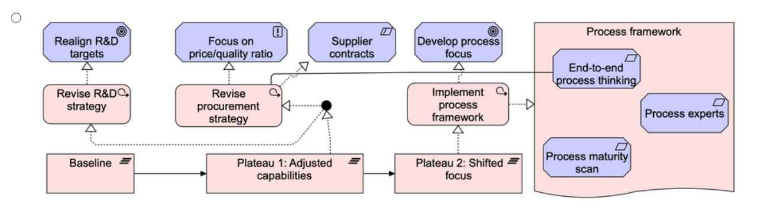
Moving forward, it has been determined that two out of the three current capabilities require revision. Materials sourcing needs to be adjusted to meet optimization demands, and R&D targets must align with future goals to enable affordable

production. Additionally, process engineering is introduced as a fourth capability to shift the company's focus from products to a process-oriented approach.

The Enterprise Architecture team has been tasked with migration planning, and identifying key work packages and deliverables. They have identified two transition states between the current and future scenario. The first transition aims to adjust

current capabilities, including revising the R&D approach and procurement strategy. The second transition aims to shift from a product-centric mindset to a process-focused approach and adjust materials sourcing accordingly. It is important to

consider existing supplier contracts that cannot be immediately canceled during this process.

The Enterprise Architecture team has identified that the second transition must implement a process framework, in order to shift to a process focus and meet a number of requirements, including the requirement for end-to-end process thinking. As

this requirement impacts procurement processes, it also impacts the procurement strategy.

Refer to the Scenario

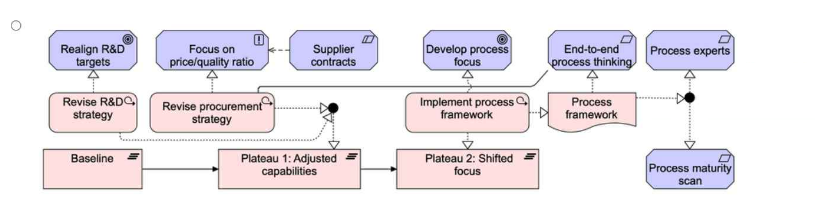
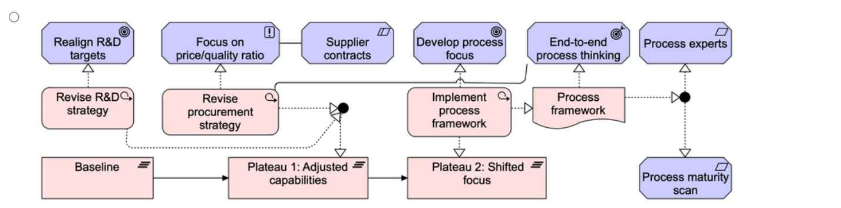
You have been asked to model parts of the overall scenario, including migration planning, the motivations driving the migration, and the work packages necessary to achieve the desired deliverables.

Which of the following answers best describes the scenario?

A.

B.

C.

D.


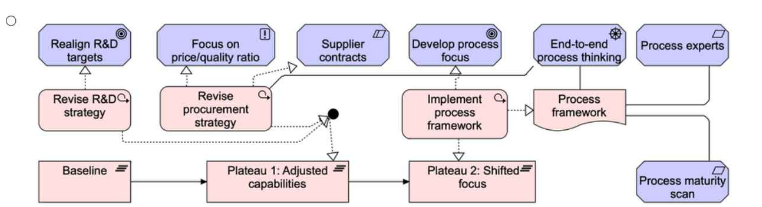
Answer : B

This scenario involves migration planning for ArchiCar as it transitions from a product-centric approach to an operational excellence strategy for mass-producing affordable cars in emerging markets. The task is to model the steps involved, including work packages, deliverables, and the motivations driving the transitions.

Key ArchiMate 3.2 Concepts Applied:

Capabilities and Transition Phases:

The existing capabilities---R&D, material sourcing, and engineering---need to be adjusted to fit the new strategy. In particular:

Revising R&D targets to align with the goal of affordable production.

Revising the procurement strategy to optimize material sourcing.

Introduction of a process focus in the second phase to shift from a product-centered approach to operational excellence.

Two transition states are identified:

Plateau 1 (Adjusted Capabilities): Focuses on revising the R&D strategy and procurement strategy.

Plateau 2 (Shifted Focus): Involves shifting to a process-oriented focus, adjusting material sourcing, and implementing a process framework to enable end-to-end process thinking.

Work Packages and Deliverables:

Work packages include activities such as revising R&D strategy and procurement strategy during the first transition, and then developing process focus and implementing a process framework in the second transition.

These work packages are linked to key deliverables:

Plateau 1: Realigning R&D and procurement strategies to achieve adjusted capabilities.

Plateau 2: Implementing a process framework, shifting to process-oriented thinking, and achieving the operational excellence goals.

Motivation Elements:

The migration is driven by a need to realign current capabilities (such as focusing R&D on affordability and optimizing procurement) and a requirement to shift focus from product leadership to operational excellence.

The external driver is the competition and market opportunity in emerging markets, where cost is more critical than luxury.

Dependencies and Constraints:

Supplier contracts may impose constraints on how quickly procurement strategies can change, which is considered in the transition planning.

The process framework must be implemented in a way that supports end-to-end process thinking.

Why Option B is Correct:

Option B accurately reflects the two transition phases (Plateaus 1 and 2) and shows the appropriate work packages and deliverables in line with the scenario.

It clearly models the steps for revising R&D strategy and procurement strategy in the first transition, and the shift to a process focus in the second transition.

The process framework and its link to end-to-end process thinking and procurement strategy are also correctly modeled, fulfilling the requirements of the scenario.

Motivations for the changes, such as the focus on the price/quality ratio, and the external drivers for shifting strategy are well captured.

Why Other Options Are Incorrect:

Option A and Option C misrepresent or omit important relationships between work packages, such as the link between the process framework and the end-to-end process thinking.

Option D does not correctly capture the sequence of work packages and the logical flow of transitions between phases.

Conclusion:

Option B provides the most complete and accurate description of the scenario, correctly illustrating the migration planning, motivations, and the work packages necessary to achieve the target state. It aligns well with ArchiMate 3.2 modeling standards and meets the scenario's requirements.


Question 3

Please read this scenario prior to answering the question

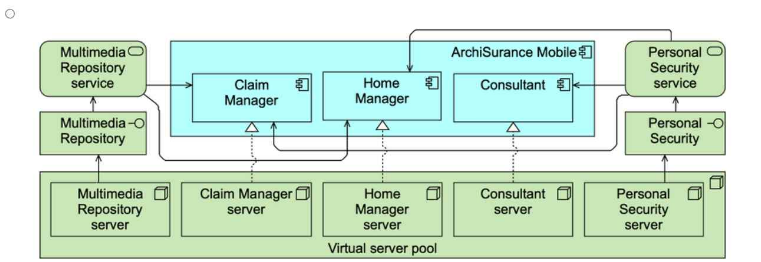
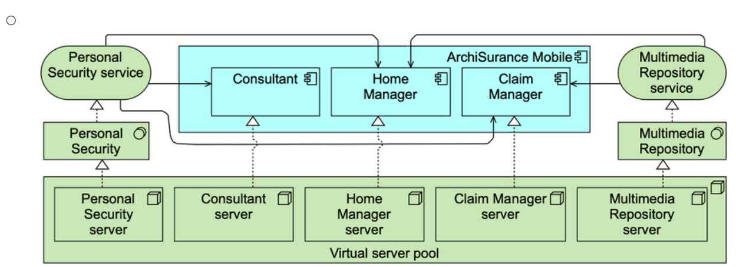
The ArchiSurance Mobile consumer solution is used for selling and renewing insurance products, providing customer service, enabling accurate and convenient home recordkeeping, and capturing and processing claims. The solution consists of

three applications. The Consultant application lets customers review their existing coverage, and update it based on common life events, such as getting a new car, moving into a new home, or having a family member move in or out. If necessary,

they can speak or chat with a customer service representative. The Home Manager application helps customers photograph and catalogue their valuable possessions in order to support the filing of accurate claims in case of loss or damage. The

Claim Manager application enables customers to quickly file a claim for loss or damage to an insured auto, home or possession. It enables customers to describe the incident by referencing information captured with the Consultant and the Home

Manager applications. In addition, it allows the customer to add photographs, audio, video and text to support a claim, submit the claim, and monitor its progress.

The ArchiSurance Mobile applications rely on a number of application services hosted by ArchiSurance. The first is an Auto Identification and Description (AID) service that the Consultant application uses to validate and complete auto information

entered by customers. The second service, Home Identification and Description (HID) performs the same function for home information, and is used by the Home Manager application. The Consultant application also uses the Virtual Agent

service to guide customers as they select coverage options, the Payment Processor service to arrange premium payments, and the Coverage Activator service to generate policies and put them in force.

ArchiSurance Mobile also relies on a number of technology services. The Home Manager application uses a Multimedia Repository service to store and retrieve information about insured homes. The Claim Manager application also uses this

service for claim information entered by customers. All three ArchiSurance Mobile applications use a Personal Security service to register and authenticate customers, and to manage their profiles.

Each application service is realized by an application component with the same name. Each technology service is realized by a system software environment, having the same name. ArchiSurance hosts both the application components and

system software environments in a virtualized server pool within its data center. Each service has its own virtual server. Each virtual server is connected to a data center network (DCN) which in turn connects to a commercial wide area network

(WAN).

Refer to the Scenario

You have been asked to show the applications that make up the ArchiSurance Mobile solution and the technology that supports these applications.

Which of the following answers provides the best description? Note that it is not necessary to model the networks.

A.

B.

C.

D.


Answer : C

In this scenario, the focus is on modeling the ArchiSurance Mobile solution, showing the applications that make up this solution and the technology infrastructure that supports them. This includes applications, application services, and the system software environments (technology services) upon which the applications rely.

Key ArchiMate 3.2 Concepts Applied:

Application Components and Services:

Consultant Application: This allows customers to review, update coverage, and speak with customer service representatives. It uses the following application services:

Auto Identification and Description (AID) for validating auto information.

Virtual Agent for helping customers select options.

Payment Processor to arrange payments.

Coverage Activator to generate and activate policies.

Home Manager Application: This allows customers to catalogue possessions and use the Home Identification and Description (HID) service to validate home information.

Claim Manager Application: Enables filing of claims, referencing data from the Consultant and Home Manager applications and storing information (such as photos, videos) via the Multimedia Repository.

Technology Services:

Personal Security Service: Used for customer registration, authentication, and profile management across all three applications.

Multimedia Repository Service: Used to store and retrieve information related to home possessions and claim details, supporting both the Home Manager and Claim Manager applications.

Technology Infrastructure:

Each application component (Consultant, Home Manager, Claim Manager) is hosted on its own virtual server within a virtualized server pool.

Each technology service is realized by a corresponding system software environment (e.g., Multimedia Repository, Personal Security), each with its own virtual server.

The infrastructure is hosted in a data center, but the focus here is on the services rather than the network connections.

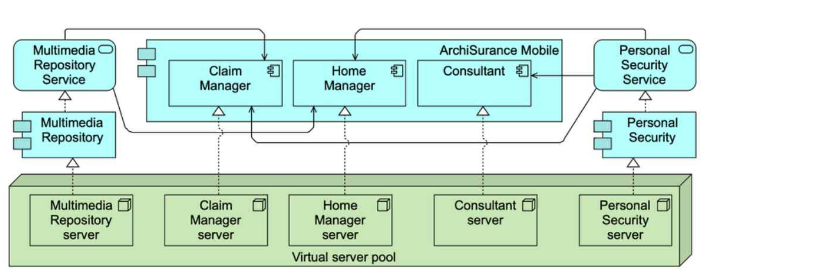
Why Option C is Correct:

Option C accurately represents the key applications (Consultant, Home Manager, Claim Manager) in connection with the appropriate technology services and their respective virtual servers.

The model shows the relationships between the applications and their dependencies on Personal Security and Multimedia Repository, aligning with the description provided.

The virtual server pool is depicted clearly, showing how the applications and services are realized within this infrastructure.

The relationships between applications and application services (AID, HID, Virtual Agent, Payment Processor, Coverage Activator) are not modeled in full detail here, but they are implicitly understood through the applications.

Why Other Options Are Incorrect:

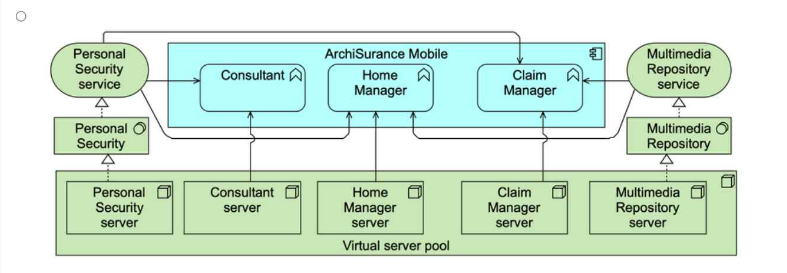
Option A and Option D both incorrectly depict some relationships between the applications and their supporting technology services or servers, or miss certain dependencies.

Option B does not provide as clear a depiction of the virtualized infrastructure and how the applications relate to the Multimedia Repository and Personal Security services.

Conclusion:

Option C provides the most accurate and complete description of the ArchiSurance Mobile solution and the supporting technology, as required by the scenario. It correctly illustrates the relationships between the applications, the virtual servers, and the supporting technology services according to ArchiMate 3.2 principles.


Question 4

Please read this scenario prior to answering the question

The ArchiSurance enterprise document management solution plays a crucial role in supporting a large number of document types and managing a high volume of document-based transactions each day. Given its business-critical nature, the document

management solution is hosted redundantly across two geographically separate data center sites: Site A and Site B. Both sites are configured identically to ensure seamless operations.

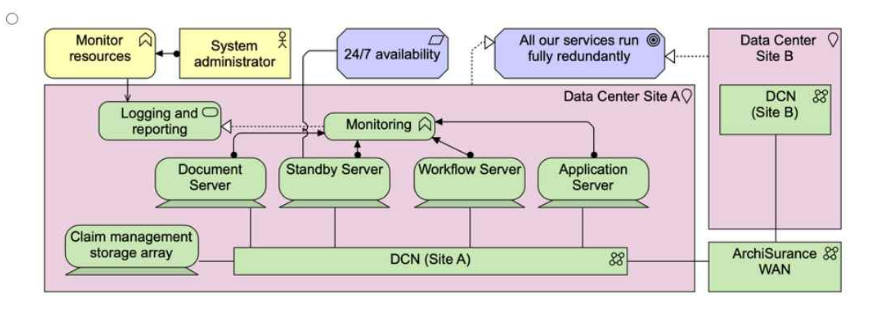
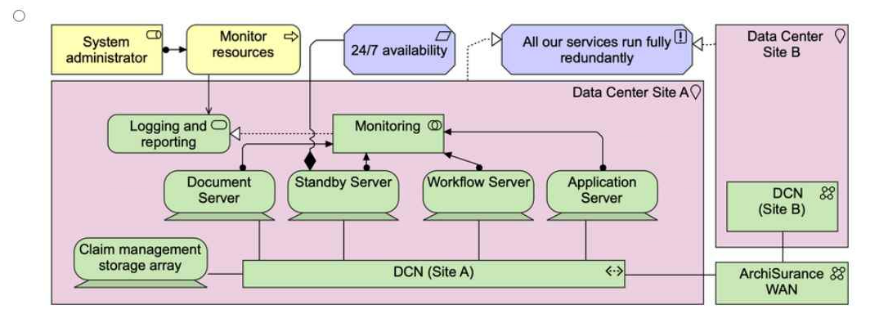
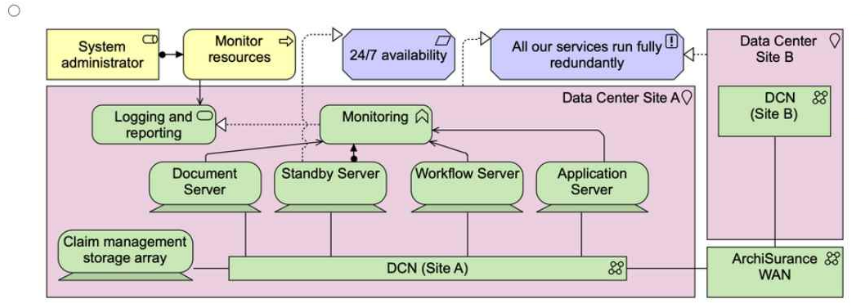
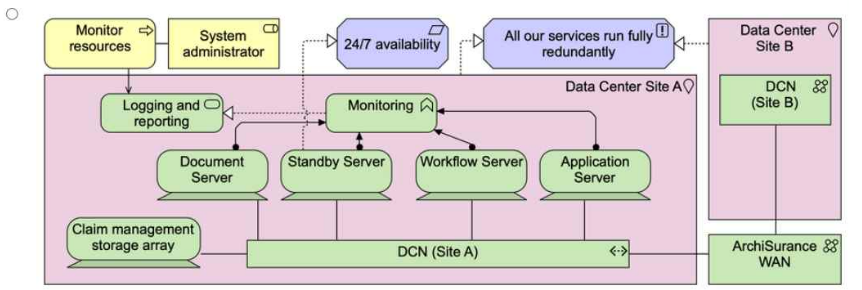
Each site has a highly available data center network (DCN) that connects to the resilient ArchiSurance wide area network (WAN). Each claim management server is connected to its respective site's DCN, forming a converged network that interconnects

servers and storage arrays. A dedicated physical storage array is allocated to the claim management application within each DCN. Additionally, each site houses four powerful physical servers exclusively dedicated to the claim management application.

Among these servers, one remains on standby at any given time, while the other three take on specific roles in hosting the document, workflow, and application engines.

The standby server is responsible for monitoring the behavior of the other servers, providing a logging and reporting service. The active servers regularly transmit data to facilitate this monitoring functionality. In the event of a server failure, the standby

server steps in to perform resource reallocation, replacing the faulty server. However, this task requires manual intervention from a system administrator to reconfigure the logging and reporting service to adapt to the new environment.

Refer to the Scenario

The IT manager has asked you to model the hardware and networks that support the document management solution. This includes capturing the infrastructure components such as data center sites, servers, storage, and networks. Additionally, you

are expected to outline the necessary functionality and services required to enable failover within a server cluster. Given that both data centers share an identical configuration, it is sufficient for Site B to only show the associated networking.

Which of the following is the best answer?

A.

B.

C.

D.


Answer : D

We need to identify the most accurate and complete model that represents:

Infrastructure Components -- Including data centers, servers, storage arrays, and networks.

Failover Capabilities -- Showing the standby server's role in monitoring and switching functionality upon failure.

Redundant Setup -- Ensuring the representation of both data centers (Site A and Site B), with Site B showing only networking.

Interconnectivity -- Between servers, DCN, and WAN.

Why D is the Best Choice:

All required infrastructure components are included, such as:

Physical servers (Document, Workflow, and Application Servers).

Standby Server for failover.

Claim Management Storage Array.

DCN (Data Center Network) for Site A and Site B.

ArchiSurance WAN for external connectivity.

The Standby Server is correctly linked to logging, monitoring, and reporting, showing its role in monitoring and failover.

Networking is modeled properly:

Both Site A and Site B have a DCN, correctly interconnecting storage and servers.

Site B does not duplicate servers but represents networking, as per the scenario.

Functionality of Failover is Modeled Accurately:

Monitoring and reporting services are depicted.

Manual intervention by a system administrator is present.

Why Not A, B, or C?

A: Does not fully capture the network and storage relationships clearly.

B: Similar to A but misses some essential network connections.

C: Incorrect failover representation, and networking elements are not clearly depicted.


Question 5

Please read this scenario prior to answering the question

The ArchiSurance enterprise document management solution includes a sophisticated ecosystem of applications and technologies. Designed with a strong emphasis on high availability, it plays a vital role in providing support for a diverse range of

document types and managing a substantial volume of document-based transactions on a daily basis. Recognizing its importance to the business, the document management solution is redundantly hosted at two geographically separate data

center sites, both configured identically for seamless operations.

The system software at the core of the document management solution is comprised of three key modules. The Document Engine serves as a repository, facilitating document storage, retrieval, and various other operations. The Workflow Engine

acts as a host for document management applications, while the Application Engine powers the most advanced and sophisticated applications within the system.

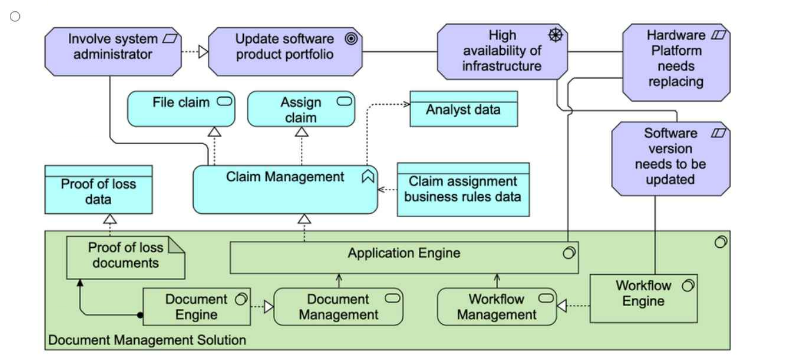
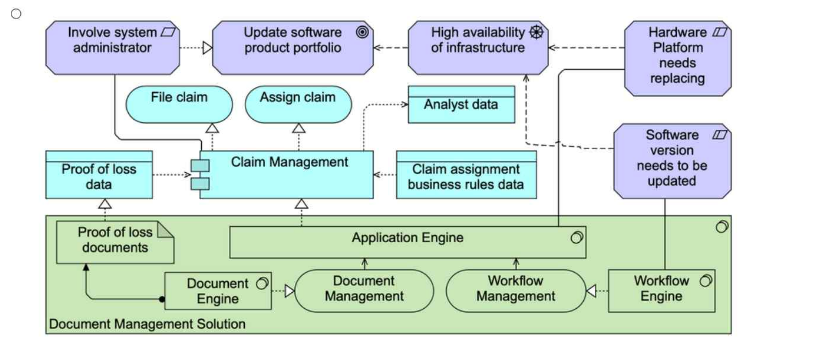
Two key factors have driven the Architecture Board's approval of a project aimed at updating this critical solution. Firstly, the supplier of the Workflow Engine has given notice of the end of support for the current software version, necessitating an

upgrade. Secondly, the system administrator responsible for the Application Engine has flagged the need for hardware replacement on the server where the software is currently running. Given that the Claim Management application shares

infrastructure with the Application Engine, the involvement of the system administrator responsible for this application is crucial in the project planning and execution.

Refer to the Scenario

You are the Enterprise Architect within this organization. You have been assigned the task of modeling the applications and technology for this solution, as well as outlining the motivations driving the need for its update.

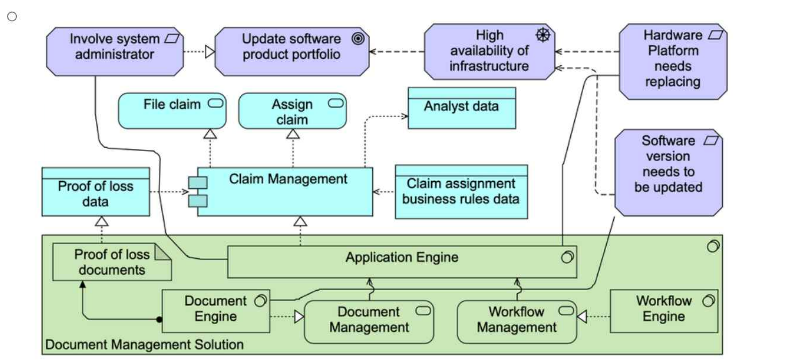
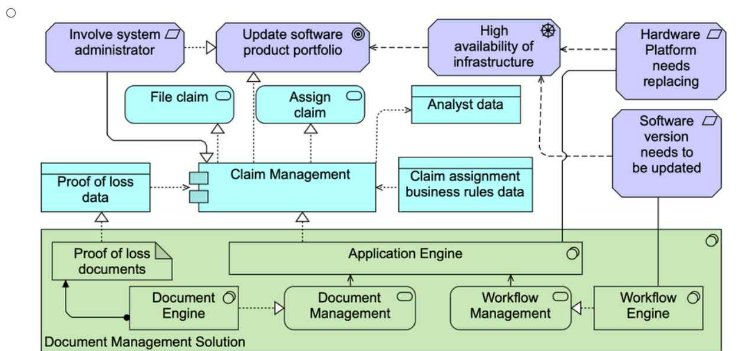
Based on the scenario, which answer provides the most complete and accurate description?

A.

B.

C.

D.


Answer : D

This scenario revolves around ArchiSurance's document management solution and the motivations behind updating the solution due to software and hardware challenges. The task is to model both the applications and technology components involved, along with the motivations driving the need for an update.

Key ArchiMate 3.2 Concepts Applied:

Applications and Components:

Claim Management Application: This application handles key processes such as filing claims and assigning claims, and it shares infrastructure with the Application Engine.

Document Management Solution: Includes several subsystems such as:

Document Engine: Manages document storage, retrieval, and processing operations.

Workflow Engine: Facilitates document workflows and supports document-related operations.

Application Engine: Hosts sophisticated applications like Claim Management.

Data Objects:

Proof of Loss Documents and Proof of Loss Data are critical components managed by the Document Management Solution. This data is processed and handled by both the Document Engine and the Claim Management application.

Technology and Infrastructure:

Hardware Platform Needs Replacing: The Application Engine runs on hardware that needs replacement. This drives a part of the motivation for updating the infrastructure.

Software Version Needs to Be Updated: The Workflow Engine is running on outdated software, necessitating an upgrade to ensure continued support and functionality.

High Availability of Infrastructure: Given that the system is redundantly hosted across two data centers, high availability is crucial for seamless operations. This includes continuous availability for the document management processes.

Motivations and Drivers:

The end-of-support notice from the Workflow Engine supplier requires an upgrade to maintain operational continuity.

The system administrator responsible for the Application Engine has raised concerns about hardware needing replacement, adding urgency to the infrastructure upgrade.

Why Option D is Correct:

Option D provides the most comprehensive representation of the applications, infrastructure, and motivations for updating the solution.

It clearly shows the Claim Management Application and its interaction with the Claim Assignment Business Rules Data, as well as how it relies on the Application Engine.

The Document Management Solution and its subsystems (Document Engine, Workflow Engine, and Application Engine) are correctly depicted, with clear relationships to the data they manage (Proof of Loss Documents and Data).

The motivations for change---specifically, the need to update the Workflow Engine software and replace the hardware platform---are clearly shown, alongside their impact on the overall system.

The diagram shows the involvement of the system administrator in the update process, which is important for ensuring smooth project execution.

Why Other Options Are Incorrect:

Option A and Option B do not accurately capture all necessary relationships, particularly the connections between the Claim Management application and its reliance on the Application Engine infrastructure. They also miss some of the drivers related to the required hardware replacement.

Option C omits some key details regarding how the Claim Management Application and Document Management Solution components interact with the system, particularly the Claim Assignment Business Rules Data and Proof of Loss Data.

Conclusion:

Option D is the best answer because it offers the most complete and accurate representation of the applications, technology infrastructure, and drivers for the update project. It clearly illustrates how the Claim Management and Document Management systems work together, along with the necessary infrastructure updates, in line with ArchiMate 3.2 modeling standards.


Page:    1 / 14   
Total 12 questions