These WGU Applied Algebra (C957) sample questions are a small glimpse of our full set of WGU Applied Algebra (C957) actual questions. They give you a preview of what the real Applied Algebra (C957) exam might look like and the contents of Pass4Future's premium WGU Applied Algebra (C957) product. You must not underestimate the value of WGU Applied Algebra (C957) practice exam questions, as they allow you to understand the actual WGU Applied Algebra exam in greater depth. Using them will save your time and money otherwise wasted in WGU Applied Algebra exam reattempts. Study guides and tutorials provide you with theoretical details about the Applied Algebra (C957) exam; these Applied Algebra (C957) practice exam questions prepare you to pass the exam. Get Pass4Future's premium access to continue your Applied Algebra (C957) exam practice with the complete set of WGU Applied Algebra (C957) realistic questions. Our WGU Applied Algebra (C957) practice questions come in various formats; make sure to check out the details and free demo of each format.
Do you know that you can access more real WGU Applied-Algebra exam questions via Premium Access? ()
The number of people auditioning for a game show is expected to be 4 times the number of people who auditioned last year. The function A(t) can be used to model the situation, where t represents the number of people who auditioned last year and A represents the number of people expected to audition this year.
Which quantity represents the number of people expected to audition this year, given that 330 people auditioned last year?
Answer : B
We are told that the number of people expected to audition this year is 4 times the number of people who auditioned last year.
Let:
t=number of people who auditioned last year
and
A(t)=number of people expected to audition this year
Since this year's number is 4 times last year's number, the function is:
A(t)=4t
The question says that 330 people auditioned last year, so:
t=330
Now substitute 330 into the function:
A(330)=4(330)
A(330)=1320
So, the correct function notation is:
A(330)=1,320
This means: when 330 people auditioned last year, 1,320 people are expected to audition this year.
Therefore, the correct answer is:
B
A set of data was gathered and used to create a model for the number of subscribers to a blog. The function model is
where represents the number of years since 2003 and represents the number of subscribers.
What is the correct interpretation of the average rate of change of the number of subscribers from 2012 to 2015? Round to the nearest whole number, if necessary.
Answer : B
The function is:
Since represents the number of years since 2003:
The average rate of change from 2012 to 2015 is:
First, find :
Now find :
Now calculate the average rate of change:
Rounded to the nearest whole number:
The negative sign means the number of subscribers is decreasing.
So the correct interpretation is:
A company provides internet service to approximately 1,050 customers each year. The table shows the percentage of customers with fiber internet each year since 2020.
Years since 2020 Percent of Customers with Fiber
0 19
1 28
2 40
3 57
What was the approximate number of customers with fiber internet in 2023?
Answer : C
The table gives the percent of customers with fiber internet for each year since 2020.
Since 2023 is:
20232020=3
we use the row where:
Years since 2020=3
From the table, the percent of customers with fiber internet in 2023 is:
57%
The company has approximately:
1,050
customers each year.
Now find 57% of 1,050:
0.571,050=598.5
The closest answer choice is:
598
So approximately 598 customers had fiber internet in 2023.
Therefore, the correct answer is:
C
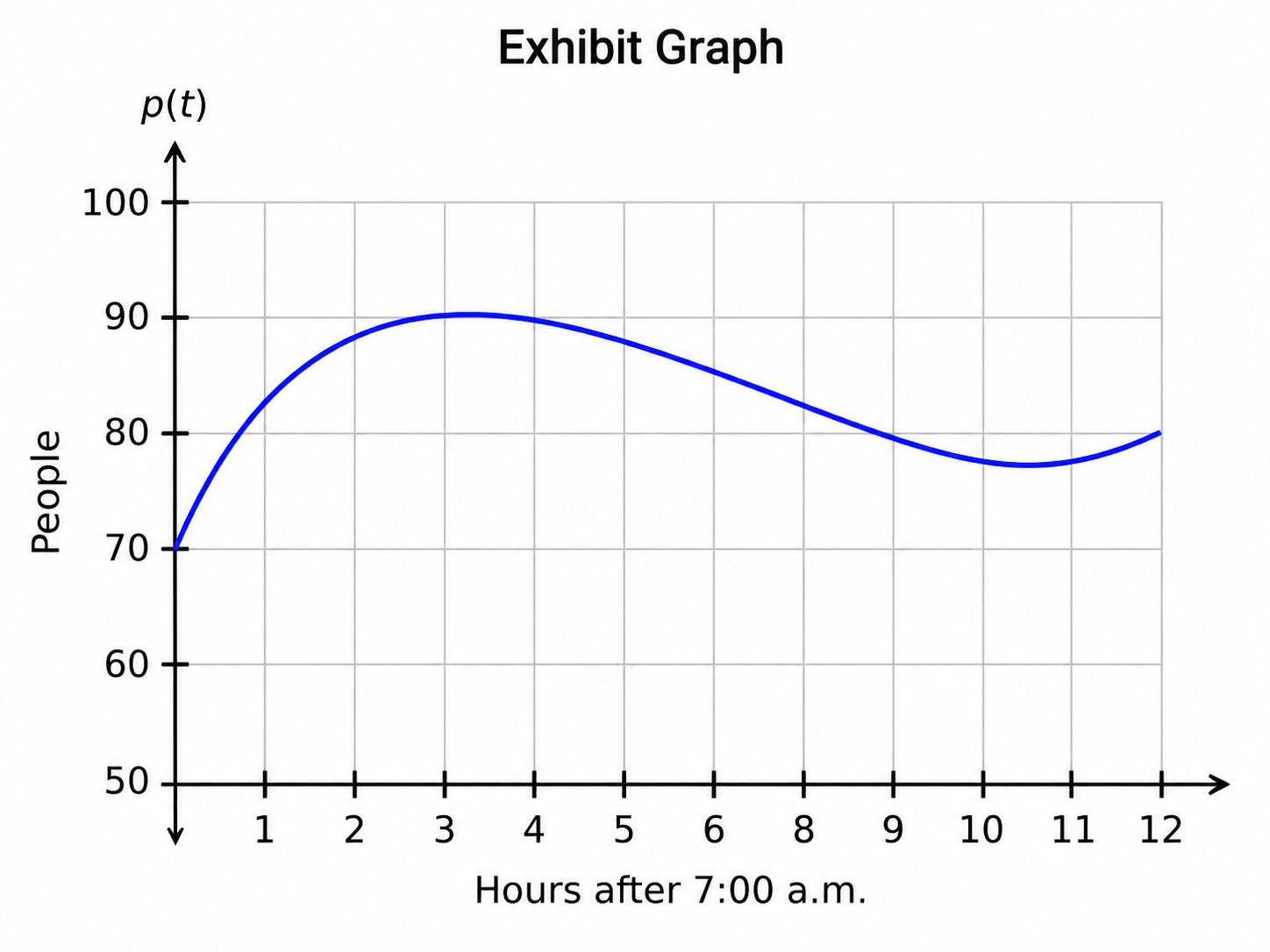
The figure shows the graph of , which represents the number of people, , at a gym hours after 7:00 a.m.

How should the concavity between and be interpreted?
Answer : C
The graph represents:
where:
The question asks about the concavity of the graph between:
and
On this interval, the graph is still going upward, so the number of people is increasing.
However, the graph is beginning to flatten as it approaches its highest point. That means the slope is positive, but the slope is getting smaller.
In other words:
This is called concave down behavior. For a concave down graph that is increasing, the correct interpretation is:
Therefore, the correct answer is:
A cart is being loaded with boxes, and each box has the same weight. After 4 boxes are loaded, the total weight of the boxes and cart is 116 pounds. After 9 boxes are loaded, the total weight is 161 pounds.
What is the weight of each box?
Answer : A
This situation can be modeled with a linear relationship because each box has the same weight.
We are given:
and
The weight increases because more boxes are added.
First, find the change in total weight:
Then find the change in the number of boxes:
Since 5 additional boxes increased the total weight by 45 pounds, the weight of each box is:
So each box weighs:
Check:
If each box weighs 9 pounds, then adding 5 more boxes adds:
This matches the given information.